Thursday, September 20, 2007

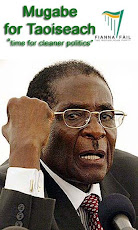
It's Mugabe or me - Brown

LONDON (AFP) Sept 20th. - Prime Minister Gordon Brown proposed new sanctions against Zimbabwe on Thursday and threatened to boycott an African summit in December if its President Robert Mugabe attended. The government in Harare said Brown was "wasting his time" by warning he would stay away from the talks in Lisbon, insisting the 83-year-old president had been invited and was going, and the president of neighbouring Zambia said he would boycott the summit if Mugabe were excluded. Portuguese Foreign Minister Luis Amado later said he would prefer Brown to attend the meeting than Mugabe, but that no invitations had yet been sent out. He promised to work towards resolving the situation in the coming weeks.

Brown, whose comments were applauded by Zimbabwean activists and rights groups, said Mugabe's presence in the Portuguese capital would flout a European Union travel ban on him and his entourage. "President Mugabe is the only African leader to face an EU travel ban. There is a reason for this -- the abuse of his own people," he wrote in an article in The Independent newspaper. "There is no freedom in Zimbabwe; no freedom of association; no freedom of the press. And there is widespread torture and mass intimidation of the political opposition." As a result, Mugabe's presence would "undermine" the summit and divert attention from the issues in hand, Brown said, adding: "In those circumstances, my attendance would not be appropriate."

Brown later told British broadcaster ITV News that the existing travel ban should be widened.
His first policy statement on Zimbabwe goes further than his predecessor Tony Blair, who held off personally criticising Mugabe in favour of focusing on the plight of ordinary Zimbabweans and an "African solution" to the problem. The Independent said Brown was uncomfortable about attending a meeting with someone who is seen to have wrecked his country and brought it to the brink of collapse with hyper-inflation, mass unemployment and chronic food shortages. At an EU summit next month, he will urge others in the 27-member bloc to join him in the boycott, although he risked isolation if he could not get support, the newspaper added. Brown maintained Blair's line of supporting the humanitarian effort and made clear that Britain "will not shirk our responsibilities" to the Zimbabwean people. He said Britain was currently the second-largest donor to Zimbabwe, providing up to 40 million pounds (57 million euros, 80 million dollars) a year in aid and support for HIV/AIDS programmes. London was also to provide an additional eight million pounds of aid to its former colony through the World Food Programme; Brown also called for the UN Security Council to send a humanitarian mission to Zimbabwe. In addition, he called for EU sanctions against more than 100 individuals in Mugabe's regime to be more widely applied.

Mugabe, who is seeking a seventh term in office, has ruled the former Rhodesia since independence from Britain in 1980. He has blamed the country's economic woes on limited sanctions imposed by the EU and United States over claims that he rigged his 2002 re-election.
Mugabe still enjoys public support from neighbouring African countries, with Zambian President Levy Mwanawasa saying that he would refuse to attend the Lisbon summit if Mugabe were not allowed to go, a Zambia National Broadcasting Corporation news bulletin said Thursday. Nwanawasa, the current president of the Southern African Development Council, was the first African leader to threaten to boycott the summit, arguing that the travel ban on Mugabe did not solve the problems facing Zambia's southern neighbour. Brown's comments came three days after the second-highest ranking cleric in the Church of England, Archbishop of York John Sentamu, called on him to take action against Mugabe. Sentamu said Thursday the threat did not go far enough, telling ITV News that all Zimbabwean embassies in the EU should be downgraded and the African Union should put pressure on Mugabe to quit immediately.
By Phil Hazlewood
+++++++++++++++++++++++++++++++++++++++++++++++++++
Disclaimer
No responsibility or liability shall attach itself to either myself or to the blogspot ‘Mozlink’ for any or all of the articles/images placed here. The placing of an article does not necessarily imply that I agree or accept the contents of the article as being necessarily factual in theology, dogma or otherwise. Mozlink

Monday, September 10, 2007

MOZLINK ON HOLIDAY UNTIL AROUND SEPTEMBER 22nd.

Volunteer Work is a Valuable Service to Mankind

VATICAN CITY, SEP 9, 2007 (VIS) - This evening in the "Wiener Konzerthaus," the Viennese concert hall inaugurated in 1913 in the presence of the emperor Francis Joseph I, the Pope met with civil and ecclesial voluntary groups active in Austria. Greetings from the young volunteer workers and talks by the president of the Republic of Austria and by the Pope were interspersed with brief musical interludes.

At the beginning of his talk, the Pope expressed "gratitude and heartfelt thanks for the remarkable 'culture of volunteerism' existing in Austria. ... Love of neighbor is not something that can be delegated; the State and the political order, properly concerned with the relief of the needy and the provision of social services, cannot take the place of volunteer work. Love of neighbor always demands a voluntary personal commitment, and the State, of course, should provide the conditions which make this possible. To say 'yes' to volunteering to help others is a decision which is liberating; it opens our hearts to the needs of others, to the requirements of justice, to the defense of life and the protection of creation. Volunteer work is really about the heart of the Christian image of God and man: love of God and love of neighbor."

Volunteer work is characterized by its "gratuitousness" said the Pope, affirming that "a readiness to be at the service of others is something which surpasses calculations of outlay and return: it shatters the rules of market economy. The value of human beings cannot be judged by purely economic criteria. In the gaze of others, and particularly of the person who needs our help, we experience the concrete demands of Christian love. Jesus Christ does not teach us a spirituality 'of closed eyes,' but one of 'alertness,' one which entails an absolute duty to take notice of the needs of others." The Holy Father dwelt on the importance of prayer for people involved in charitable enterprises. "Praying to God sets us free from ideologies and from a sense of hopelessness in the face of endless needs," he said. "Whenever people do more than their simple duty in professional life and in the family - and even doing this well calls for great strength and much love - and whenever they commit themselves to helping others, putting their precious free time at the service of man and his dignity, their hearts expand." Benedict XVI concluded his address by affirming that "anyone who takes seriously the 'priority' of his neighbor lives and acts in accordance with the Gospel and shares in the mission of the Church, which always looks at the whole person and wants everyone to experience the love of God. The Church fully supports this valuable service that you offer."
+++++++++++++++++++++++++++++++++++++++++++++++++++
Disclaimer
No responsibility or liability shall attach itself to either myself or to the blogspot ‘Mozlink’ for any or all of the articles/images placed here. The placing of an article does not necessarily imply that I agree or accept the contents of the article as being necessarily factual in theology, dogma or otherwise.
Mozlink

Zimbabwe - Illegal Immigrants Flee Hunger & Chaos

MUSINA, SOUTH AFRICA: Sept 9th. (Los Angeles Times) -- The two men stared at each other for a long moment, captor and captive: a white game farmer named Andre Nienaber, with mirrored sunglasses, neatly pressed khaki clothes and an aura of military precision; and a 16-year-old Zimbabwean orphan named Peter Jell, wearing a cap marked "Jesus" and the desperate look of someone who knew he was headed back to the country he had risked his life to escape. Moments earlier, the South African farmer had arrested Peter and four other Zimbabwean border jumpers where they sat, exhausted, hungry and demoralized, hoping to hitch a ride 300 miles south to Johannesburg. He cuffed the five to the back of his truck with plastic ties and called the police. "We're so frightened to go back to that hunger country, where there's nothing," Peter said as he waited.

His parents died in a bus crash two years ago, Peter said, and he has five younger siblings and no hope of feeding them. Before he left Zimbabwe last month, he and the other children, ages 2 to 12, were eating two or three times a week. In between, he said, the children scoured the bush for any wild fruit they could find. "It's terrible. You feel sorry for them," Nienaber said before buying some bread and milk for the five illegal immigrants and handing them over to the police. Yet he sees the Zimbabweans who cross his land, cutting his fences and destroying his water pipes, as a threat to his survival.

The tide of Zimbabweans arriving in South Africa, driven by extreme shortages of food and basic goods, has grown into a flood as strong as the nearby Limpopo River in the rainy season. Zimbabwe used to be one of Africa's most prosperous countries. Its slide into economic chaos under President Robert Mugabe's regime has forced people to make heart-wrenching decisions -- taking their children out of schools because they can't pay the fees, or even leaving them behind while they try to find work in South Africa. The government of South Africa rejects the view of some activists that hunger and social upheaval in Zimbabwe are so severe that most border jumpers should be classified as refugees. The migrants are sent back to the chaos and poverty they fled. The countryside around the Limpopo, which forms the border between the two nations, is a stunning canvas of red earth and green bush, but at times it is like stepping into a bygone era. Walk into some bars around here, and you're plunged into the reflexive racial hostility of apartheid.You might hear someone express the view that there is no such thing as a good black; another says that "it just doesn't look right" when you see black people driving BMWs around Johannesburg. Not everyone puts it so bluntly, but you occasionally run into whites who, like the Leonardo DiCaprio character in the film "Blood Diamond," still refer to Zimbabwe by its colonial-era name, Rhodesia. Some people profess pity for the Zimbabweans, but many farmers have run out of compassion. They go on regular patrols, rounding up Zimbabweans and handing them to the police, and some of the farmers say they are so angry that they sometimes feel like shooting the trespassers on their land.

Police have stopped releasing statistics on immigrant arrests. The latest police data available indicate that here in Limpopo province, police arrested 5,000 Zimbabwean border jumpers in January. But the army alone has arrested almost 42,000 Zimbabweans this year, and expects the total to reach 100,000 by year's end, compared with about 72,000 last year, according to figures provided at a military briefing to businessmen and farmers last month in this border town. The majestic baobab trees that loom tall in Limpopo's scrubby acacia bush are of little scenic interest to hungry, footsore travelers from Zimbabwe, who care only for the shelter and shade they offer. The spectacular rocky outcrops are just barriers to walk around. To landowners, the stony, dry soil is of little value except for game farming. The landscape draws hunters from all over the world to kill kudu, eland, impala -- all antelope -- and other game. It's not hard to pick out the ragged, dirty border jumpers who venture onto Limpopo's roads looking for a lift. They radiate fear and vulnerability.

Akimu Tafire, 17, and Sheron Chimbuya, 20, had been wandering for five days without food or water after crossing the border with a group of 100 people. "There's no food. There's no clothes. Education is poor and life is bad" in Zimbabwe, said Akimu, an orphan who supports five siblings. Zimbabweans speak of a disintegrating society, a place so desperate that mothers of young children leave them behind to make the terrifying journey south.
By Robyn Dixon
+++++++++++++++++++++++++++++++++++++++++++++++++++
Disclaimer
No responsibility or liability shall attach itself to either myself or to the blogspot ‘Mozlink’ for any or all of the articles/images placed here. The placing of an article does not necessarily imply that I agree or accept the contents of the article as being necessarily factual in theology, dogma or otherwise.
Mozlink

Rape in E. Congo - Worst in the World

NAIROBI, Sept. 8 (Washington Post Foreign Service) The prevalence and intensity of sexual violence against women in eastern Congo are "almost unimaginable," the top U.N. humanitarian official said Saturday after visiting the country's most fragile region, where militia groups have preyed on the civilian population for years. John Holmes, who coordinates U.N. emergency relief operations, said 4,500 cases of sexual violence have been reported in just one eastern province since January, though the actual number is surely much higher. Rape has become "almost a cultural phenomenon," he said. "Violence and rape at the hands of these armed groups has become all too common," said Holmes, who spent four days in eastern Congo. "The intensity and frequency is worse than anywhere else in the world."

The chronic sexual violence is just one facet of a broader environment of insecurity that still defines eastern Congo after a decade-long war that killed an estimated 4 million people, mostly from hunger and other effects of being driven from their homes. Tensions have risen in the east following recent clashes between government soldiers and forces loyal to a renegade general, Laurent Nkunda. Nearly 300,000 people have been displaced since December, including tens of thousands in the past several weeks, according to the United Nations. Nkunda says he is protecting eastern Congo's Tutsi minority from Hutu militias that fled Rwanda after committing the genocide there in 1994. The Hutu militias -- along with others, including Nkunda's -- have never been disarmed and have menaced the civilian population for years. With camps for displaced people sprawling across the east, Holmes said, basic humanitarian needs such as food and clean water are "enormous." Donor nations are providing only about half the needed funding, he said.

Holmes emphasized the need for a political solution to the underlying problems left over from the Rwandan genocide: namely, the Hutu militias. Their continued presence in the forests of eastern Congo is a point of tension between the Congolese government and Rwanda, which says Congo has not done enough to disarm them. The Hutu militias also provide Nkunda with a reason to fight, contributing to overall insecurity, Holmes said. "There needs to be a political solution to the problems there, which are connected to the past, to the genocide in Rwanda," he said. "There needs to be a major political effort locally, regionally and internationally."

Holmes spoke at length about the stories he heard from women who had been raped by members of various armed groups, including the Congolese army. The degree of the brutality and humiliation involved -- women being gang-raped in front of crowds including their husbands, for instance -- were particularly disturbing, Holmes said. "It's the scale and brutality of it," he said, grasping for words. "It's the use of it as a weapon of terror. It's the way it's done publicly, for maximum humiliation. It's hard to understand."
By Stephanie McCrummen
+++++++++++++++++++++++++++++++++++++++++++++++++++
Disclaimer
No responsibility or liability shall attach itself to either myself or to the blogspot ‘Mozlink’ for any or all of the articles/images placed here. The placing of an article does not necessarily imply that I agree or accept the contents of the article as being necessarily factual in theology, dogma or otherwise.
Mozlink

Sunday, September 9, 2007

Top Vatican Official Appeals for Life of Texas Death-Row Inmate

VATICAN CITY (CNS) Fri. Sept 7th – A top Vatican official appealed for the life of a death-row inmate whose execution was scheduled for Sept. 13 in Texas. Cardinal Renato Martino, president of the Pontifical Council for Justice and Peace, urged Texas government authorities Sept. 7 to commute the death sentence of Joseph Lave. Lave, 42, has been on death row for 13 years. He was convicted of the brutal murders in 1992 of two 18-year-old store clerks, Frederick Banzhaf and Justin Marquart. During a Sept. 5-12 international meeting in Rome on the pastoral care of prisoners, Cardinal Martino asked for Lave's life "to be saved or at least for a stay of execution," said a release from the justice and peace council. The cardinal called the death penalty an inhumane and ineffective form of punishment that also "impoverishes the society that legitimizes and practices it," the release said.

It said Cardinal Martino had been following Lave's situation through a campaign by the Rome-based Sant'Egidio Community, which is lobbying for a worldwide moratorium on the use of the death penalty.
+++++++++++++++++++++++++++++++++++++++++++++++++++
Disclaimer
No responsibility or liability shall attach itself to either myself or to the blogspot ‘Mozlink’ for any or all of the articles/images placed here. The placing of an article does not necessarily imply that I agree or accept the contents of the article as being necessarily factual in theology, dogma or otherwise.
Mozlink

Saturday, September 8, 2007

NE Congo - Missionary Warns of a New War in the Country

GOMA, September 7, 2007 (CISA) - A Catholic missionary in North Kivu where fierce fighting has been raging between the regular army and rebels led by Laurent Nkunda has given a dramatic account of the violence. Latest reports say aid workers in eastern Congo are struggling to cope with a surge of people fleeing the recent fighting. More than 10,000 people have fled their homes in the past week. “The streets are filled with people carrying mattresses on their heads, the only thing they manage to take with them as they run from violence,” the missionary, who asked not to be named, told FIDES news agency. “These people come from an area about 25-30 km west of Goma. They say that yesterday morning (September 4) at about 6 am they were woken by mortar shelling and decided to abandon their village en masse before the fighting reached their homes.

“The fortunate ones go to family or friends in Goma, the main town in North Kivu. Those who have no one to go to are settling in makeshift shelters close to the town. “I wonder who is funding the violence. Who has the money to pay people to take up weapons again? Recently Congolese authorities said they had dismantled a network of provocateur agents, rebels preparing to take action in Bukavu, Uvira and other parts of Kivu, to spread the conflict. There is fear of a third Congolese war, after those of 1996-97 and 1998-2003. “Sadly, when the militia in this area were disarmed nothing was done to reintegrate them into society. They were given an incentive of 100 dollars to hand over the arms, but many of them failed to find work. Unemployed and with no prospects, they are easy prey.

“There exist then the conditions for another war: all that is needed is someone with a box of matches. The members of the provocateur agents are paid 250 dollars a month, a fortune in this part of the world. Not even a university professor earns as much! Who is paying?” “There are precise strategies behind these events. Nothing is left to chance. I saw, for example, that the media in the West gave ample coverage to the killing of the mountain gorillas in Virunga Park. This was not useless cruelty to nature; instead it was to prevent tourists coming here to see what is happening.”

Laurent Nkunda commands rebel brigades of the unified Congolese army established after the peace agreement of 2003. He is wanted for war crimes. Nkunda's troops have repeatedly thwarted efforts on the part of the central government to restore peace in the eastern regions of D.R. Congo. Because of the fighting, tens of thousands of Congolese have fled to Uganda.

+++++++++++++++++++++++++++++++++++++++++++++++++++
Disclaimer
No responsibility or liability shall attach itself to either myself or to the blogspot ‘Mozlink’ for any or all of the articles/images placed here. The placing of an article does not necessarily imply that I agree or accept the contents of the article as being necessarily factual in theology, dogma or otherwise.
Mozlink

Friday, September 7, 2007

First Lady Calls for U.N. Resolution over Ongoing Strife in Burma

Washington, Sept. 6th. During her recent vacation at the family ranch near Crawford, Texas, first lady Laura Bush was reading news articles about the ongoing strife in Burma, where the military government has been arresting dissidents and protesters in large numbers in recent weeks. When she returned to Washington last week, she did something unusual: She called the secretary-general to register her dismay and urged him to condemn "the brutal crackdown." Yesterday, the first lady invited a small group of reporters to her office in the East Wing to explain her passion for the cause of Burmese freedom and called for a U.N. resolution expressing the world's concern over the deteriorating situation in one of the world's most isolated and repressive governments. "So far as we can tell, they thumb their nose at the rest of the world," Bush said in the interview. "But that doesn't mean the rest of the world shouldn't continue to speak out about these issues."

Bush said her long-standing concern about Burma began several years ago when she learned the compelling story of Aung San Suu Kyi, the Nobel Peace Prize laureate who has spent much of her time in detention since her party won elections in 1990. The Burmese military rejected the electoral result. But Bush's engagement has grown more pronounced in the past year or two, as she has consulted with numerous experts and human rights officials, met with the nation's ethnic minorities and hosted a forum about Burma at the United Nations last September. "I think this is sort of one of those myths that I was baking cookies, and then they fell off the cookie sheet and I called Ban Ki Moon," she joked, referring to the U.N. secretary-general. Even so, Bush seems to be playing a more confident and expansive role in the past year: Along with her focus on Burma, she has stepped in to help the lobby lawmakers on the president's education law and has traveled to highlight the administration's initiatives on curbing AIDS. She is careful not to raise too much of a ruckus. Asked yesterday whether her call to Ban was a sign of administration frustration with the United Nations, Bush quickly cut off the question, saying, "No, no, no. I wouldn't say that at all." But Bush also made clear her willingness to eschew normal diplomatic language, acknowledging that China and Russia stand in the way of the kind of tough resolution that the United States might seek at the Security Council. She said she has a "small amount of optimism that China will work with us on this issue," noting that Beijing helped facilitate a recent meeting between U.S. and Burmese diplomats and has an interest in stability in the country. "I don't know about Russia," she added. "You know, they seem that whatever we're for, they're against."

Yesterday's interview was part of an accelerating campaign among Western leaders to raise consciousness about the strife in Burma, also known as Myanmar, where dissidents have been arrested amid scattered protests against recent increases in the price of fuel and other consumer goods. Yesterday, there were reports from Rangoon that hundreds of Buddhist monks in the town of Pakokku were met by warning shots from soldiers when they staged an anti-government protest. President Bush issued his own condemnation of the Burmese government last week, and administration officials said they expect the president to make Burma an issue as he meets with Asian leaders at a Pacific Rim summit this week in Sydney. The first lady's campaign seems to be having some impact on the U.N. bureaucracy, which has been on the defensive somewhat since Ban issued what was seen inside the U.S. government as a weak statement last month. It called on the Burmese government to exercise "restraint" but also urged "all parties to avoid any provocative action."

In an interview, the top U.N. envoy on Burma, Ibrahim Gambari, said he was caught off guard by what he saw as a critical statement last week from the first lady, whom he said he has briefed three times. "The tone was surprising," he said. "We share the same end result, which is a democratic Myanmar with greater respect for human rights." Gambari said the United Nations is pursuing a strategy of "patient diplomacy" by painstakingly rallying support for its policies from key regional and international powers -- including the United States, China and Russia. "We don't condone what has happened recently," he added. "We have issued a strong statement that this is unacceptable." Laura Bush said she was hoping "for as much pressure as we can possibly put" on Burma's ruling generals "to get them to move." "These are all peaceful protesters," she added. "None of them are calling for a violent overthrow of the government. They're only asking the government to be responsive
By Michael Abramowitz
+++++++++++++++++++++++++++++++++++++++++++++++++++
Disclaimer
No responsibility or liability shall attach itself to either myself or to the blogspot ‘Mozlink’ for any or all of the articles/images placed here. The placing of an article does not necessarily imply that I agree or accept the contents of the article as being necessarily factual in theology, dogma or otherwise.
Mozlink

Thursday, September 6, 2007

Avoid Punishment that Debases Human Dignity of Prisoners

VATICAN CITY, SEP 6, 2007 (VIS) - In Castelgandolfo at midday today, the Pope received participants in the Twelfth World Congress of the International Commission of Catholic Prison Pastoral Care, which is currently being held in Rome on the theme: "Discovering the Face of Christ in Every Prisoner." Addressing the group in English, the Holy Father acknowledged that the work of prison chaplains "requires much patience and perseverance. Not infrequently there are disappointments and frustrations," but "this ministry within the local Christian community will encourage others to join you in performing corporal works of mercy, thus enriching the ecclesial life of the diocese. Likewise, it will help to draw those whom you serve into the heart of the universal Church, especially through their regular participation in the celebration of the Sacraments of Penance and the Holy Eucharist.

"Chaplains and their collaborators are called to be heralds of God's infinite compassion and forgiveness. In cooperation with civil authorities, they are entrusted with the weighty task of helping the incarcerated rediscover a sense of purpose so that, with God's grace, they can reform their lives, be reconciled with their families and friends, and, insofar as possible, assume the responsibilities and duties which will enable them to conduct upright and honest lives within society."

Judicial and penal institutions, the Pope went on, "must contribute to the rehabilitation of offenders, facilitating their transition from despair to hope and from unreliability to dependability. When conditions within jails and prisons are not conducive to the process of regaining a sense of a worth and accepting its related duties, these institutions fail to achieve one of their essential ends. "Public authorities must be ever vigilant in this task, eschewing any means of punishment or correction that either undermine or debase the human dignity of prisoners. In this regard," he concluded, "I reiterate that the prohibition against torture 'cannot be contravened under any circumstances'."

+++++++++++++++++++++++++++++++++++++++++++++++++++
Disclaimer
No responsibility or liability shall attach itself to either myself or to the blogspot ‘Mozlink’ for any or all of the articles/images placed here. The placing of an article does not necessarily imply that I agree or accept the contents of the article as being necessarily factual in theology, dogma or otherwise.
Mozlink

Tuesday, September 4, 2007

Sudan - UN Secretary General Renews Peace Effort

Kartoum, Sudan Sept. 3rd. United Nations Secretary General Ban Ki-moon began a weeklong Africa trip devoted to Darfur by pleading with Sudan on Monday to ensure the human rights of its citizens. Mr. Ban also hinted that he would show more understanding toward the country’s much-criticized leadership. "I have never put much stock in grand rhetoric, dreams of the future, ‘visions’ that promise more than can be delivered," he said, addressing an invited gathering at Khartoum’s palatial Friendship Hall. "I am a realist, a man of action," he said. "I believe in results." Following his speech, he held a private meeting with Sudan’s president, Omar Hassan al-Bashir. Mr. Bashir has been shunned by many national leaders for his repeated denials of human rights abuses under his government. Mr. Ban told the audience that he was here to help end the violence in Darfur with a plan that combines a large force of peacekeepers with negotiations toward a political settlement between rebel militias and the government. "There must be a peace to keep," Mr. Ban said. "Peacekeeping must be accompanied by a political solution."

Last month, the Security Council authorized a joint United Nations force of 20,000 soldiers and 6,000 civilian police officers to be sent to Darfur to protect civilians from the wave of killings, rapes and pillaging that has cost more than 200,000 lives and left more than two million villagers homeless. The joint force will be the world’s largest peacekeeping operation and cost more than $2 billion a year. United Nations officials hope to begin deployment in October and complete it by the beginning of 2008. Mr. Ban said he would extend an invitation to the eight major rebel groups involved in the fighting in Darfur for a "full-fledged peace conference" this fall. The groups met last month in Arusha, Tanzania, and came up with a framework for sharing power and resources that the United Nations says lays a basis for talks with the government. "There has to be a political will inside the government of Sudan to move toward negotiations, and we think that there is such a political will," said an official traveling with the secretary general. The official, who spoke on the condition of anonymity to avoid upstaging Mr. Ban, added, "I never use the word ‘optimistic’ about Sudan as a rule, but at least there are some positive trends here." He listed them as the unified support of the Security Council, the cooperation of neighboring countries like Chad, Eritrea, Egypt and Libya, and the "express will" of Sudan to participate in negotiations.

Mr. Ban is concluding his visit to Sudan this weekend before heading to Chad and Libya to enlist their continuing support in trying to end the Darfur crisis. In his talk, Mr. Ban coupled his offer of United Nations cooperation with an appeal to the audience, supporters of the Sudanese government, to recognize Sudan’s own responsibilities. "We have only to look around us to see how far Sudan has to go in upholding human rights," he said. Mr. Bashir had long resisted the entry of United Nations peacekeepers in Darfur, but this summer bowed to international pressure and agreed to the joint force. United Nations officials said they were placing hopes for progress in Darfur on the working relationship they believed has developed between Mr. Ban and the Sudanese president. The men have held three face-to-face meetings and a number of phone conversations since Mr. Ban became secretary general in January. "Bashir knows that the secretary general will be frank, but trusts him not to go parading around afterward saying, ‘I told him a thing or two,’" said another United Nations official traveling with Mr. Ban. "I won’t go so far as to say the talks are friendly, but the S.G. feels that he can talk in a very forceful way without derailing things," he said. Many countries have been less trusting of Mr. Bashir, who has a record of going back on his word. Last week at the United Nations, Britain and France suggested that there should be new sanctions against the Sudanese government for the continuing violence in Darfur.

On taking office in January, Mr. Ban said Darfur would be his top international priority, and fulfilling that pledge has become a growing obligation as concerned countries and aid groups have increasingly looked to the United Nations to produce an outcome. While he seeks their support for the peace effort in Darfur, Mr. Ban faces pressure from the Sudanese to produce United Nations action on development, water scarcity and the war-ravaged environment of Darfur. His audience greeted him with polite applause on Monday. Yet questioners focused not on Darfur but on the need for United Nations development assistance and the lack of a permanent seat on the Security Council for Africa. One asked if Mr. Ban could bring South Korean business success to Sudan. Mr. Ban responded by saying he found the give-and-take "much more lively than in the General Assembly."
By Warren Hoge
+++++++++++++++++++++++++++++++++++++++++++++++++++
Disclaimer
No responsibility or liability shall attach itself to either myself or to the blogspot ‘Mozlink’ for any or all of the articles/images placed here. The placing of an article does not necessarily imply that I agree or accept the contents of the article as being necessarily factual in theology, dogma or otherwise.
Mozlink

Education - The Path out of Poverty

Sept. 3rd: Returning from hiding to her village in Sierra Leone, 15-year-old Mary Smart was stunned to find her classroom burned to the ground by rebels. The rebels ransacked her school and killed her teachers, as they had done countless times across the country, in the hope of keeping the population uneducated. But it didn't work. Now that the country's civil war is over – with largely peaceful elections held last month – Mary and others have begun returning to class, refusing to have their education taken from them. Mary wants to be a lawyer, she says. That way, she can defend the rights of other children to ensure they also get to go to school.

This is the kind of success story that next Saturday's International Literacy Day is meant to honour. But while we are celebrating stories like Mary's, we must remember just how low on the world's list of priorities literacy has become. Less than 3 per cent of official development assistance is spent on education, with just a fraction of that going to literacy programs. While it would cost just $7 billion (U.S.) to teach every person to read and write, one in six is illiterate.

By contrast, the U.S. and Europe alone spend upwards of $18 billion every year on makeup products. That's a discouraging disparity. It means that there are still 120 million children not in primary school and that nearly a billion people cannot read papers like this one. No one doubts that even a basic education is vital. The UN estimates that earning potential increases by as much as 10 per cent for every year of schooling. Basic literacy vastly improves a family's quality of life: they are better able to find jobs, prevent diseases and protect their rights and dignity. What's key about education is that it allows people to lift themselves out of poverty. It's not charity, but rather a long-term and sustainable path to development. Countries in the developing world, from Brazil to Senegal, are becoming aware of these benefits and in recent years have introduced national literacy strategies.

Ethiopia's initiative is called the Education Sector Development Program. It provides alternative learning for children not in school, literacy classes for youth and even basic skills training for adults. With a literacy rate of only 41 per cent, the program will go a long way in helping ordinary Ethiopians out of poverty. It is expected to reach more then five million people by 2011.

But these countries are struggling to fund their programs. Kenya spends just over $30 per person on education, while China spends about $20. Canada spends nearly $1,500 per person on education. Part of the problem is that many developing world countries are saddled with debt repayment, diverting billions of dollars a year away from social services. Burkina Faso spends five times more on its debt than it does on education. That is where the developed world can help. By dropping crippling debt repayments for countries that show good governance, the West can ensure poor nations have more money for education. And by linking aid and trade deals to education spending, countries can know that their money is being put to good use. Three per cent of official development assistance is simply not enough. Because, as Stephen Lewis once said, "education is the solution to everything.
By Craig and Marc Kielburger
+++++++++++++++++++++++++++++++++++++++++++++++++++
Disclaimer
No responsibility or liability shall attach itself to either myself or to the blogspot ‘Mozlink’ for any or all of the articles/images placed here. The placing of an article does not necessarily imply that I agree or accept the contents of the article as being necessarily factual in theology, dogma or otherwise.
Mozlink

Monday, September 3, 2007

Pope Urges Young People to Care for the Planet

Loreto, Italy Sept. 2nd: (Zenit.org).- The world is in urgent need of Catholics working to protect the environment, says Benedict XVI. The Pope said this today at the end of his homily for the closing Mass of his encounter with young people in Loreto. Following Christ, the Holy Father affirmed, brings with it "the continual effort to make one's own contribution to building a more just and solidary society, where all can enjoy the goods of the earth." "I know that many of you dedicate yourselves with generosity to bear witness to your own faith in various social ambits, volunteering, working to promote the common good, peace and justice in every community," he said. "One of the areas in which work appears to be urgent is without a doubt that of protecting creation. "To the new generations the future of the planet is entrusted, in which there are evident signs of a development that has not always known how to safeguard the delicate equilibriums of nature. "Before it is too late, it is necessary to make courageous decisions that reflect knowing how to re-create a strong alliance between man and the earth. "A decisive 'yes' to the protection of creation is necessary and a firm commitment to reverse those tendencies that run the risk of bringing about situations of unstoppable degradation."

Benedict XVI applauded an initiative from the Church in Italy to promote sensitivity to the issue of protecting creation. Sept. 1 has been established as a national day for promoting awareness of these matters. "This year," the Holy Father observed, "attention is focused above all on water, a most precious good that, if it is not shared in a fair and peaceful way, will unfortunately become a cause for significant tensions and bitter conflicts."
+++++++++++++++++++++++++++++++++++++++++++++++++++
Disclaimer
No responsibility or liability shall attach itself to either myself or to the blogspot ‘Mozlink’ for any or all of the articles/images placed here. The placing of an article does not necessarily imply that I agree or accept the contents of the article as being necessarily factual in theology, dogma or otherwise.
Mozlink

HTLM Link

Watch this excellent Video


Watch this excellent Video (Top Left)


Watch this excellent Video

More Info


See the video

Sunday, September 2, 2007

Military Spending

Annual Cost of Improving the World
• $19 billion: Eliminates starvation and malnutrition globally.
• $12 billion: Provides education for every kid on earth.
• $15 billion: Provides access to water and sanitation.
• $23 billion: Reverses the spread of AIDS and Malaria.

The Cost in Perspective
• $522 billion: U.S. Military budget this year.
• $340 billion: Cost of Iraq War thus far.
+++++++++++++++++++++++++++++++++++++++++++++++++++
Disclaimer
No responsibility or liability shall attach itself to either myself or to the blogspot ‘Mozlink’ for any or all of the articles/images placed here. The placing of an article does not necessarily imply that I agree or accept the contents of the article as being necessarily factual in theology, dogma or otherwise.
Mozlink

Saturday, September 1, 2007

Irish Neutrality

As a child growing up in the early 1960's in Ireland, I can remember hearing reports of our Foreign Minister, Frank Aitken working tirelessly at the UN, in pioneered treaties to stop the nuclear arms race. Being from a small non-aggressive nation, with no history of colonialism, our Foreign Minister was able to challenge the great nations of the world to address this growing security problem in our world at the time. There was also an excitement and a pride throughout the land in Ireland, as our soldiers began to take part in UN peace missions throughout the world. People of my generation will remember the word "Baluba", which in fact became a part of our daily language for many years. (When one wanted to denegrate someone, he or she was often described as a "stupid Baluba"). Patrice Lumumba, the first prime minister of the Congo and Conor Cruise O'Brien, the head of the UN mission in the Congo, were names on the lips of most Irish people of the time. "Baluba" was a reference to a tribe in the Democratic Republic of Congo who ambushed our Irish UN soldiers at a place called Katanga. Nearly 40 years later when working in Africa, I was aware of unusual feelings within, when I discovered that one of my working colleagues and friends was himself a Baluba. Read about ambush Six Irish soldiers were killed. The whole country came to a halt for the funeral of these six young Irish men, who paid the ultimate price for peace and evoked so much pride in ourselves as a nation, as they were laid to rest in Glasnevin cemetery.

Even before the arrival of our Celtic Tiger, our own English colonial history and decades of UN service by the Irish defense forces along with the presence of over 5,000 Irish Catholic and Protestant missionaries scattered in over 100 countries throughout the world, spoke of Ireland as a nation of peacemakers, in places where no one knew where Ireland was or anything about us. In more recent times, I have little doubt in my own mind that it was the fact that Ireland the peace maker, had the European Presidency in 1990, that our Prime Minister succeeded in securing the release of many of the hostages (including Irish man Brian Keenan) caught up in the Lebanon hostage stalemate that had gone on for years.

This is our heritage, of which we can still continue to be proud as a nation. However in recent years there seems to be a move afoot to draw back from this proud tradition. The upcoming proposed revised EU Constitutional Treaty referendum deserves our careful consideration as a nation in the coming months, in the light of our proud tradition. Through a lack of a proper explanation and dialogue on the consequences of this new Treaty, our Government may be leading us into becoming part of a European super state, supported by a full European army.

In recent years, the Government has decided to have 200 Irish soldiers join the EU Battle Groups, who already have had their first training exercises earlier this year. Battle Groups mark the creation of several rapidly deployable units for international intervention and tasks reaching up to full-combat situations. Interestingly, the European Union Battlegroups are intended to be deployable more rapidly and for shorter periods than the long-planned European Rapid Reaction Force. While these battle groups are envisaged to be ready to offer assistance in situations like the genocide in Rwanda, (what about Darfur today?) we have to be wary of this as a possible 1st step to becoming part of a full European army. If Ireland is integrated into an militarized European superstate allied to the US, this will ensure the full and active participation of all of Ireland in the resource wars of the 21st century. Gone will be our Irish neutrality.

The way forward for Ireland to protect it's neutrality, is to seek a protocol for Ireland to this revised European Constitution. There is a precedent in that a protocol was adopted to the European Maastricht Treaty, which excluded Denmark from the military structure of the EU. We need a similar protocol for Ireland if we are to retain our pride and our image as a nation that values peace above all else.

The decision by the Irish Government to allow the US military to use Shannon airport as a stop off point on their way to and from Iraq, is most worrying in the context of us loosing our recognition as a peace loving people. In the complex world of international relations, no Muslim radicals are going to take our traditional neutrality into account if they decide to act against this aspect of the US military involvement in Iraq. I believe that the action or inaction of our Government over the Shannon stop over, is putting Ireland directly in the firing line. Perhaps it is even more worrying that depite polls conducted by the reputable Landsdowne market research company, the government refuses to address the US military presence in Shannon issue. (58% polled against Shannon being used by the US Military and 76% voted that planes linked to rendition should be checked)

Growing up with that sense of Peace and Neutrality being values at the heart of Irishness, I was shocked and taken aback some months ago, to read in the business section of the Irish Times, of the profits being made by Adtec Teoranta/Timoney Holdings, a Navan based company who design and export military vehicles. Because of this, I did some extra study and discovered that there are at least 14 different Irish companies directly involved in this industry of death. (List of Companies & their wares) We all know that being involved in the military industrial world is indeed a profitable business. But it is truly worrying that our Government is willing to grant export licenses to Irish and foreign companies, whose products are designed to bring death to our fellow human beings. In 2001, a damning Amnesty International report highlighted the lack of effective monitoring by the Irish government in the whole area of the production and export of military goods. Surely the time has come for Ireland to legislate on arms brokering.

How long more can we justify the claim to the world, that Neutrality and a love of Peace are values at the heart of our identity as Irish?

More Countries Renounce Death Penalty, yet Number of Executions Up

ROME Aug 30th: - Even though more countries are renouncing the death penalty, more people were put to death last year -- 5,628 -- than in the past two years, an anti-death penalty group reported Thursday. Rome-based Hands Off Cain said the increase came because more countries that have capital punishment on their books actually resorted to it in 2006.

In its annual report on the death penalty, Hands Off Cain said the gradual trend of abolishing capital punishment continued, with 51 countries retaining the death penalty compared to 54 in 2005. But it said 27 countries had resorted to the death penalty in 2006, up from 24 in 2005. As a result, the number of executions increased, to at least 5,628 last year compared to 5,494 in 2005 and 5,530 in 2004. Overall, 146 countries and territories have renounced the death penalty to some extent, either through outright abolition or a moratorium, Hands Off Cain said. The group said uses reports from NGOs and mainstream media in compiling its report.

The report said China remained the top executioner, with unconfirmed reports that as many as 8,000 people are put to death annually. The report cited Chinese officials and academics as saying executions had decreased, however -- in part because of a new amendment requiring the Supreme Court to confirm all death sentences and for public hearings for appeals. Iran came in second in the group's top execution rankings. Hands Off Cain said Tehran doubled the number of people it put to death in 2006, executing at least 215 people compared to 113 in 2005, though it said the real number may be even higher. Pakistan also nearly doubled the number of executions in 2006, putting at least 82 people to death last year compared to 42 the year earlier. Hands Off Cain said both Iran and Pakistan executed minors in violation of the U.N. Convention on the Rights of the Child. The United States remained the only country in the Americas that carried out a death sentence in 2006. Fifty-three people were executed in the United States in 2006, down from 60 in 2005 and 59 in 2004, the group said.

Hands Off Cain was honoring Rwandan President Paul Kagame with a special award Thursday for his role in ending the death penalty in Rwanda. Earlier this year, the government approved a bill abolishing capital punishment, in part to encourage European and other countries to extradite suspected masterminds of the country's 1994 genocide. Rwanda has also signed on as a co-sponsor to a U.N. General Assembly resolution calling for a worldwide moratorium on executions. Rwanda's actions, the group said, were of "exceptionally symbolic value, through which Rwanda has emblematically shown the world the possibility of an end to the absurd cycle of vengeance and that justice and lawfulness cannot be achieved with capital punishment." Hands Off Cain said it believed the U.N. resolution -- which has failed in previous years -- now has enough support to pass. Italy has been at the forefront of the U.N. campaign.
+++++++++++++++++++++++++++++++++++++++++++++++++++
Disclaimer
No responsibility or liability shall attach itself to either myself or to the blogspot ‘Mozlink’ for any or all of the articles/images placed here. The placing of an article does not necessarily imply that I agree or accept the contents of the article as being necessarily factual in theology, dogma or otherwise.
Mozlink

Rich countries deadlocked over 2020 climate goals

VIENNA, Aug 30 (Reuters) - Industrial nations were deadlocked on Thursday about whether to set stringent 2020 goals for cutting greenhouse gases at a first U.N. session about long-term climate targets, delegates said. A draft text at the Vienna meeting said rich countries should recognise a need for cuts of between 25 and 40 percent below 1990 levels by 2020 to avert the worst effects of climate change. Russia, Japan, Canada, New Zealand and Switzerland objected that such goals would be too demanding after a first period of the U.N. Kyoto Protocol, the main plan for fighting global warming, ends in 2012, delegates said. The European Union was among those in favour of the non-binding range to guide future work by governments as part of a drive to shift from use of fossil fuels. "I hope we will be able to agree on an indicative range," Leon Charles of Grenada, the chair of the meeting who drafted the proposed text, told Reuters. Delegates from 158 countries are meeting in Vienna from Aug. 27 to 31 to try to agree ways to extend a fight against global warming after a first period of Kyoto ending in 2012.

Environmentalists urged all rich nations to take the lead and agree deep cuts to avert mounting effects likely to include more powerful storms, more floods, droughts and rising seas. "Only if industrialised countries agree to cut their emissions by at least 25-40 percent by 2020 does the world have a chance of avoiding the worst excesses of climate change," said Stephanie Tunmore of Greenpeace. Kyoto binds 35 countries to cut emissions, mainly from burning fossil fuels, by 5 percent below 1990 levels by 2008-12. Thursday's talks were the first chance for Kyoto backers to see if they could agree a range of cuts to guide talks on a new climate pact by the end of 2009.The United States is not part of Kyoto and not involved in the discussions. Charles's draft aims to stabilise greenhouse gas emissions at a level that would limit global warming to between 2.0 and 2.4 Celsius (3.6 and 4.3 Fahrenheit) above pre-industrial levels. The EU, which has said it will unilaterally cut emissions by 20 percent by 2020 and by 30 percent if other countries follow suit, says that any gain in temperatures above two degrees Celsius (3.6 Fahrenheit) will bring "dangerous" climate changes.
+++++++++++++++++++++++++++++++++++++++++++++++++++
Disclaimer
No responsibility or liability shall attach itself to either myself or to the blogspot ‘Mozlink’ for any or all of the articles/images placed here. The placing of an article does not necessarily imply that I agree or accept the contents of the article as being necessarily factual in theology, dogma or otherwise.
Mozlink

McAleese Urges End to Bullying of Gays

Dublin August 31st: President Mary McAleese today called for a national change in attitudes to end the bullying of gay people. Addressing the International Association of Suicide Prevention Conference in Killarney, the President said the link between sexual identity and suicide had to be addressed. "Ireland is making considerable progress in developing a culture of genuine equality, recognition and acceptance of gay men and women," she said. "But there is still an undercurrent of both bias and hostility which young gay people must find deeply hurtful and inhibiting." The President said: "Homosexuality is a discovery, not a decision, and for many it is a discovery which is made against a backdrop where, within their immediate circle of family and friends as well as the wider society, they have long encountered anti-gay attitudes which will do little to help them deal openly and healthily with their own sexuality."

Ireland's suicide toll is around 500 every year. Young men make up 40 per cent of these, and elderly men comprise the second-highest at risk group. The President said the dangers of alcohol and cannabis to young people's psychological well-being had been well documented along with the effect of bullying. But Mrs McAleese said more discussion was needed on the link between sexual identity and suicide. The President also said Ireland had to go through an attitude change and develop a sensitive culture in dealing with people affected by mental problems to combat suicide.
+++++++++++++++++++++++++++++++++++++++++++++++++++
Disclaimer
No responsibility or liability shall attach itself to either myself or to the blogspot ‘Mozlink’ for any or all of the articles/images placed here. The placing of an article does not necessarily imply that I agree or accept the contents of the article as being necessarily factual in theology, dogma or otherwise.
Mozlink

Catholic Bishops Speak Out - Defend Archbishop Ncube

HARARE, August 31, 2007 (CISA) - The Catholic bishops of Zimbabwe have come out in strong defence of President Mugabe’s fearless critic, Archbishop Pius Ncube, who faces accusations of adultery. The country’s nine bishops said the accusations were “outrageous and utterly deplorable” and “constitute an assault on the Catholic Church.”

The full text of the bishops’ statement is as follows: “The recent attacks by some politicians and the state media on the person of Archbishop Pius Ncube are outrageous and utterly deplorable. They constitute an assault on the Catholic Church, to which we take strong exception. The Catholic Church has never been and is not an enemy of Zimbabwe. “We are serving the people of our country pastorally and in many other ways, through over 60 mission hospitals, many orphanages and 174 primary, secondary and tertiary educational institutions. Our record during the years of the liberation struggle speaks for itself.

“The matter of Archbishop Ncube is now before the High Court of Zimbabwe in Bulawayo. It is, therefore, sub judice and should not be discussed in public until a verdict has been delivered by the courts. Moreover, the Constitution of Zimbabwe clearly defends the presumption of innocence of an accused person as a legal safeguard for a fair hearing before an impartial tribunal. Acting in complete disregard of these universally respected conventions, the state media obtained and publicised, for days on end, in print and on television, video and photographic material, which violated the most fundamental personal rights of Archbishop Ncube and were utterly offensive to the public.

We repeat what we said in our recent Pastoral Letter: The people of Zimbabwe are suffering. Their freedom and fundamental human rights are violated daily with impunity, the shelves of the shops and supermarkets are empty, our currency has become worthless, the public health service has collapsed, the country’s main roads are lined with tens of thousands of citizens waiting for public transport, corruption is rampant and young people are risking their lives daily and in growing numbers to escape the catastrophe that our country has become. The crude attempts at diverting attention from these facts by intensifying the hate propaganda and character assassination against those Zimbabweans who, like Archbishop Ncube, have spoken out in defence of the oppressed, has not deceived ordinary Zimbabweans. Quite the contrary. Archbishop Ncube has fearlessly exposed the evils of the Gukurahundi massacres and of Operation Murambatsvina. For years, he has courageously and with moral authority advocated social justice and political action to overcome the grievous crisis facing our country. We support him fully in his present painful personal situation and ask all our faithful to remember him in their prayers.”

+++++++++++++++++++++++++++++++++++++++++++++++++++
Disclaimer
No responsibility or liability shall attach itself to either myself or to the blogspot ‘Mozlink’ for any or all of the articles/images placed here. The placing of an article does not necessarily imply that I agree or accept the contents of the article as being necessarily factual in theology, dogma or otherwise.
Mozlink

Friday, August 31, 2007

UN Seeks Measures to Combat Climate Change Crises

Vienna Aug. 30 (Bloomberg) -- Rising sea levels are likely to prompt mass migrations accompanied by conflicts and sanitary crises, requiring urgent planning to guarantee food and other essentials, a UN conference on climate change heard. Funds of $67 billion annually in 2030 "may represent the lower bound of the amount actually required" to help people in developing countries adapt to climate change, the United Nations said in a report to the meeting in Vienna. Money is needed to ensure access to food supplies, healthcare and infrastructure. "These issues are certainly going to be a factor", said the senior climate negotiator for the U.S. State Department, Harlan Watson, late yesterday. "Climate change can exacerbate already underlying tensions".

About 1,000 diplomats, scientists and business leaders from 150 countries are attending the Vienna Climate Change Talks organized by the UN Framework Convention on Climate Change. More than 1 billion hectares (2.5 billion acres) of land worldwide, equivalent to the size of Canada, has been damaged by human activity, according to an Organization for Security and Cooperation in Europe report published in January. Rising sea levels, the spread of tropical diseases and frequent storms are likely to result from a warmer climate, the Intergovernmental Panel on Climate Change said in April.
The U.S. and U.K. militaries are taking note. Risk of Wa: "Expanding populations around the world are already placing a strain on scarce resources", U.K. Air Chief Marshal Sir Jock Stirrup said in a June speech in London. "Climate change will make this competition more acute and history is replete with cases of resource competition that have rapidly descended into armed conflict". Yvo de Boer, head of the UN Framework Convention, credited the U.K. with pushing climate change to the forefront of European Union policy considerations. The EU agreed in June to cut greenhouse gas emissions 50 percent, from 1990 levels, in the next four decades. The IPCC on Feb. 2 said temperatures have risen by 0.76 degrees Celsius (1.37 Fahrenheit) since the 19th century, and will rise by another 1.1 to 6.4 degrees this century. Global warming is "very likely" caused by human activities, such as emissions of carbon dioxide from burning fossil fuels, according to the panel. The panel said 75 million to 250 million more people in Africa will be exposed to water shortages and rain-dependent agricultural yields could fall by 50 percent by 2020; the cost of adapting to changes brought on by global warming could be as much as 10 percent of economic output. Persistent Conflict: U.S. security experts are gearing up for an era of "persistent conflict", Army Chief of Staff George Casey told the National Press Club in Washington on Aug. 14. Climate change raises the risk, he said. "We live close to a very large number of countries that will be vulnerable to climate change as sea levels rise", said New Zealand's climate change ambassador, Adrian Macey, in an interview. "Future population shifts caused by climate change need to be explored further". Developing countries like Indonesia, with 250 million people spread over hundreds of islands, would like to see discussions about population shifts brought into treaty negotiations, Deputy Environment Minister Masnellyarti Hilman said. "We're already experiencing the problems of eroding coastlines and flooding", Hilman said, noting that talks will continue when the UN's climate change panel meets in Bali in December. Formal negotiations are due then on a treaty to reduce greenhouse-gas emissions that will replace the Kyoto Protocol when it expires in 2012. The Vienna talks, which began Aug. 27, end tomorrow.
By Jonathan Tirone and Mathew Carr
+++++++++++++++++++++++++++++++++++++++++++++++++++
Disclaimer
No responsibility or liability shall attach itself to either myself or to the blogspot ‘Mozlink’ for any or all of the articles/images placed here. The placing of an article does not necessarily imply that I agree or accept the contents of the article as being necessarily factual in theology, dogma or otherwise.
Mozlink