Thursday, August 21, 2008

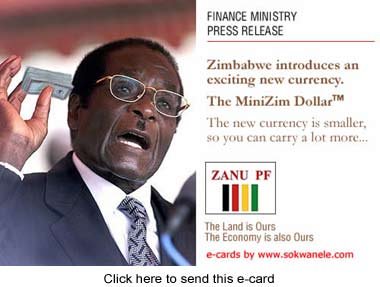
Zimbabwe Parliament to Reconvene

Morgan Tsvangirai and Robert Mugabe
Power-sharing talks have not produced any solid agreement

BBC News: August - Zimbabwe's parliament will open next week, officials say, despite no deal being reached on power-sharing. The opposition Movement for Democratic Change, which won a majority in March's parliamentary election, says it is not opposed to the opening of parliament. But it said it would oppose any move by President Robert Mugabe, leader of the Zanu-PF party, to appoint a cabinet.

The two parties have been trying to thrash out a deal to share power, but have so far failed to agree terms. Parliamentary clerk Austin Zvoma told state TV that parliament would be convened on Monday or Tuesday. "The preparations for the swearing in of members of the seventh parliament [since independence] are at an advanced stage," AFP news agency quoted him as saying.

The Zanu-PF party lost its parliamentary majority for the first time since 1980 - taking 97 seats to the MDC's 109. But the main MDC, led by Morgan Tsvangirai, will rely on the backing of an MDC breakaway faction to preserve its majority. A cabinet is usually formed shortly after parliament reopens, but the MDC is adamant Mr Mugabe should not be allowed to form a government. MDC spokesman Tapiwa Mashakada told Reuters such a move would be "against the letter and spirit" of an agreement both sides had signed to hold power-sharing talks.

Mr Tsvangirai finished ahead of Mr Mugabe in the first round of presidential elections, which were also held in March. But he pulled out of the run-off vote in June, citing a campaign of violence against his supporters. Mr Mugabe went on to win the vote unopposed, with critics and the MDC accusing him of stealing the election. The two leaders have been holding power-sharing talks since mid-July, but have so far failed to reach a deal. The negotiations appear to have stalled on the issue of who should hold executive power. Correspondents say Mr Tsvangirai agreed to take on a beefed-up prime minister's post, with Mr Mugabe in a ceremonial role as president. But Mr Mugabe is believed to have rejected the proposal.
+++++++++++++++++++++++++++++++++++++++++++++++++++
Disclaimer
No responsibility or liability shall attach itself to either myself or to the blogspot ‘Mozlink’ for any or all of the articles/images placed here. The placing of an article does not necessarily imply that I agree or accept the contents of the article as being necessarily factual in theology, dogma or otherwise.
Mozlink

Wednesday, August 20, 2008

UN approves Somalia Force for Six More Months

UNITED NATIONS Wed Aug 20th: (Reuters) - The U.N. Security Council authorized on Tuesday an African Union force in Somalia for another six months, a day after Somalia's government signed a peace agreement with some opposition figures. A unanimous resolution also asked U.N. Secretary-General Ban Ki-moon to work with the AU to strengthen U.N. logistical, political and technical support to help bring the African Union Mission in Somalia, or AMISOM, up to U.N. standards. Somalia has been mired in anarchy since warlords overthrew a dictator in 1991. The waters off the Horn of Africa country are considered among the most dangerous in the world for shipping because of rife piracy.

The peace agreement, which was initialed on June 9 in Djibouti and signed on Monday, has been rejected by hard-liners and done little to quell violence. More than 8,000 civilians have been killed and 1 million uprooted in fighting since early last year pitting President Abdullahi Yusuf's interim administration and allied Ethiopian forces against Islamist rebels. Last month the AU said it was incapable of stabilizing the situation in Somalia and urged the United Nations to take over peacekeeping operations. The world body has been cautious of stepping in in before some kind of peace is established.

AMISOM has authorized the deployment of 8,000 troops but has only 2,600 on the ground. Nigeria said last week it would deploy a battalion of 850 officers and soldiers to Somalia in the next few weeks to join existing AMISOM forces. AMISOM is made up of soldiers from Uganda and Burundi. AMISOM was meant to replace Ethiopian troops whose presence inflamed the insurgency because they helped Somalia's government dislodge an Islamist movement at the start of 2007. A shortage of funds and the violence raging in the capital Mogadishu have prompted several nations to reconsider their offers of troops. The Security Council's resolution stated a willingness to consider at an appropriate time "a peacekeeping operation to take over from AMISOM, subject to progress in the political process and improvement in the security situation on the ground."
By Daniel Bases
+++++++++++++++++++++++++++++++++++++++++++++++++++
Disclaimer
No responsibility or liability shall attach itself to either myself or to the blogspot ‘Mozlink’ for any or all of the articles/images placed here. The placing of an article does not necessarily imply that I agree or accept the contents of the article as being necessarily factual in theology, dogma or otherwise.
Mozlink

China Fails to Approve 77 Protest Applications

BEIJING: August 9th. (Associated Press) -- Chinese authorities have not approved any of the 77 applications they received from people who wanted to hold protests during the Beijing Olympics, state media reported. According to the rules governing protests, today is the last day anyone could apply for permission to demonstrate during the Olympic Games. The state-run New China News Agency said Monday that the applications received since Aug. 1, a week before the Games opened, included such things as labor disputes and inadequate welfare. But 74 of the applications were withdrawn because the problems "were properly addressed by relevant authorities or departments through consultations," the news agency said, citing an unidentified spokesman for the Public Security Bureau. Two other applications were suspended because they did not provide sufficient information and one was rejected because it violated laws against demonstrations and protests, the spokesman said.

Protests have become common in China, including workers upset about factory layoffs and farmers angry about land confiscation. But the Communist leadership remains wary about large demonstrations, fearing that they could snowball into anti-government movements. In July, China said protests would be allowed in three parks far from Games venues. But there were also rules: Applications with detailed paperwork had to be filed five days in advance and protests must not harm "national, social and collective interests." A response would be provided 48 hours before the requested rally time, officials promised. There have been no demonstrations in the designated areas since the Games started, though small unregulated protests have occurred in other parts of the city. Most have been conducted by foreigners who were swiftly deported after unfurling "Free Tibet" banners.
+++++++++++++++++++++++++++++++++++++++++++++++++++
Disclaimer
No responsibility or liability shall attach itself to either myself or to the blogspot ‘Mozlink’ for any or all of the articles/images placed here. The placing of an article does not necessarily imply that I agree or accept the contents of the article as being necessarily factual in theology, dogma or otherwise.
Mozlink

Saturday, August 9, 2008

Calls for France to Rethink its Africa Role

Bonhomie: The report breaks a spell of warmer ties between Rwanda and France. In January, President Paul Kagame (r.) hosted French Foreign Minister Bernard Kouchner (l.) in Kigali. (Riccardo Gangale/APA)
Rwandan report this week charged Paris with complicity in the 1994 genocide.

A bombshell of a report by Rwanda this week implicating high-ranking French officials in the arming and training of Hutu forces that committed genocide in Rwanda – could have been issued last November. President Paul Kagame sat on the 500-page study, approved by the Rwandan Senate, for months.

It was a time of some bonhomie with France. President Nicolas Sarkozy and Foreign Minister Bernard Kouchner, much liked in Kigali, were working on a new rapprochement policy – after Rwanda broke all ties with France in 2006 over a French judge's indictment of Mr. Kagame for allegedly ordering an assassination in 1994.

Kagame, a Tutsi, appears to have lost patience with France. He had hoped that the 2006 indictment would be renounced and that high-level Hutus still living in France would be deported to Rwanda to face genocide charges.

Still, what is likely the last major report on the 1994 Rwandan genocide that killed more than 800,000, leaves France with an embarrassing problem – one cutting to the heart of its own political elite, to a network of French unofficial "parallel structures" of commerce and intelligence in Africa, and to how a major power will deal with thorny questions of justice about its behavior in the postcolonial world.

"The French know this report is dynamite and wanted to keep it from seeing the light of day," says Andrew Wallis, author of "Silent Accomplice," a recounting of alleged French backing of the Hutu government in Rwanda in the early 1990s. "This creates a new chapter and ends an old one. The question is, where do the two sides go now? The French tried in every way to unseat Kagame, but now recognize he is here to stay. But you aren't going to get an apology from the French.... The Hutus were armed and trained by a foreign power that walked away and said 'I never did it.' "

The details in the Rwandan document – its naming of French political and military officials, its recounting of French weapons sales, French training, incidents, times, dates, and places of specific crimes – have so far been treated with scorn, and a blanket denial in Paris.

French defense minister Hervé Morin told Radio France Internationale Thursday that French investigators in 1998 found French soldiers in Rwanda were "beyond reproach" and said they saved hundreds of thousands of lives.

Whether Kagame, whose profile in Africa has been rising, will attempt to push a prosecution at a time when the West has been touting the arrest of Balkan leaders accused of war crimes, as well as an International Criminal Court indictment of Sudanese President Omar al-Bashir, is unknown.

Tom Cargill, Africa expert with the London think tank Chatham House, told Reuters, "I think it all points to a profound disturbance in international relations caused by the emergence of an international legal system.... The very idea that there might be a legal process ... quite separate from politics is causing many people in many countries to rethink how they approach international relations."

Paris and Kigali have spent years disputing France's role in the 100-day killing spree that became the last full-scale genocide of the 20th century. Some diplomatic sources in Paris say the Kagame report, produced by the Munyo Commission, is an effort at distracting attention from Tutsi crimes that took place after 800,000 Hutu moderates and Tutsis were slaughtered.

Yet the respected French daily Le Monde this week said the evidence presented in the Rwandan study means the issue can no longer be ignored. It argued that passionate back-and-forth charges between France and Rwanda has hidden the truth for more than a decade, and that "France has to reply to the accusations."

Much of the French complicity cited by the Munyo Commission has been described or published for years by authors, nongovernmental organizations, journalists, and eyewitnesses. Survie, a French NGO, has spent decades following the Rwandan question, investigated the French role exhaustively, and brought out "L'horreur qui nous prende au visage," a 600-page work in French that came out in 2005.

"Until Rwanda in 1992, we tried to work with French political parties to improve French policies in Africa," says Sharon Courtoux, a cofounder of Survie. "But the genocide, which was clear to see even before it happened, changed everything. Rwanda proved to us that there was absolutely no limit to what people were capable of doing, in defending their interests."

The 1998 French parliamentary investigation into its mission in Rwanda found that "mistakes were made," but that France was not knowingly involved in or complicit in the crimes committed by military and paramilitary forces. Yet Survie's study, and the Munyo Commission, presented compelling evidence that France trained government and paramilitary forces.

"All roads to the truth were opened up in the 1998 investigation in France," argues Ms. Courtoux, "but they did not go to the end of the road."

Mr. Wallis, reporter Chris McGreal, and Survie accounts point particularly to the French role in instances like "Operation Turquoise" – an attempt to create a safe haven for the Hutu government and peoples, which took place in the mountains of the south, a place called Bisesero. French soldiers were instructed to go into the zone. When they did, hundreds of Tutsis who were hiding in the hills thought they were coming to save them, according to Wallis. The Tutsis came out of the hills, then the French soldiers were instructed to withdraw – exposing them to the Hutu Interahamwe militia squads (who had allegedly received training from the French). "The Interahamwe just clapped their hands at that point," says Wallis. "These Tutsis had been impossible to route out, and now they were attacked and killed."

Mr. McGreal, who was in Rwanda at the time, spoke to the French colonel who was giving the orders, who identified himself as Didier Thibault. He said that he was taking orders from the "legal organization," the Hutu government.

He was actually Col. Didier Tauzin – a man who had advised the Rwandan Army and, according to a 2007 report by McGreal, had "commanded the French operation that halted the RPF [Tutsi] advance on Kigali a year earlier." That advance had been an effort by the Kagame forces to end the killing in the Hutu-run capital.
BY Robert Marquand
+++++++++++++++++++++++++++++++++++++++++++++++++++
Disclaimer
No responsibility or liability shall attach itself to either myself or to the blogspot ‘Mozlink’ for any or all of the articles/images placed here. The placing of an article does not necessarily imply that I agree or accept the contents of the article as being necessarily factual in theology, dogma or otherwise.
Mozlink

Solzhenitsyn Represented 'Freedom and Dignity', says Church

Russian Premier Vladimir Putin pays condolence to Natalya Solzhenitsyna, the widow of the famous Russian author, Soviet dissident and Nobel literature prize winner Alexander Solzhenitsyn during the farewell ceremony in the Russian Academy of Science building in Moscow, Russia 05 August 2008. Alexander Solzhenitsyn died of heart failure late Sunday at the age of 89 and will be burried on the cemetery of Donskoy Monastery in Moscow on Wednesday 06 August. (EPA/YURI KOCHETKOV)
Moscow: August 4th. (ENI) - Alexander Solzhenitsyn, the Nobel Prize-winning author who survived the Soviet gulag of labour camps under dictator Josef Stalin, will go down in history as a "model of inner freedom and human dignity," a top official of the Russian Orthodox Church has said. Solzhenitsyn died in Moscow of heart failure late on Sunday night. He was 89 years old. "He was able to speak boldly with the rulers of his country and of the West, [and] with the people, without fearing to speak the truth and without being a slave to fashion or public opinion," the Rev. Vsevolod Chaplin, deputy chairperson of the Department of External Church Relations of the Moscow Patriarchate, was quoted as saying by the Interfax-religion news agency.

A report on patriarchia.ru, the official Web site of the Moscow Patriarchate, described Solzhenitsyn as "one of the spiritual leaders of patriotic Orthodox organizations". The Rev. Vladimir Vigilyansky, director of the Moscow Patriarchate's press service, told RIA Novosti, an official Russian news agency, that the Russian Orthodox Church would be holding memorial services for Solzhenitsyn. He described the writer as a believer who was in close contact with many clerics and religious thinkers. "Without a doubt he thought within a religious framework and his views on man and society were of a clearly religious character," Vigilyansky told the news agency.

Solzhenitsyn came to fame in 1962 with his book, "One Day in the Life of Ivan Denisovich". Critics compared the short novel about prison camp life to works by Tolstoy and Dostoyevsky, and the book came to epitomise the promise, and the beginning of the end of the period of thaw, under Soviet leader Nikita Khrushchev. Solzhenitsyn was expelled from the USSR in 1974 after the publication in the West of "The Gulag Archipelago", his monumental history of the Soviet prison camp system. He soon settled in the United States, in Cavendish, Vermont but did not embrace the American way of life. He returned to Russia in 1994, and travelled across the country by train from Vladivostok to Moscow. The state of Russia depressed him and the initial triumphant response to his return soon faded. In 2001, Solzhenitsyn published "Two Hundred Years Together," a study of the relationship between Russians and Jews that fanned charges that he was anti-Semitic. David Remnick, writer and editor of the New Yorker, who has profiled Solzhenitsyn, defended Solzhenitsyn against such accusations. "Solzhenitsyn, in fact, is not anti-Semitic; his books are not anti-Semitic, and he is not in his personal relations anti-Jewish," Remnick wrote in 2001.

Solzhenitsyn did not approve of Mikhail Gorbachev, the last Soviet leader, and became disenchanted with Boris Yeltsin, the first post-Soviet president of Russia. Still, in 2007, he accepted a State prize from then-president Vladimir Putin, a former lieutenant colonel in the Soviet-era secret intelligence agency, the KGB. Solzhenitsyn told the German weekly Der Spiegel in an interview that Putin, "inherited a ransacked and bewildered country with a poor and demoralised people. And he started to do what was possible: a slow and gradual restoration."
by Sophia Kishkovsky
+++++++++++++++++++++++++++++++++++++++++++++++++++
Disclaimer
No responsibility or liability shall attach itself to either myself or to the blogspot ‘Mozlink’ for any or all of the articles/images placed here. The placing of an article does not necessarily imply that I agree or accept the contents of the article as being necessarily factual in theology, dogma or otherwise.
Mozlink

Russia and Georgia Clash Over Separatist Region

A Georgian man mourned a dead relative in the town of Gori, which was hit by Russian bombs, according to residents. (David Mdzinarishvili/Reuters)

GORI, Georgia: Aug 8th (NY Times) — Russia conducted airstrikes on Georgian targets on Friday evening, escalating the conflict in a separatist area of Georgia that is shaping into a test of the power and military reach of an emboldened Kremlin. Earlier in the day, Russian troops and armored vehicles had rolled into Sth Osseita, supporting the breakaway region in its bitter conflict with Georgia. The United States and other Western nations, joined by NATO, condemned the violence and demanded a cease-fire. Secretary of State Condoleezza went a step further, calling on Russia to withdraw its forces. But the Russian soldiers remained, and Georgian officials reported at least one airstrike, on the Black Sea port of Poti, late on Friday night. Russian military units — including tank, artillery and reconnaissance — arrived in Tskhinvali, the capital of South Ossetia, on Saturday to help Russian peacekeepers there, in response to overnight shelling by Georgian forces, state television in Russia reported, citing the Ministry of Defense. Ground assault aircraft were also mobilized, the Ministry said. Also on Saturday a senior Georgian official said by telephone that Russian bombers were flying over Georgia and that the presidential offices and residence in Tbilisi had been evacuated. The official added that Georgian forces still had control of Tskhinvali.

Neither side showed any indication of backing down. Prime Minister Vladimir Putin of Russia declared that “war has started,” and President Mikheil Saakashvili of Georgia accused Russia of a “well-planned invasion” and mobilized Georgia’s military reserves. There were signs as well of a cyberwarfare campaign, as Georgian government Web sites were crashing intermittently during the day. The escalation risked igniting a renewed and sustained conflict in the Caucasus region, an important conduit for the flow of oil from the Caspian Sea to world markets and an area where conflict has flared for years along Russia’s borders, most recently in Chechnya. The military incursion into Georgia marked a fresh sign of Kremlin confidence and resolve, and also provided a test of the capacities of the Russian military, which Mr. Putin had tried to modernize and re-equip during his two presidential terms. Frictions between Georgia and South Ossetia, which has declared de facto independence, have simmered for years, but intensified when Mr. Saakashvili came to power in Georgia and made national unification a centerpiece of his agenda. Mr. Saakashvili, a close American ally who has sought NATO membership for Georgia, is loathed at the Kremlin in part because he had positioned himself as a spokesman for democracy movements and alignment with the West. Earlier this year Russia announced that it was expanding support for the separatist regions. Georgia labeled the new support an act of annexation.

The conflict in Georgia also appeared to suggest the limits of the power of President Dmitri Medbedev, Mr. Putin’s hand-picked successor. During the day, it was Mr. Putin’s stern statements from China, where he was visiting the opening of the Olympic Games, that appeared to define Russia’s position. But Mr. Medvedev made a public statement as well, making it unclear who was directing Russia’s military operations. Officially, that authority rests with Mr. Medvedev, and foreign policy is outside Mr. Putin’s portfolio. “The war in Ossetia instantly showed the idiocy of our state management,” said a commentator on the liberal radio station, Ekho Moskvy. “Who is in charge — Putin or Medvedev?” The war between Georgia and South Ossetia, until recently labeled a “frozen conflict,” stretches back to the early 1990s, when South Ossetia and another separatist region, Abkhazia, gained de facto independence from Georgia after the collapse of the Soviet Union. The region settled into a tenuous peace monitored by Russian peacekeepers, but frictions with Georgia increased sharply in 2004, when Mr. Saakashvili was elected.

Reports conflicted throughout Friday about whether Georgian or Russian forces had won control of Tskhinvali, the capital of the mountainous rebel province. It was unclear late on Friday whether ground combat had taken place between Russian and Georgian soldiers, or had been limited to fighting between separatists and Georgian forces. Marat Kulakhmetov, commander of Russian peacekeeping forces in Tskhinvali, said early on Saturday that South Ossetian separatists still held most of the city and that Georgian forces were only present on its southern edge. That report aligned with a statement by Georgia’s ambassador to the UN, Irakli Alasania, who said that Georgian military units held eight villages at the capital’s edge. Georgian officials asserted that Russian warplanes had attacked Georgian forces and civilians in Tskhinvali, and that airports in four Georgian cities had been hit. Shota Utiashvili, an official at the Georgian Interior Ministry, said they included the Vaziany military base outside of Tbilisi, the Georgian capital, a military base in Marneuli, and airports in the cities of Delisi and Kutaisi. “We are under massive attack,” he said.

Late in the night, George Arveladze, an adviser to Mr. Saakashvili, said that Russian planes had bombed the commercial seaport of Poti, where one worker was missing and several others were wounded. Poti is an export point for oil from the Caspian Sea; Mr. Arveladze said the initial reports indicated that the oil terminal had not been struck. Eduard Kokoity, the president of South Ossetia, said in a statement on a government Web site that hundreds of civilians had been killed in fighting in the capital. Russian peacekeepers stationed in South Ossetia said that 12 peacekeeping soldiers were killed Friday and that 50 were wounded. The claims of casualties by all sides could not be independently verified. Analysts said that either Georgia or Russia could be trying to seize an opportune moment — with world leaders focused on the start of the 2008 Olympics this week — to reclaim the territory, and to settle the dispute before a new American presidential administration comes to office. Richard C. Holbrooke, the former American ambassador to the United Nations, said that Russia’s aims were clear. “They have two goals,” he said. “To do a creeping annexation of South Ossetia and Abkhazia and, secondly, to overthrow Saakashvili, who is a tremendous thorn in their side.” A spokesman for Mr. Medvedev declined to comment. The United States State Department issued a press release late Friday saying that John D. Negroponte, the deputy secretary of state, had summoned the Russian chargĂ© d’affairs to press for a de-escalation of force. “We deplore today’s Russian attacks by strategic bombers and missiles, which are threatening civilian lives,” the statement said.

The United States also said Friday that it would send an envoy to the region to try to broker an end to the fighting. Chancellor Angela Merkel of Germany issued a statement calling on both sides “to halt the use of force immediately.” Germany has taken a leading role in trying to ease the tensions over Abkhazia. The trigger for the fresh escalation began last weekend, when South Ossetia accused Georgia of firing mortars into the enclave after six Georgian policemen were killed in the border area by a roadside bomb. As tensions grew, South Ossetia began sending women and children out of the enclave. The refugee crisis intensified Friday as relief groups said thousands of refugees, mostly women and children, were streaming across the border into the North Caucasus city of Vladikavkaz in Russia. Early on Friday, Russia’s Channel One television showed Russian tanks entering South Ossetia and reported that two battalions reinforced by tanks and armored personnel carriers were approaching its capital. There were unconfirmed reports that Georgian forces had shot down two Russian planes and that its aircraft had bombed a convoy of Russian tanks. Russian state television showed what it said was a destroyed Georgian tank in Tskhinvali, its turret smoldering. Women and children in Tskhinvali were hiding in basements while men had fled to the woods, said a woman reached by telephone in the neighboring Russian region of North Ossetia, who said she had been in phone contact with relatives there. She declined to give her name. In Gori, a city outside South Ossetia and about 12 miles from Tskhinvali, residents said there had been sporadic bombing all day. The city was shaken by numerous vibrations from the impact of bombs on Friday evening. One Russian bomb exploded in Gori near a textile factory and a cellphone tower, leaving a crater.

At the United Nations on Friday, diplomats continued to wrangle over the text of a statement after attempts to agree to compromise language collapsed Friday afternoon, after nearly three hours of consultations. The Russians, who had called the emergency session, proposed a short, three-paragraph statement that expressed concern about the escalating violence, and singled out Georgia and South Ossetia as needing to cease hostilities and return to the negotiating table. But one phrase calling on all parties to “renounce the use of force” met with opposition, particularly from the United States, France and Britain. The three countries argued that the statement was unbalanced, one European diplomat said, because that language would have undermined Georgia’s ability to defend itself. Belgium, which holds the rotating presidency of the Security Council this month, circulated a revised draft calling for an immediate cessation of hostility and for “all parties” to return to the negotiating table. By dropping the specific reference to Georgia and South Ossetia, the compromise statement would also encompass Russia. The Security Council was scheduled to meet Saturday to resume deliberations. China, in its statement during the early morning debate, had asked for a traditional cease-fire out of respect for the opening of the Olympics.

President Bush discussed the conflict by telephone with Secretary of State Condoleezza Rice and the national security adviser, Stephen J. Hadley, for about an hour after attending the opening ceremonies of the Olympics, the White House press secretary, Dana M. Perino said. Mr. Bush held another conference with Mr. Hadley and his deputy, James Jeffery, on Saturday morning before attending beach volleyball practice. There are over 2,000 American citizens in Georgia, Pentagon officials said. Among them are about 130 trainers — mostly American military personnel but with about 30 Defense Department civilians —assisting the Georgian military with preparations for deployments to Iraq. The American military was taking no actions regarding the outbreak of violence, according to Pentagon and military officials. While there has been some contact with the Georgian authorities, the Defense Department had received no requests for assistance, the officials said.
By Michael Schwirtz, Anne Barnard & C, J, Chivers
+++++++++++++++++++++++++++++++++++++++++++++++++++
Disclaimer
No responsibility or liability shall attach itself to either myself or to the blogspot ‘Mozlink’ for any or all of the articles/images placed here. The placing of an article does not necessarily imply that I agree or accept the contents of the article as being necessarily factual in theology, dogma or otherwise.
Mozlink

Wednesday, August 6, 2008

Rwanda Accuses France Directly Over 1994 Genocide

KIGALI Aug. 5th. (Reuters) - Rwanda formally accused senior French officials on Tuesday of involvement in its 1994 genocide and called for them to be put on trial. Among those named in a report by a Rwandan investigation commission were former French Prime Minister Dominique de Villepin and late President Francois Mitterrand. Kigali has previously accused Paris of covering up its role in training troops and militia who carried out massacres that killed some 800,000 people, and of propping up the ethnic Hutu leaders who orchestrated the slaughter. France denies that and says its forces helped protect people during a UN -sanctioned mission in Rwanda at the time.

The latest allegations from Kigali came on Tuesday with the publication of the report by an independent Rwandan commission set up to investigate France's role in the bloodshed. "The French support was of a political, military, diplomatic and logistic nature," the report said. "Considering the gravity of the alleged facts, the Rwandan government asks competent authorities to undertake all necessary actions to bring the accused French political and military leaders to answer for their acts before justice." An official at the French Foreign Ministry told Reuters that the French government had not yet received any official communication from Kigali and so could not comment. Attached to the report was a list of 33 accused French political and military officials. As well as Mitterrand and Villepin, others listed include then foreign minister Alain Juppe, a senior figure in current President Nicolas Sarkozy's party, then prime minister Edouard Balladur and Hubert Vedrine, both still senior politicians.

Rwandan President Paul Kagame cut ties with France in November 2006 in protest at a French judge's call for him to stand trial over the death of his predecessor in April 1994 -- an event widely seen as unleashing the genocide. That call prompted street protests in Kigali. Relations soured further after the Rwandan commission later heard accounts from victims who said they were raped by French soldiers after seeking refuge with them during the genocide. But ties between the two nations had improved in recent months after Kagame met Sarkozy at a EU-Africa summit in Lisbon in December 2007.
by Daniel Wallis
+++++++++++++++++++++++++++++++++++++++++++++++++++
Disclaimer
No responsibility or liability shall attach itself to either myself or to the blogspot ‘Mozlink’ for any or all of the articles/images placed here. The placing of an article does not necessarily imply that I agree or accept the contents of the article as being necessarily factual in theology, dogma or otherwise.
Mozlink

Wednesday, July 30, 2008

After 7 Years, Talks on Trade Collapse

Kamal Nath of India said developing nations were concerned for their poor farmers.
GENEVA: July 30th. (NY Times) — World trade talks collapsed here on Tuesday after seven years of on-again, off-again negotiations, in the latest sign of India’s and China’s growing might on the world stage and the decreasing ability of the United States to impose its will globally. Pascal Lamy, director general of the World Trade Organization, could not bridge differences between a group of newly confident developing nations and established Western economic powers. In the end, too few of the real power brokers proved committed enough to make compromises necessary to deliver a deal. The failure appeared to end, for the near term at least, any hopes of a global deal to further open markets, cut farm subsidies and strengthen the international trading system. “It is a massive blow to confidence in the global economy,” said Peter Power, spokesman for the European Commission. “The confidence shot in the arm that we needed badly will not now happen.”

After nine consecutive days of high-level talks, discussions reached an impasse when the United States, India and China refused to compromise over measures to protect farmers in developing countries from greater liberalization of trade. Supporters of the so-called Doha round of talks, which began in 2001, say a deal would have been a bulwark against protectionist sentiments that are likely to spread as economic growth falters in much of the world. The failure also delivers a blow to the credibility of the World Trade Organization, which sets and enforces the rules of international commerce. It could set back efforts to work out other multilateral agreements, including those intended to reduce the threat of global warming. The collapse of the talks will not bring an end to world trade, of course, which will continue under current agreements, many of which are between two or more countries rather than under the W.T.O. But it is a big setback, particularly to the hopes of smaller and poorer developing countries, which were counting on gaining greater access to consumers in the United States, Europe and Japan.

Economists and trade experts predicted that negotiators, having come this close, might not find the conditions for a broad deal among the 153 members of the trade organization for years, if ever again. Deep skepticism about the advantages of free trade was on vivid display during the Democratic primaries and it is growing in Europe, particularly as France, Italy and other countries have fallen into an American-style economic malaise. “It’s important to move forward when the world is in a slowdown and is tempted to think of protectionism rather than opening up,” said Norbert Walter, the chief economist at Deutsche Bank. He said soaring food prices provided another rare opportunity for a deal, since European and American farmers are prospering. It may never be easier to reduce farm subsidies, one of the most delicate issues in trade talks. “The feeling went from ‘Who cares?’ to a surge of excitement and sense of breakthrough to ‘Oh, no, not again,’ ” said Rory Macrae, a partner at GPlus Europe, a communications consulting firm in Brussels, who was on the sidelines of the negotiations in Geneva. He said the sticking point this time was countries like China and India, which have become more aggressive in advancing their interests. “Maybe they’re now thinking, ‘We’re big enough that we don’t even need the process,’ ” Mr. Macrae said. Like the United States and Europe, he said, China and India might find it more advantageous to negotiate bilateral agreements in which they can apply more pressure on a single trading partner.

On Tuesday night, ministers were still discussing whether any of the agreements reached in principle could be salvaged. But there seemed little prospect for that any time soon, in part because the presidential campaign in the United States will make it all but impossible for Washington to take part until a new administration takes over. Talks foundered on the right of India and other developing nations to protect sensitive agricultural products from competition in the event of a surge of imports that would make their own farmers less competitive. The United States argued that such protection, which is not permitted now, would mean moving backward on current world trade commitments. Mari Elka Pangestu, the Indonesian trade minister, said the failure of the talks reflected the inability of the rich industrial powers to deal with the growing influence of China, India and Brazil in the global economy. She complained that what she called “a reasonable request” had been blocked because the United States “is not going to show flexibility.” Susan C. Schwab, the United States trade representative, challenged assertions by some developing countries that the United States had been the chief obstacle to sewing up the deal. She added, “The U.S. commitments remain on the table, awaiting reciprocal responses.” She said, “It is unconscionable that we could have come out with an outcome that rolled the global trading system back not by one year or 5 years but by 30 years.” Ms. Schwab said it would be possible to help developing nations address surges in imports in ways that could not “be used as a tool of blatant protectionism.”

One official said that the relatively technical nature of the cause of the breakdown underlined a lack of political will to reach an agreement that would be a tough sell to voters in many countries. The Indian trade minister, Kamal Nath, in a briefing with reporters, said he was “very disappointed” but that developing countries were “deeply concerned about issues which affected poor and subsistence farmers.” Washington’s negotiating team was also under pressure from the country’s powerful farm lobby, and the EU was under pressure from its own. Lourdes Catrain, a trade partner at the law firm Hogan & Hartson, said the real danger created by failure after getting so close was “that the seven years of hard negotiations will be lost and there will be no guarantees on the starting point of a future round.” The proliferation of bilateral deals and the continuing expansion of exports from both developing and developed countries have raised doubts among some Doha skeptics about the necessity of a global agreement. But experts said it was important, particularly as a bulwark against rising protectionist sentiments. “There are people who argue that no Doha outcome is better than a weak Doha outcome, but I don’t agree,” said Katinka Barysch, the deputy director of the Center for European Reform in London.
By Stephen Castle and Mark Lander
+++++++++++++++++++++++++++++++++++++++++++++++++++
Disclaimer
No responsibility or liability shall attach itself to either myself or to the blogspot ‘Mozlink’ for any or all of the articles/images placed here. The placing of an article does not necessarily imply that I agree or accept the contents of the article as being necessarily factual in theology, dogma or otherwise.
Mozlink

Monday, July 28, 2008

Sudan Rallies Behind Leader Reviled Abroad

Sadiq al-Mahdi, in Khartoum, Sudan, on Sunday, now supports the man who ousted him from power, Omar Hassan al-Bashir. (Joao Silva for The New York Times)
KHARTOUM, Sudan: July 28th. — President Omar Hassan al-Bashir of Sudan has been accused by the prosecutor of the International Criminal Court of genocide and vilified the world over as an incorrigible mass murderer bent on slaughtering his own people in Darfur. But inside Sudan, his grip on power seems, for the moment, to be surer than ever. In the past few weeks, one sworn political enemy after another has closed ranks behind him. A result has been a swift and radical reordering of the fractious political universe in Sudan, driven in part by national pride but also by deep-seated fears that the nation could tumble into Somalia-like chaos if Mr. Bashir were removed as president. The Sudanese government, joined by many of its onetime foes who see the court’s looming arrest warrant as a mortal threat to the country, is scrambling to determine exactly how much it needs to concede to survive.

One previously unthinkable proposal being discussed is whether the government should arrest two men accused of orchestrating the campaign of rape, murder and pillage in Darfur that has left about 300,000 dead and scattered 2.5 million people from villages reduced to circles of ash. The two men, Ahmad Harun, the former interior minister, and Ali Kushayb, a militia leader, face arrest warrants issued by the international court for crimes against humanity. But the government has refused to turn them over. Sudanese officials say they hope that putting the two men on trial in Sudan might persuade the UN Security Council to exercise its power to suspend the case against Mr. Bashir. “Everything short of the presidency is on the table,” said Sudan’s foreign minister, Deng Alor. Although the West has been relentlessly focused on Darfur, here in Sudan, most people view the crisis as simply a continuation of a long chain of internal conflicts between an autocratic government and the deeply impoverished people on the periphery. The deadliest of these conflicts, between the north and south, raged for decades, killing 2.2 million people — many more than the lives lost in Darfur — and threatened to split the country along religious lines.

Sudan has been at war with itself for almost its entire post-colonial history, starting in 1956. Nearly all of the major ethnic and religious groups have fought one another, and politics continue to be dominated by mistrust, outside interference and combustible animosities. There are dozens of armed groups across the country, each with its own political agenda. One growing concern is that without Mr. Bashir, a peace treaty signed in 2005 between Sudan’s central government and southern rebels could fall apart. The treaty, which he fought hard-liners in his own party to approve, is widely seen as the glue that is holding this unwieldy and deeply divided country together. It calls for elections next year and outlines ways to share wealth and power. “The situation in Sudan now is so pregnant with trouble,” said Sadiq al-Mahdi, Sudan’s last elected leader, who was overthrown by Mr. Bashir in 1989 and has remained a bitter opponent ever since. Until now. After the warrant was announced, Mr. Mahdi threw the support of the party he leads, one of Sudan’s biggest, behind Mr. Bashir, at least for the moment.

Luis Moreno-Ocampo, the prosecutor of the international criminal court, or I.C.C., has described Mr. Bashir as the mastermind of a genocide in Darfur. But here on the sun-blasted streets of Sudan’s capital, Mr. Bashir is widely perceived as a relative moderate. “He is a pigeon, not a hawk,” said Ghazi Suleiman, a human rights lawyer who has been jailed 18 times by the Bashir government. Half of Mr. Suleiman’s face is paralyzed as a result of torture at the hands of the country’s notorious security forces. Nevertheless, he opposes any attempt to charge Mr. Bashir with war crimes now. From the perspective of many Sudanese political leaders, the I.C.C. move could not have come at a worse time. A lightning-fast attack on the capital by a Darfur rebel group in May rattled the ruling National Congress Party. Hundreds of heavily armed rebels from an Islamist Darfur rebel faction thundered into the capital’s outskirts. They were repulsed, but the assault exposed gaps in the government’s aura of military invincibility. “It just showed how the army is stretched to the limits,” said Ghazi Salah al-Din, a top adviser to Mr. Bashir, in a rare admission of vulnerability by a senior ruling party official. A week later, new fighting between the national army and a former rebel force in the disputed oil-rich area of Abyei forced more than 50,000 to flee and sparked fears of a new round of bloodletting. “A lot of the political entities looked into the abyss and were scared,” said a senior Western diplomat in Khartoum, speaking anonymously because he is not authorized by his government to speak publicly. A number of nightmare scenarios — an implosion of the government that might invite Al Qaeda back into Sudan or embolden rebel groups to try to topple the government — forced political elites in Sudan to choose sides. Most have chosen, for now, to stick with Mr. Bashir. “These are frail and critical moments in our history,” said James Morgan, a spokesman for the Sudan People’s Liberation Movement, the rebel group that signed the Comprehensive Peace Agreement ending the north-south war. Mr. Bashir, he said, should be given “ample time to implement these agreements.”

The international court’s announcement also came as there were signs that the country was taking its first steps toward democracy after years of autocratic rule. The National Assembly had just passed a new electoral law, which would set up rules for the country’s first free elections in more than 20 years. “The country was preparing itself for a new phase of government,” said Mr. Salah al-Din. Mr. Salah al-Din acknowledged that “mistakes had been made in Darfur,” and said that the coming political transformation would, through elections, deal with the roots of the crisis — political marginalization. The north-south war had always been viewed as the biggest threat to Sudan. But in 2003, as negotiations to end that conflict dragged on, a new rebel group rose up in Darfur to demand a greater share of wealth and power for the long-neglected western region. The government responded with the same ruthless tactics it used in the south, unleashing Arab militias to chase the rebels and their supporters from Darfur’s villages. The terror they caused aroused outrage across the world; the Bush administration called the killings genocide. The crisis came to dominate Western policy toward Sudan, often at the expense of the larger struggle to keep the north-south deal alive.

But diplomats, aid workers and analysts who have traveled to the region recently say things have changed in Darfur. The conflict has become a violent free-for-all in which a bewildering cast of rebels, bandits and militias murder each other and civilians largely unchecked by government authority. “The government is brutal, untrustworthy and bloodthirsty, but the reality is that most of the violence in Darfur today is not caused by them,” the senior Western diplomat said. “Is there a genocide in Darfur right at this moment? No, there isn’t.” Mr. Bashir’s tour of Darfur last week was short on proposals to jump start a peace process, but a panel led by Mr. Mahdi and other political leaders has been charged with finding a way to defuse the crisis. The government sent an official to Qatar to ask the government there, which helped negotiate a settlement to Lebanon’s most recent crisis, to contribute $500 million for the compensation of Darfur’s victims. The government and its new allies are hoping that if they can provide evidence of progress in Darfur and persuade the international community that an arrest warrant would create more problems than it would solve, the Security Council will act to hold back the criminal court.

Salih Mahmoud Osman, a Darfur lawyer who has documented thousands of human rights violations in Darfur, said the court represented the only chance for victims to get justice. In a recent interview, he wept as he described the painful process of collecting testimony from rape victims. “They told us, ‘Our suffering must be documented,’ ” he said, hiding his face with his hands to cover his tears. “ ‘Our story is not forgotten. You are putting criminals on the record. If not today, tomorrow we will have justice.’ And now it has happened.” In any case, Mr. Bashir’s newfound popularity among Sudan’s political elite is likely to be short lived. If the arrest warrant is issued, analysts and diplomats said, all bets are off. “He could end up very weak to challenges from inside and outside the ruling party,” a senior UN official in Khartoum said. The government has responded so far to the court’s action with diplomacy and public relations, not violence. It has agreed to allow the delivery of hundreds of containers of United Nations supplies held up in Sudan’s port, and to make visas and permits for aid workers easier to get. “We’ve been receiving very strong messages of cooperation” from the government, said Ameerah Haq, the top United Nations aid official in Sudan. Mr. Alor, the foreign minister, said the threat of an arrest warrant may prove to be a blessing in disguise. “Now we are seriously talking about the resolution of the problem of Darfur,” he said, adding that the government was also considering ways to cooperate with the peacekeeping force in Darfur that it long resisted. “If we take the I.C.C. from that angle, it can be a blessing for the whole country.”
By Lydia Polgreen and Jeffrey Gettleman
+++++++++++++++++++++++++++++++++++++++++++++++++++
Disclaimer
No responsibility or liability shall attach itself to either myself or to the blogspot ‘Mozlink’ for any or all of the articles/images placed here. The placing of an article does not necessarily imply that I agree or accept the contents of the article as being necessarily factual in theology, dogma or otherwise.
Mozlink

Friday, July 11, 2008

NEWS FROM AEFJN

Britain is the world’s biggest arms exporter Times, 18/06/2008

Britain was the world’s biggest arms seller last year, accounting for a third of global arms exports, the Government’s trade promotion organisation said. UK Trade and Investment (UKTI) said that arms exporters had added £9.7 billion in new business last year, giving them a larger share of global arms exports than the United States. « As demonstrated by this outstanding export performance, the UK has a first-class defence industry, with some of the world’s most technologically sophisticated companies. » Digby Jones, the Minister for Trade and Inestement said. UKTI said that the figures were boosted by orders from Eurofighter Typhoon jets from Saudi Arabia, the world’s biggest arms buyer, which has imported $ 31 billion in weapons over the past five years. There are also orders from Oman and Trinidad and Tobago for offshore patrol vessels. The US is still the world’s biggest exporter over the past five years, with $63 billion in total arms exports. Britain was second with $53 billion and Russia third with $33 billion.

Powerful new tool to diagnose drug-resistant TB http://tinyurl.com/6p3jdw
Clinical trials of a new molecular technique have found it to be effective at quickly identifying multidrug-resistant tuberculosis (MDR-TB) in resource-poor settings. As a result, the WHO has endorsed the use of the test in all countries with MDR-TB.

African continent faces ‘dramatic’ physician shortage
http://www.un.org/apps/news/story.asp?NewsID=27252
The United Nations World Health Organization (WHO) warned that Africa faces a “dramatic” shortage of physicians by the year 2015, according to a new study that has just been made public. It is projected that there will be nearly 13 million doctors by then, a figure that will meet demand and will exceed the target of achieving the benchmark of having 80 per cent of all live births covered by a skilled attendant. But given the imbalances in physician distribution, Africa will face a scarcity of care, WHO said, with 255,000 doctors in 2015, which is 167,000 fewer than needed to meet the birth coverage goal. The study notes that in 2004, Africa carried nearly one quarter of the world’s disease burden with only 2 per cent of global physician supply and less than 1 per cent of health expenditures worldwide. Similarly, South-East Asia bore 29 per cent of the global disease burden, with 11 per cent of the world’s supply of doctors and 1 per cent of health expenditures. Meanwhile, the American region, with 10 per cent of the world’s disease burden, accounted for half of the world’s health expenditures and one fifth of all physicians. Hefty increases in health-care investment and robust policies are essential to boost the number of doctors in Africa, WHO said. “Given the disproportionate burden of disease in this region, policies for increasing the supply of physicians are urgently needed to stem projected shortages,” according to the study.

The Taubira Report on Economic Partnership Agreements (EPAs)
Christiane Taubira, a left-wing French MP representing Guyana, was invited by Nicolas Sarkozy to produce a report to help the French Presidency of the EU formulate its stance on the EPAs that are being negotiated between the European Union (EU) and the Africa/Caribbean/Pacific (ACP) countries. Sarkozy asked her to clarify the European Commission’s intentions towards the ACP countries with these aims in mind: to restore a relationship of confidence; to enable all countries affected by the opening of the market to take full advantage of it; and to create a dynamic that favours development by promoting regional integration.

The MP gathered the opinions of more than 150 people, ministers, diplomats, negotiators, experts, social scientists and NGOs. She had two working sessions with each of the two European Commissioners responsible for EPA negotiations, Peter Mandelson and Louis Michel. She visited countries that are affected by the agreements to talk with specialists on food and development. In her report she sketches out ideas for resolving the problem areas of the current EPAs.

The report emphasises the need for a thorough review of the aim of the EPAs as well as of the mandate entrusted to the European Commission (EC) concerning its trade negotiations with the ACP countries. It comes out in favour of a revision of the EC’s method of working and suggests that the intention to finalise EPAs in October 2009 be reviewed. It proposes a re-think of the extent of the opening of the market for ACP states, the cornerstone of negotiations and major source of discontent among the ACP countries. The Economic Partnership Agreement envisages an almost total opening of the market – 100% for the European market and 80% for ACP countries – to bring competition into play. By bringing down most customs barriers, the African market risks being flooded with cheaper, better quality European goods. The compensation proposed by the EU will not make up for this, especially as customs duty is an important part of ACP income. The report also calls for greater transparency in the negotiation process and calls for European aid to be dissociated from trade negotiations.

In her report, the Guyana MP even tends towards a return to agreements without reciprocity, because, with the North and the South being at different stages of development, the same liberal rules cannot be applied to both sides. Madame Taubira places sustainable development at the heart of the EPAs. She suggests a cancellation of foreign debt for African states and devotes the first chapter to ways of putting an end to the food crisis and avoiding hunger riots. Her proposals aim to protect the right to food, to promote the development of ACP countries (instead of serving Europe’s trade interests) and to establish a genuine relationship of partnership between the EU and the 76 ACP countries, most of which feature among the poorest in the world. Taubira comes back to criticisms made by the NGOs and sides with those who wish to protect human values. AEFJN and other NGOs are delighted with the conclusions and recommendation in this report; they are in line with the messages that civil society in Africa and Europe has been sending since the beginning of negotiations. Her recommendations would represent a political about-turn for the EU and this is of great importance to those seeking partnership agreements ‘for development’.

This report was submitted to the ElysĂ©e Palace on June 15th. It has still not received the presidential green light for publication and so far no reaction to it has been expressed. Apparently the French government asked her to reconsider her views – but so far in vain. Christiane Taubira reaffirms that, in her opinion, the report should be published. Oxfam France Action is inviting Nicolas Sarkozy to bring these recommendations to the attention of the other member states of the Council of the European Union so that the EPAs may be real tools for development. The cause of the upset in this report is probably its critical tone. It pulls no punches in criticising an economic policy which, in the opinion of the author, has kept African countries in a state of dependence on the European market. Bearing in mind the fragility of the countries, reviving the EPAs without changing the format would be dangerous. She believes that such agreements would make very little difference to Europe but risk damaging whole sectors of the economies of ACP countries. The French presidency of the EU is supposed to be the beginning of a dynamic revival – and Taubira’s report was to prepare the ground. By not responding to the report, Nicolas Sarkozy is indicating that the European reaction will not be in favour of the report’s recommendations. The strategic economic relationship between Africa and Europe is at stake.
For the full report write to: begoinarra@aefjn.org

Call to Action to Stop the WTO Doha Round July 6, 2008
Ministers from dozens of countries, including the U.S., EU, Brazil, India, Indonesia, Philippines, South Africa, Kenya and Egypt, will meet in Geneva on July 21 to attempt to push through the conclusion of the WTO’s Doha Round. After years of negotiations, failed Ministerials, and re-starts, this is their “last chance” before President Bush leaves office. The Ministers are seeking to conclude this faltering round while pushing aside key global priorities like the food crisis, fuel prices, global warming, global poverty and debt.
If concluded, the expansion of the WTO will benefit large corporations – but will have profoundly negative impacts on workers, farmers, women, consumers, and the environment. Falsely labelled a “Development Round” the real consequences would be:

· Job loss, de-industrialization, and the foreclosing of development space for decades to come. Rich countries are demanding that developing countries provide “new market access,” meaning slashing protective tariffs on manufactured goods and natural resources.
· Farmers’ livelihoods, food security, and rural development would come under even greater pressure. The United States and Europe continue to subsidize their agribusiness exporters, while at the same time fighting against key protections for millions of farmers in developing countries. This is outrageous in the face of a global food crisis.
· Increased privatization and deregulation of services, including in key sectors such as finance and energy. Recent instability in global markets demonstrates the need for increased intervention in and oversight of global financial and other markets, not more deregulation.
· Global efforts to tackle climate change may be curtailed by the WTO expansion.
· The poorest countries will be the biggest losers. Economic projections of a potential Doha deal, by several think tanks and even the World Bank, show that the costs of lost jobs, reduced policy space, and lost tariff revenues far outweigh supposed “benefits” of the so-called “Development” Round.

We cannot risk allowing the Doha Round to conclude. Social movements and civil society organizations across the world must unite to oppose the corporate agenda of the WTO Doha Round. We call on all people to:

1. Organize national public pressure (media, mobilizations, campaigns) as your Trade Minister leaves for Geneva and from July 19-21, to ensure that your government acts in the interests of the people, not corporations or foreign governments. Basic Talking Points and a list of Call to Action Resources should be included in the attachments to this Call to Action; if they are not, please contact Verda Cook at verda.cook@gmail.com.
2. Demand a meeting with your Trade Minister to express your opposition to the Doha Round, demanding that they do NOT agree to a Doha conclusion – and let your government know that you are monitoring their activities in Geneva.
3. Contact the media and tell them about the negative impacts on the economy, workers, farmers, consumers, fisher folk, women, climate change, and the environment of the WTO.
4. Send a national letter, endorsed by a wide variety of social movements, to your national government (OWINFS will be circulating a sample letter which can be adjusted to your national context soon.)
5. Come to Geneva to lobby your Minister during the Ministerial Conference, 19-25 July, and tell the media in Geneva what you think about the Doha Round. Please contact Deborah James at djames@cepr.net if you are planning on travelling to Geneva.
Deborah James
Director of International Programs
Center for Economic and Policy Research
1611 Connecticut Avenue, NW, Suite 400
Washington, DC 20009
202 293 5380 x111
202 588 1356 fax
www.cepr.net


STOP EPAs Day, 27 September
Since 2004 every 27 September, the anniversary of the launch of the EPA negotiations is “Stop EPAs Day. This year 2008 EPA actions remain as necessary as ever as the EU is still pushing to make ACP countries accept their trade liberalisation recipe. All ACP regions have accepted to continue to negotiate, but it is not to be taken for granted that they are willing to accept the EU EPA package. European civil society must continue to denounce the EU approaches and continue to create space for alternatives.

Since the CARIFORUM EPA will be signed on 23 July and the interim EPAs may follow after summer, the European Parliament will be invited to give its assent (to ratify). Therefore we decided to focus on the European Parliament and its Members (MEPs). European organisations campaigning on EPAs will organize on Tuesday 23 September a demonstration/media-stunt in Strasbourg where the European Parliament Plenary will be in session at that moment. Representatives from ACP civil society organisations will be invited to join in Strasbourg and then, if possible to follow to our capitals for national actions towards national MEPs.

Go-ahead for more biofuels
David Adam and Alok Jha The Guardian, Tuesday July 8, 2008
Britain will continue to expand the use of biofuels in petrol and diesel for transport, despite an independent review that found that the fuels can drive up food prices and do little to combat global warming. Ruth Kelly, the transport minister, said yesterday that Britain needed to press ahead with biofuels as the technology could still prove beneficial, but their introduction would be slowed down. "I believe it is right to adopt a more cautious approach until the evidence is clearer about the wider environmental and social effects of biofuels," she said.

The move follows the publication of a review of the environmental and social impact of biofuels by Ed Gallagher, head of the Renewable Fuels Agency. The report recommended that more effective controls needed to be in place to prevent an inadvertent rise in emissions if, for example, forests are cleared to make way for biofuels. Food prices can also rise as competition for land increases. The report said that if left unchecked, current targets for biofuel production could cause a global rise in greenhouse gas emissions and an increase in poverty by 2020.

Chad: European Union peacekeeping force tries to tread lightly David Axe, Iriba 7/4/2008
IPS News http://ipsnews.net/africa/nota.asp?idnews=43079
EUFOR is deploying thousands of Polish, French, Irish, and Belgian soldiers and tonnes of equipment to build a major military base in Chad that every day uses tens of thousands of litres of water brought over fragile roads by French convoys from Abéché. Potable water from local wells, 8,000 litres - enough to meet the needs of 500 typical Chadian families - is also used from time to time. There is considerable friction among the local inhabitants.

One issue - water - may just prove too contentious for lasting compromise. Arid eastern Chad has always suffered water shortages. In 2004, a quarter-million Darfuri refugees settled in the region, placing further strain on local water sources. Intensive labor by a wide range of aid groups - drilling new wells, building dams to catch rainwater, opening up channels to feed rain into underground reservoirs - has alleviated but not eliminated the problem. Now EUFOR is deploying thousands of soldiers and tonnes of equipment, all requiring tens of thousands of liters of water per day - and water shortages have become a water crisis.
++++++++++++++++++++++++++++++++++++++++++++++++++
Disclaimer
No responsibility or liability shall attach itself to either myself or to the blogspot ‘Mozlink’ for any or all of the articles/images placed here. The placing of an article does not necessarily imply that I agree or accept the contents of the article as being necessarily factual in theology, dogma or otherwise.
Mozlink

Thursday, July 10, 2008

Peacekeepers in Sudan Lose 7 in Ambush

DAKAR, Senegal, July 10th. (NY Times) — Seven international peacekeepers were killed and 22 wounded in a brazen day ambush by heavily armed men in trucks and on horseback in the Sudanese province of Darfur, United Nations officials said Wednesday. The attack, on Tuesday, was the deadliest on international forces in Darfur since September 2007, when 10 peacekeepers were killed in an assault on a base, and was a severe blow to the combined United Nations and African Union peacekeeping force that has struggled to protect civilians and itself. About 200 men in 40 trucks descended on a convoy of peacekeeping soldiers and police officers about 60 miles east of their base in El Fasher, the regional capital, as they returned from patrol. They had been investigating allegations of abuses by a rebel faction allied with the government. The militiamen had heavy weapons, including antiaircraft and antitank guns mounted on their trucks, and a fierce firefight raged for three hours. The peacekeepers took heavy casualties. Five Rwandan soldiers were killed, with police officers from Uganda and Ghana, a United Nations official in Sudan said. Officials did not say who was responsible for the attack, and it has become increasingly difficult to determine who is who in the kaleidoscope of rebel movements and militia groups vying to control Darfur.

The conflict began five years ago as an uprising of non-Arab ethnic groups against the Arab-dominated government in Khartoum. But as the rebel groups and Arab militias have splintered and alliances have formed and faded, the Darfur region has become increasingly lawless and chaotic. “It is just a free-for-all,” said a Western aid official in Sudan, speaking on the condition of anonymity because aid workers have faced retribution for talking publicly about the conditions in Darfur. “Security simply doesn’t exist.” Attacks on aid workers by rebels, militia and bandits have been on the rise, and aid workers in the region say it is increasingly difficult to provide even the basics to the millions of needy civilians. Rising food and fuel prices have made it harder still to help the 2.7 million people displaced by the conflict in Sudan and neighboring Chad. The United Nations estimates that 300,000 people have died from violence, hunger and disease since the conflict began.

The new joint peacekeeping force, which took over from the African Union in January and was approved by Sudan after extensive negotiations, was supposed to help protect civilians from harm. But despite its goal of 26,000 troops, it has little more than a third of that number, most of whom are former members of the African Union force. The soldiers simply painted their green helmets blue. Further deployments have been stymied by logistical and political problems and stonewalling by the Sudanese government, United Nations and aid officials said. The prospects of a political solution to the Darfur crisis look equally grim.

The part-time United Nations and African Union mediators who had sought in vain to jump-start the peace process resigned in frustration last month over lack of progress and have been replaced by a full-time mediator for both organizations. But with the rebel groups fractured and unwilling to unite to seek a settlement to the crisis, peace seems more distant than ever. “The peace process is going nowhere,” said Alex de Waal of the Social Science Research Council in New York. “There is absolutely no incentive for either side to make a move.”
By LYDIA POLGREEN
+++++++++++++++++++++++++++++++++++++++++++++++++++
Disclaimer
No responsibility or liability shall attach itself to either myself or to the blogspot ‘Mozlink’ for any or all of the articles/images placed here. The placing of an article does not necessarily imply that I agree or accept the contents of the article as being necessarily factual in theology, dogma or otherwise.
Mozlink

Saturday, July 5, 2008

Exclusive: secret film reveals how Mugabe stole an election

Link to this video

A film that graphically shows how Robert Mugabe's supporters rigged Zimbabwe's election has been smuggled out of the country by a prison officer. It is believed to be the first footage of actual ballot-rigging and comes as Zimbabwe's president faces growing international pressure.

Shepherd Yuda, 36, fled the country this week with his wife and children. He said that he hoped the film, which was made for the Guardian, would help draw further attention to the violence and corruption in Zimbabwe. Much of the footage was shot inside the country's notorious jail system. Yuda, who has worked in the prison service for 13 years, was motivated by the intensifying violence directed towards the opposition Movement for Democratic Change (MDC) and the murder, two months ago, of his uncle, a MDC activist. Initially he intended to chronicle secretly what life was like inside Zimbabwe's jails but he found himself present when a war veteran and Mugabe supporter organised the vote-rigging by getting prison officers to fill in their postal ballots in his presence. Using a hidden camera, Yuda filmed for six days prior to last Friday's run-off election in which Mugabe claimed victory with 90% of the vote. Morgan Tsvangirai, the MDC leader, had earlier said his party would not be participating in the run-off because of intimidation. "I had never seen that kind of violence before," said Yuda, of the run-up to the election. "How can a government that claimed to be democratically elected kill its people, murder its people, torture its people?"

The film, made for Guardian Films, shows how Yuda and his colleagues at Harare central jail had to fill in their ballots in front of Zanu-PF activists. Yuda also obtained footage of Zanu-PF rallies where voters were told they should pretend to be illiterate so that an official could fill in their ballot for them on behalf of Mugabe. He was able to film the MDC's general secretary, Tendai Biti, in leg irons in jail. Biti, now on bail, faces treason charges which carry the death penalty. Having completed filming, Yuda left Zimbabwe with his family for a new life and is now at a secret destination. "I don't regret doing this, although it is a painful decision I have taken," he said. "We can live without the memories of seeing dead bodies in the prison, dead bodies in the street, dead bodies in my family. "I've lost my uncle. My father was also beaten by Zanu-PF. I am praying to God: please God deal with Zanu-PF ruthlessly."

Mugabe has now been sworn in for a sixth term as Zimbabwe's president, a process which Tsvangirai described as "a complete joke". More than 130,000 voters spoiled their ballot papers in the election. International pressure is mounting against Mugabe. It emerged yesterday that a US draft resolution to the UN will call for sanctions against Mugabe and demand that his government immediately begin talks with the MDC. If adopted by the Security Council, the resolution would freeze the financial assets of Mugabe and 11 other Zimbabwean officials and ban them from travelling.
+++++++++++++++++++++++++++++++++++++++++++++++++++
Disclaimer
No responsibility or liability shall attach itself to either myself or to the blogspot ‘Mozlink’ for any or all of the articles/images placed here. The placing of an article does not necessarily imply that I agree or accept the contents of the article as being necessarily factual in theology, dogma or otherwise.
Mozlink