Showing posts with label China. Show all posts

Wednesday, August 20, 2008

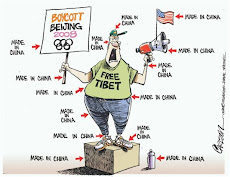
China Fails to Approve 77 Protest Applications

BEIJING: August 9th. (Associated Press) -- Chinese authorities have not approved any of the 77 applications they received from people who wanted to hold protests during the Beijing Olympics, state media reported. According to the rules governing protests, today is the last day anyone could apply for permission to demonstrate during the Olympic Games. The state-run New China News Agency said Monday that the applications received since Aug. 1, a week before the Games opened, included such things as labor disputes and inadequate welfare. But 74 of the applications were withdrawn because the problems "were properly addressed by relevant authorities or departments through consultations," the news agency said, citing an unidentified spokesman for the Public Security Bureau. Two other applications were suspended because they did not provide sufficient information and one was rejected because it violated laws against demonstrations and protests, the spokesman said.

Protests have become common in China, including workers upset about factory layoffs and farmers angry about land confiscation. But the Communist leadership remains wary about large demonstrations, fearing that they could snowball into anti-government movements. In July, China said protests would be allowed in three parks far from Games venues. But there were also rules: Applications with detailed paperwork had to be filed five days in advance and protests must not harm "national, social and collective interests." A response would be provided 48 hours before the requested rally time, officials promised. There have been no demonstrations in the designated areas since the Games started, though small unregulated protests have occurred in other parts of the city. Most have been conducted by foreigners who were swiftly deported after unfurling "Free Tibet" banners.
+++++++++++++++++++++++++++++++++++++++++++++++++++
Disclaimer
No responsibility or liability shall attach itself to either myself or to the blogspot ‘Mozlink’ for any or all of the articles/images placed here. The placing of an article does not necessarily imply that I agree or accept the contents of the article as being necessarily factual in theology, dogma or otherwise.
Mozlink

Saturday, February 23, 2008

China, in New Role, Presses Sudan on Darfur

A restaurant in Khartoum, Sudan’s capital, is among the signs of China’s active commercial and diplomatic role in the country. (Lynsey Addario for The New York Times)
KHARTOUM, Sudan: Feb. 23rd. (NY Times) — Amid the international outrage over the bloodshed in Darfur, frustration has increasingly turned toward China, Sudan’s biggest trading partner and international protector, culminating in Steven Spielberg’s decision last week to withdraw as artistic adviser to the Beijing Olympics. And it may be working. China has begun shifting its position on Darfur, stepping outside its diplomatic comfort zone to quietly push Sudan to accept the world’s largest peacekeeping force, diplomats and analysts say. It has also acted publicly, sending engineers to help peacekeepers in Darfur and appointing a special envoy to the region who has toured refugee camps and pressed the Sudanese government to change its policies. Few analysts expect China to walk away from its business ties to Sudan, but its willingness to take up the issue is a rare venture into something China swears it never does — meddle in the internal affairs of its trading partners. “China in my view has been very cooperative,” said Andrew S. Natsios, the former special envoy of President Bush to Sudan. “The level of coordination and cooperation has been improving each month.”

For all of China’s billion-dollar oil contracts, multimillion-dollar arms shipments and Security Council veto protection of Sudan, the global power with the biggest influence over the country has scarcely a dime invested here, has no ambassador on Sudanese soil and has slapped progressively tougher sanctions on its government: the United States. While conventional wisdom holds that the wars in Iraq and Afghanistan have sapped America’s prestige and power, especially in Muslim countries, the United States remains the gatekeeper to international respectability in the eyes of the Sudanese government, and its power to influence top officials here — through threats or inducements — remains unmatched, diplomats, Sudanese government officials and analysts say. “Coming to some sort of agreement with the United States is the Holy Grail of Sudanese politics,” said a senior Western diplomat in Khartoum, who was not authorized to speak publicly. “No one has been able to deliver it.” This holds true though Sudan is awash in investments from Asia and the gulf that would, in theory, allow the oil-rich but development-poor country to prosper more broadly than it has despite American opprobrium.

American approval and acceptance would transform Sudan in a way the billions of dollars from China, India, Malaysia, Iran and the gulf have been unable to: by opening the spigots of Western development aid and with it a deal to reduce its nearly $30 billion in external debt, along with technical assistance to manage the tide of money rushing in. “We are receiving billions of dollars in foreign investment that we are not even prepared to absorb,” said Ali al-Sadig, a senior diplomat and Sudanese government spokesman who worked on the China desk of Sudan’s Ministry of Foreign Affairs for many years. “We don’t have the capacity. We need Western expertise. Sudan wants, above all, a normal relationship with the United States and the West.” But the Bush administration seems divided on what to do about Darfur. On one hand, there is heavy pressure from advocacy groups, Congress and others to take a tough line with Sudan, stepping up sanctions and hammering the government over new attacks.

At the same time, because Sudan is a crucial ally of the United States in fighting terrorism, some in the administration argue that it cannot be allowed to become more isolated and further beyond the West’s orbit than it already is, diplomats and analysts say. Sudan’s relationship with the West has been troubled ever since Omar al-Bashir seized power in 1989 and embraced militant Islam, playing host to a variety of jihadists, including Osama bin Laden. The relationship hit its lowest in 1998 when the Clinton administration bombed a Khartoum pharmaceutical factory it claimed was producing chemical weapons, though the allegation has never been proved. After Sept. 11, Sudan reached out to the United States, realizing that it could find itself in the cross hairs of America’s military might just as Taliban-controlled Afghanistan and Iraq later did. The two countries have since cooperated on counterterrorism issues, even though Sudan remains on an American list of nations that sponsor terrorism. Mr. Bush sent John C. Danforth, the former Missouri senator, to help negotiate a deal to end the civil war in southern Sudan that had lasted two decades and claimed two million lives. Sudan had many reasons for wanting to end the war — its military was exhausted, and a stalemate was helping neither side — but the chance to improve relations with the United States was a big inducement for Sudan’s government. Then “Darfur happened,” the diplomat said.

At first, the conflict in Darfur seemed a fly in the ointment, a distraction from the main work of securing peace between the north and south. But five years later, the Darfur crisis is undermining the peace agreement and threatens to tear Sudan apart. More than 200,000 have died in Darfur, according to international estimates, and 2.5 million have been pushed into camps here and in Chad, sowing chaos in one of the world’s poorest regions. Sudan’s government says the toll has been greatly exaggerated. The conflict has also inspired one of the largest protest movements in the United States since the battle to end apartheid in South Africa. China, with its vast commercial interests and sensitivity to criticism around the Olympics, presents a unique leverage point for this movement. Like Mr. Spielberg, Mia Farrow, an actress and Darfur activist, has said China can do more, specifically by pushing for the full deployment of 27,000 peacekeeping troops in Darfur, supplying some of the helicopters needed for the mission and demanding an end to aerial bombardment of civilian areas. But some diplomats and analysts argue that offering concessions, not demands — a chance to come off the state sponsor of terrorism list or easing sanctions — may offer the best opportunity to get Sudan’s government to strike a deal in Darfur.

There are grave risks to that strategy, not least of which is that Sudan’s government has a history of making agreements and not fully putting them in place. “What this government responds to is pressure,” Jerry Fowler, executive director of the Save Darfur Coalition, said of Sudan’s leaders. As a senior Western diplomat in Khartoum put it, the West’s stance on Sudan must be “mistrust but verify,” a twist on Reagan’s posture on the Soviet Union. Furthermore, the Sudanese government is far from unanimous in its craving for international respectability. The small cadre who have ruled this country since the National Islamic Front seized power in a coup in 1989 have tried a variety of guises — radical Islamism, Arab nationalism and garden variety despotism — in their quest to hang on to power. The relative moderates who were crucial to negotiating a deal with the south have been largely sidelined, and analysts and diplomats say that hard-liners in the military and elsewhere are increasingly less interested in Western ties.

As for China, analysts warn, there are limits to how far it will go. Olympics or no, China’s leadership simply has too much at stake in Sudan. “Their political fortunes are tied to their ability to deliver a constant stream of economic goods at home,” said Christopher Alden, a senior lecturer at the London School of Economics who has studied China-Africa relations. “They can’t say, ‘O.K., we have sunk billions over the long term in Sudan and we are just going to walk away from it because of Darfur.’ It is just not going to happen.” China, along with Iran, Russia and others, is still selling weapons to Sudan. While China says it is abiding by a United Nations embargo on sending weapons directly to Darfur, an analysis of shell casings and vehicles found in Darfur by a panel of United Nations experts found that Chinese weapons were making their way to Darfur. Fractures among the rebel groups in Darfur and threats from Sudan’s neighbors, like Chad, may have more impact on the quest for peace than anything Washington or Beijing does. Still, John Prendergast, a former Clinton administration official, advocate and writer on Sudan for two decades, said that China and the United States needed to be engaged. “Unless China and the U.S. are both exerting much more pressure on Sudan, the crisis will continue to spiral out of control,” he said in an e-mail message. “China has unique economic leverage, while the U.S. retains leverage based on its ability to confer or withdraw legitimacy.”
By Lydia Polgreen
+++++++++++++++++++++++++++++++++++++++++++++++++++
Disclaimer
No responsibility or liability shall attach itself to either myself or to the blogspot ‘Mozlink’ for any or all of the articles/images placed here. The placing of an article does not necessarily imply that I agree or accept the contents of the article as being necessarily factual in theology, dogma or otherwise.
Mozlink

Thursday, February 14, 2008

Spielberg Drops Out as Adviser to Beijing Olympics in Dispute Over Darfur Conflict

WASHINGTON, Feb. 13th. (NY Times) - Steven Spielberg said Tuesday that he was withdrawing as an artistic adviser to the 2008 Summer Olympics in Beijing, after almost a year of trying unsuccessfully to prod President Hu Jintao of China to do more to try to end Sudan’s attacks in the darfur region. Mr. Spielberg’s decision, and the public way he announced it, is a blow to China, which has said that its relationship with Sudan should not be linked to the Olympics, which have become a source of national pride. “Sudan’s government bears the bulk of the responsibility for these ongoing crimes but the international community, and particularly China, should be doing more to end the continuing human suffering there,” the statement said. “China’s economic, military and diplomatic ties to the government of Sudan continue to provide it with the opportunity and obligation to press for change.” Responding to Mr. Spielberg’s action, a spokesman at the Chinese Embassy in Washington said, “As the Darfur issue is neither an internal issue of China nor is it caused by China, it is completely unreasonable, irresponsible and unfair to link the two as one.” Mr. Spielberg had written to Mr. Hu about Darfur twice in the past 10 months, his spokesman said, taking China to task for its “silence” while Sudan blocked the deployment of international peacekeepers and expelled aid workers from the region.

In September, Mr. Spielberg also met with China’s special envoy to Darfur at the Chinese mission to the United Nations, said Mr. Spielberg’s spokesman, Andy Spahn. None of those efforts yielded the results Mr. Spielberg wanted, Mr. Spahn said. In the meantime, Mr. Spielberg had come under increasing pressure from advocates working on Darfur, including a campaign by the actress mia Farrow, to drop his association with the Beijing Olympics. After receiving word that Mr. Spielberg had done just that, Ms. Farrow was jubilant. “His voice and all of the moral authority it gives, used this way, brings a shred of hope to Darfur, and God knows, rations of hope are meager at this time,” said Ms. Farrow, a good-will ambassador for the Unicef who helped start a campaign last year to label the Games in Beijing the “Genocide Olympics.” The actor Don Cheadle, a co-founder of Not On Our Watch, a Darfur advocacy group, said he hoped that Mr. Spielberg’s actions would force China to rethink its position. “One guy like Steven in a position like that is like 100 other guys,” he said. “Those are the kinds of moves, that if they catch fire, and other people think of boycotting, or refraining, the cumulative effect could be something that potentially could change the calculation of that government.”

Mr. Spahn said Mr. Spielberg planned to encourage others to do more to pressure China on Darfur, but he did not offer details. Advocates said they hoped to enlist help from corporate sponsors of the Olympics. China has fought attempts to link Darfur to the Olympics, but it has also responded at times to the pressure. Last year, shortly after Mr. Spielberg’s first letter to Mr. Hu, China dispatched a senior official to Sudan to push the government to accept a peacekeeping force and appointed a special envoy. But the Sudanese military has continued its attacks there, as recently as last week.
By Helene Cooper. David M. Halbfinger contributed reporting from Los Angeles.
+++++++++++++++++++++++++++++++++++++++++++++++++++
Disclaimer
No responsibility or liability shall attach itself to either myself or to the blogspot ‘Mozlink’ for any or all of the articles/images placed here. The placing of an article does not necessarily imply that I agree or accept the contents of the article as being necessarily factual in theology, dogma or otherwise.
Mozlink

Friday, August 17, 2007

KOUDJIWAI, Chad — The small plane flew in low over a scorched, peppercorn scrubland, following a broad, muddy river that was all elbows on its run to the southeast. A young man selling expensive imported gasoline in Ndjamena, Chad’s capital, where little oil revenue has reached the people. The first hint of humanity came with the appearance of an immense grid for seismic testing, laboriously traced through the brush. Finally, a lonely, hulking steel drilling platform popped into view. Chad is as geographically isolated as places come in Africa. It is also among the continent’s poorest and least stable countries, the scene of recurrent civil wars and foreign invasions since it gained independence from France in 1960. None of that has put off the Chinese, though. In January, they bought the rights to a vast exploration zone that surrounds this rural village, making the baked wilderness here, without roads, electricity or telephones, the latest frontier for their thirsty oil industry and increasingly global ambitions. The same is happening in one African country after another. In large oil-exporting countries like Angola and Nigeria, China is building or fixing railroads, and landing giant exploration contracts in Congo and Guinea.

In mineral-rich countries that had been all but abandoned by foreign investors because of unrest and corruption, Chinese companies are reviving output of cobalt and bauxite. China has even become the new mover and shaker in agricultural countries like Ivory Coast, once the crown jewel in France’s postcolonial African empire, where Chinese companies are building a new capital, in Yamoussoukro, paid for by Chinese loans. Surging Chinese interest in this continent has helped bring about what many Africans believe is the most important moment since the end of the cold war, when democracy was spreading in Africa and Western nations spoke of a “peace dividend” that might ease African poverty. That blush of interest in Africa quickly faded, though, as did several of the new democracies, and Africans and Westerners have regarded each other warily ever since. Westerners complain about chronic corruption and ineffective government, while Africans lament broken promises on aid and a hostile international economic system. The Chinese have stepped into this picture, coming to struggling countries like Chad with deep pockets, fewer demands on how African governments should behave and an avowed faith in everyone’s ability to prosper. As Beijing’s ambassador to this country, Wang Yingwu, said at his residence in Ndjamena, Chad’s capital, where the electricity repeatedly failed, “We are exempting Chadian goods from import duties.” When the interviewer noted that Chad produced almost nothing besides oil, Mr. Wang was undaunted, saying, “If they don’t produce things today, they will tomorrow.”

To help make that happen, China plans to build the country’s first oil refinery, lay new roads, provide irrigation and erect a mobile telephone network, for starters. With such intensive efforts across the continent, China’s trade with Africa topped $55 billion in 2006, up from less than $10 million in the 1980s. To achieve this growth, it has bypassed multinational institutions like the World Bank and the International Monetary Fund and flouted many of their lending criteria, including minimum standards of transparency, open bidding for contracts, environmental impact studies and assessments of overall debt and fiscal policies. In some ways, the new Chinese model of doing business in Africa is a throwback to an earlier era of Western involvement that is now widely seen as disastrous. In that era, borrowing countries typically had to work with companies from the lending nation, limiting competition and giving priority to business over development. Today, China takes things even further, signing long-term deals for rights to natural resources that allow countries otherwise unworthy of credit to repay their debt in oil or mineral output. “In what manner has Africa progressed, in what sector?” said the Chadian president, Idriss Déby, referring to decades of close ties to the West. “Whatever the good will of Africa’s old friends and the old partners in its development, it has not progressed at all.” Still, major doubts hang heavily in the air. Will China’s hunger for raw materials enable this continent to take off? Or will Beijing’s willingness to spend whatever it needs in Africa, without regard to fiscal prudence, democracy, honest business practices and human rights, produce a replay of booms past, enriching local elites but leaving the continent poorer, its environment despoiled and its natural resources depleted?

+++++++++++++++++++++++++++++++++++++++++++++++++++
Disclaimer
No responsibility or liability shall attach itself to either myself or to the blogspot ‘Mozlink’ for any or all of the articles/images placed here. The placing of an article does not necessarily imply that I agree or accept the contents of the article as being necessarily factual in theology, dogma or otherwise. Mozlink