Showing posts with label Sudan. Show all posts

Monday, July 28, 2008

Sudan Rallies Behind Leader Reviled Abroad

Sadiq al-Mahdi, in Khartoum, Sudan, on Sunday, now supports the man who ousted him from power, Omar Hassan al-Bashir. (Joao Silva for The New York Times)
KHARTOUM, Sudan: July 28th. — President Omar Hassan al-Bashir of Sudan has been accused by the prosecutor of the International Criminal Court of genocide and vilified the world over as an incorrigible mass murderer bent on slaughtering his own people in Darfur. But inside Sudan, his grip on power seems, for the moment, to be surer than ever. In the past few weeks, one sworn political enemy after another has closed ranks behind him. A result has been a swift and radical reordering of the fractious political universe in Sudan, driven in part by national pride but also by deep-seated fears that the nation could tumble into Somalia-like chaos if Mr. Bashir were removed as president. The Sudanese government, joined by many of its onetime foes who see the court’s looming arrest warrant as a mortal threat to the country, is scrambling to determine exactly how much it needs to concede to survive.

One previously unthinkable proposal being discussed is whether the government should arrest two men accused of orchestrating the campaign of rape, murder and pillage in Darfur that has left about 300,000 dead and scattered 2.5 million people from villages reduced to circles of ash. The two men, Ahmad Harun, the former interior minister, and Ali Kushayb, a militia leader, face arrest warrants issued by the international court for crimes against humanity. But the government has refused to turn them over. Sudanese officials say they hope that putting the two men on trial in Sudan might persuade the UN Security Council to exercise its power to suspend the case against Mr. Bashir. “Everything short of the presidency is on the table,” said Sudan’s foreign minister, Deng Alor. Although the West has been relentlessly focused on Darfur, here in Sudan, most people view the crisis as simply a continuation of a long chain of internal conflicts between an autocratic government and the deeply impoverished people on the periphery. The deadliest of these conflicts, between the north and south, raged for decades, killing 2.2 million people — many more than the lives lost in Darfur — and threatened to split the country along religious lines.

Sudan has been at war with itself for almost its entire post-colonial history, starting in 1956. Nearly all of the major ethnic and religious groups have fought one another, and politics continue to be dominated by mistrust, outside interference and combustible animosities. There are dozens of armed groups across the country, each with its own political agenda. One growing concern is that without Mr. Bashir, a peace treaty signed in 2005 between Sudan’s central government and southern rebels could fall apart. The treaty, which he fought hard-liners in his own party to approve, is widely seen as the glue that is holding this unwieldy and deeply divided country together. It calls for elections next year and outlines ways to share wealth and power. “The situation in Sudan now is so pregnant with trouble,” said Sadiq al-Mahdi, Sudan’s last elected leader, who was overthrown by Mr. Bashir in 1989 and has remained a bitter opponent ever since. Until now. After the warrant was announced, Mr. Mahdi threw the support of the party he leads, one of Sudan’s biggest, behind Mr. Bashir, at least for the moment.

Luis Moreno-Ocampo, the prosecutor of the international criminal court, or I.C.C., has described Mr. Bashir as the mastermind of a genocide in Darfur. But here on the sun-blasted streets of Sudan’s capital, Mr. Bashir is widely perceived as a relative moderate. “He is a pigeon, not a hawk,” said Ghazi Suleiman, a human rights lawyer who has been jailed 18 times by the Bashir government. Half of Mr. Suleiman’s face is paralyzed as a result of torture at the hands of the country’s notorious security forces. Nevertheless, he opposes any attempt to charge Mr. Bashir with war crimes now. From the perspective of many Sudanese political leaders, the I.C.C. move could not have come at a worse time. A lightning-fast attack on the capital by a Darfur rebel group in May rattled the ruling National Congress Party. Hundreds of heavily armed rebels from an Islamist Darfur rebel faction thundered into the capital’s outskirts. They were repulsed, but the assault exposed gaps in the government’s aura of military invincibility. “It just showed how the army is stretched to the limits,” said Ghazi Salah al-Din, a top adviser to Mr. Bashir, in a rare admission of vulnerability by a senior ruling party official. A week later, new fighting between the national army and a former rebel force in the disputed oil-rich area of Abyei forced more than 50,000 to flee and sparked fears of a new round of bloodletting. “A lot of the political entities looked into the abyss and were scared,” said a senior Western diplomat in Khartoum, speaking anonymously because he is not authorized by his government to speak publicly. A number of nightmare scenarios — an implosion of the government that might invite Al Qaeda back into Sudan or embolden rebel groups to try to topple the government — forced political elites in Sudan to choose sides. Most have chosen, for now, to stick with Mr. Bashir. “These are frail and critical moments in our history,” said James Morgan, a spokesman for the Sudan People’s Liberation Movement, the rebel group that signed the Comprehensive Peace Agreement ending the north-south war. Mr. Bashir, he said, should be given “ample time to implement these agreements.”

The international court’s announcement also came as there were signs that the country was taking its first steps toward democracy after years of autocratic rule. The National Assembly had just passed a new electoral law, which would set up rules for the country’s first free elections in more than 20 years. “The country was preparing itself for a new phase of government,” said Mr. Salah al-Din. Mr. Salah al-Din acknowledged that “mistakes had been made in Darfur,” and said that the coming political transformation would, through elections, deal with the roots of the crisis — political marginalization. The north-south war had always been viewed as the biggest threat to Sudan. But in 2003, as negotiations to end that conflict dragged on, a new rebel group rose up in Darfur to demand a greater share of wealth and power for the long-neglected western region. The government responded with the same ruthless tactics it used in the south, unleashing Arab militias to chase the rebels and their supporters from Darfur’s villages. The terror they caused aroused outrage across the world; the Bush administration called the killings genocide. The crisis came to dominate Western policy toward Sudan, often at the expense of the larger struggle to keep the north-south deal alive.

But diplomats, aid workers and analysts who have traveled to the region recently say things have changed in Darfur. The conflict has become a violent free-for-all in which a bewildering cast of rebels, bandits and militias murder each other and civilians largely unchecked by government authority. “The government is brutal, untrustworthy and bloodthirsty, but the reality is that most of the violence in Darfur today is not caused by them,” the senior Western diplomat said. “Is there a genocide in Darfur right at this moment? No, there isn’t.” Mr. Bashir’s tour of Darfur last week was short on proposals to jump start a peace process, but a panel led by Mr. Mahdi and other political leaders has been charged with finding a way to defuse the crisis. The government sent an official to Qatar to ask the government there, which helped negotiate a settlement to Lebanon’s most recent crisis, to contribute $500 million for the compensation of Darfur’s victims. The government and its new allies are hoping that if they can provide evidence of progress in Darfur and persuade the international community that an arrest warrant would create more problems than it would solve, the Security Council will act to hold back the criminal court.

Salih Mahmoud Osman, a Darfur lawyer who has documented thousands of human rights violations in Darfur, said the court represented the only chance for victims to get justice. In a recent interview, he wept as he described the painful process of collecting testimony from rape victims. “They told us, ‘Our suffering must be documented,’ ” he said, hiding his face with his hands to cover his tears. “ ‘Our story is not forgotten. You are putting criminals on the record. If not today, tomorrow we will have justice.’ And now it has happened.” In any case, Mr. Bashir’s newfound popularity among Sudan’s political elite is likely to be short lived. If the arrest warrant is issued, analysts and diplomats said, all bets are off. “He could end up very weak to challenges from inside and outside the ruling party,” a senior UN official in Khartoum said. The government has responded so far to the court’s action with diplomacy and public relations, not violence. It has agreed to allow the delivery of hundreds of containers of United Nations supplies held up in Sudan’s port, and to make visas and permits for aid workers easier to get. “We’ve been receiving very strong messages of cooperation” from the government, said Ameerah Haq, the top United Nations aid official in Sudan. Mr. Alor, the foreign minister, said the threat of an arrest warrant may prove to be a blessing in disguise. “Now we are seriously talking about the resolution of the problem of Darfur,” he said, adding that the government was also considering ways to cooperate with the peacekeeping force in Darfur that it long resisted. “If we take the I.C.C. from that angle, it can be a blessing for the whole country.”
By Lydia Polgreen and Jeffrey Gettleman
+++++++++++++++++++++++++++++++++++++++++++++++++++
Disclaimer
No responsibility or liability shall attach itself to either myself or to the blogspot ‘Mozlink’ for any or all of the articles/images placed here. The placing of an article does not necessarily imply that I agree or accept the contents of the article as being necessarily factual in theology, dogma or otherwise.
Mozlink

Thursday, July 10, 2008

Peacekeepers in Sudan Lose 7 in Ambush

DAKAR, Senegal, July 10th. (NY Times) — Seven international peacekeepers were killed and 22 wounded in a brazen day ambush by heavily armed men in trucks and on horseback in the Sudanese province of Darfur, United Nations officials said Wednesday. The attack, on Tuesday, was the deadliest on international forces in Darfur since September 2007, when 10 peacekeepers were killed in an assault on a base, and was a severe blow to the combined United Nations and African Union peacekeeping force that has struggled to protect civilians and itself. About 200 men in 40 trucks descended on a convoy of peacekeeping soldiers and police officers about 60 miles east of their base in El Fasher, the regional capital, as they returned from patrol. They had been investigating allegations of abuses by a rebel faction allied with the government. The militiamen had heavy weapons, including antiaircraft and antitank guns mounted on their trucks, and a fierce firefight raged for three hours. The peacekeepers took heavy casualties. Five Rwandan soldiers were killed, with police officers from Uganda and Ghana, a United Nations official in Sudan said. Officials did not say who was responsible for the attack, and it has become increasingly difficult to determine who is who in the kaleidoscope of rebel movements and militia groups vying to control Darfur.

The conflict began five years ago as an uprising of non-Arab ethnic groups against the Arab-dominated government in Khartoum. But as the rebel groups and Arab militias have splintered and alliances have formed and faded, the Darfur region has become increasingly lawless and chaotic. “It is just a free-for-all,” said a Western aid official in Sudan, speaking on the condition of anonymity because aid workers have faced retribution for talking publicly about the conditions in Darfur. “Security simply doesn’t exist.” Attacks on aid workers by rebels, militia and bandits have been on the rise, and aid workers in the region say it is increasingly difficult to provide even the basics to the millions of needy civilians. Rising food and fuel prices have made it harder still to help the 2.7 million people displaced by the conflict in Sudan and neighboring Chad. The United Nations estimates that 300,000 people have died from violence, hunger and disease since the conflict began.

The new joint peacekeeping force, which took over from the African Union in January and was approved by Sudan after extensive negotiations, was supposed to help protect civilians from harm. But despite its goal of 26,000 troops, it has little more than a third of that number, most of whom are former members of the African Union force. The soldiers simply painted their green helmets blue. Further deployments have been stymied by logistical and political problems and stonewalling by the Sudanese government, United Nations and aid officials said. The prospects of a political solution to the Darfur crisis look equally grim.

The part-time United Nations and African Union mediators who had sought in vain to jump-start the peace process resigned in frustration last month over lack of progress and have been replaced by a full-time mediator for both organizations. But with the rebel groups fractured and unwilling to unite to seek a settlement to the crisis, peace seems more distant than ever. “The peace process is going nowhere,” said Alex de Waal of the Social Science Research Council in New York. “There is absolutely no incentive for either side to make a move.”
By LYDIA POLGREEN
+++++++++++++++++++++++++++++++++++++++++++++++++++
Disclaimer
No responsibility or liability shall attach itself to either myself or to the blogspot ‘Mozlink’ for any or all of the articles/images placed here. The placing of an article does not necessarily imply that I agree or accept the contents of the article as being necessarily factual in theology, dogma or otherwise.
Mozlink

Tuesday, March 25, 2008

Peacekeeping in Darfur Hits More Obstacles


Poorly equipped Nigerian peacekeepers riding last month in a pickup through a camp in Genina in western Darfur for Sudanese civilians displaced by violence. (Lynsey Addario)
ABU SUROUJ, Sudan: Mar. 24th. (NY Times) — As Darfur smolders in the aftermath of a new government offensive, a long-sought peacekeeping force, expected to be the world’s largest, is in danger of failing even as it begins its mission because of bureaucratic delays, stonewalling by Sudan’s government and reluctance from troop-contributing countries to send peacekeeping forces into an active conflict. Poorly equipped Nigerian peacekeepers riding last month in a pickup through a camp in Genina in western Darfur for Sudanese civilians displaced by violence. The force, a joint mission of the United Nations, officially took over from an overstretched and exhausted African Union force in Darfur on Jan. 1. It now has just over 9,000 of an expected 26,000 soldiers and police officers and will not fully deploy until the end of the year, United Nations officials said. Even the troops that are in place, the old African Union force and two new battalions, lack essential equipment, like sufficient armored personnel carriers and helicopters, to carry out even the most rudimentary of peacekeeping tasks. Some even had to buy their own paint to turn their green helmets United Nations blue, peacekeepers here said.

The peacekeepers’ work is more essential than ever. At least 30,000 people were displaced last month as the government and its allied militias fought to retake territory held by rebel groups fighting in the region, according to United Nations human rights officials. For weeks after the attacks, many of the displaced were hiding in the bush nearby or living in the open along the volatile border between Sudan and Chad, inaccessible to aid workers. Most wanted to return to their scorched villages and rebuild but did not feel safe from roaming bandits and militias. A week spent this month with the peacekeeping troops based here at the headquarters of Sector West, a wind-blown outpost at the heart of the recent violence, revealed a force struggling mightily to do better than its much-maligned predecessor, but with little new manpower or equipment. Despite this, the force is managing to project a greater sense of security for the tens of thousands of vulnerable civilians in the vast territory it covers, mounting night patrols in displaced people’s camps and sending long-range patrols to the areas hardest hit by fighting. But these small gains are fragile, and if more troops do not arrive soon, the force will be written off as being as ineffective and compromised as the one before. “We really don’t have much time to prove we can do better,” said Brig. Gen. Balla Keita, the Senegalese commander of the roughly 2,000 troops in West Darfur, just one-third of the expected total for the area. “God gave the prophets the ability to achieve miracles so that people would believe. So people here will believe when they see improvements on the ground. And that cannot wait for more troops. We need to do better with what we have.”

The deployment of the biggest peacekeeping force in modern history in one of the most remote, hostile and forbidding corners of the globe was bound to be a logistical nightmare. Darfur is landlocked, water is scarce, the roads are rutted tracks crossed by the mud and sand traps of dry riverbeds. But those problems pale in comparison with the diplomatic and political struggles the mission faces. When previous large missions were organized in Congo, Liberia and Sierra Leone, the central governments in those countries had collapsed or were so weak that they had little choice but to accept peacekeepers. The government of Sudan agreed to accept United Nations-led peacekeepers in Darfur only after a long diplomatic tussle and under a great deal of pressure. The progress to get the mission in place has been slow, and much of the blame for this has been placed at the feet of the Sudanese government. For months after the UN Security Council approved the force, Sudan insisted on limits on its makeup and independence, demanding the power to dictate which countries contributed troops, to shut down its communication systems when the government carried out offensives and to restrict the movement of peacekeepers at night.

Ultimately, the government signed a compromise agreement with the United Nations allowing the force to operate, but Sudan was successful in insisting that the vast majority of troops come from African countries, and will be supplemented by soldiers from other regions only if suitable African troops cannot be found. This has delayed the force’s mission, because African armies are not usually able to deploy quickly with equipment and training to meet stringent United Nations standards, United Nations officials and Western diplomats said. Sudanese government officials have argued that African troops are up to the job, and that non-African troops would be seen as neocolonial interlopers. These problems have raised fears that the United Nations force would suffer the same fate as the African Union force, which was hobbled from the start by a weak mandate, which was to observe a cease-fire, not protect civilians. The thousands of troops deployed by Rwanda, Nigeria, Senegal and other nations were mainly there to protect the military observers, who were unarmed, and the unarmed civilian police, whose job it was to guard the camps for the internally displaced people. But the original cease-fire was quickly violated, and later agreements failed to bring peace. The African troops soon were seen, perhaps unfairly, as useless note-takers who visited the scene of atrocities long after the evidence had been carried off and the dead buried, gathering testimony that seemed to disappear into a bureaucratic black hole.

All of that has changed with the new hybrid mission. The force has a robust mandate to protect civilians. But that is easier said than done, said Maj. Sani Abdullahi, the man in charge of the single company charged with fending off roaming militias and rebels to protect tens of thousands of displaced villagers in a handful of camps and thousands more vulnerable residents of remote villages. One Sunday morning, Major Abdullahi, 34, a wiry Nigerian officer who served in peacekeeping operations in Sierra Leone and Liberia, led a few truckloads of troops to visit Abu Sorouj, one of the towns flattened by a recent government offensive in West Darfur. The town is just a few dozen miles away, but the drive took three bone-crunching hours. Abu Sorouj was attacked nearly a month earlier, and most of the villagers had fled, some to Chad. They said they were blocked by the Chadian authorities from reaching refugee camps. So within days, some were returning, afraid of losing their land if they became long-term displaced people living in camps. Before the attack, Abu Sorouj was a bustling town of hundreds of mud-brick huts roofed with thatch, clumped together in sprawling family compounds. It had a cinder-block school and clinic supported by a nongovernmental aid agency.

Today, it is an apocalyptic scene of ashy ruin. The residents who have returned salvaged what they could, sifting through the blackened rubble to find cooking pots, bedsteads and buried troves of grain. Fadila Ahmed Mahamat, a great-grandmother whose legs are withered stalks, sat amid the charred ruins of her home, digging holes in the sand with bare, gnarled hands to construct the frame of a makeshift dwelling out of branches from a pen that had been used to keep sheep. “Everything is gone,” she said. “I have nothing.” Surveying the scene, Major Abdullahi let out a low whistle. “My God,” he said. “Look at this.” A few of the town’s sheiks remained, and they clamored to tell him their complaints. Arab gunmen, whom the villagers here call janjaweed, roam the edge of town, they told Major Abdullahi, coming at dawn and dusk to steal what little remained here. The women could not go to the river to collect water. The men could not leave the town to find big branches to build shelters. “We need security,” one said. “Why don’t you patrol more often?” another asked. “When you come, the janjaweed stay away for two or three days.” Major Abdullahi told them: “We don’t have the number of troops on ground we need. As soon as we do, we will spread out. We are doing everything we can to make you feel more secure.” All talk ceased as a pickup truck loaded with government soldiers drove up. An officer jumped out, smiling with an outstretched hand. But his smile was tense, and after some pleasantries he asked why the peacekeepers had come. “The place is secure,” said the officer, Maj. Amar Ibrahim. “Even the Arabs who ride on camels and horses and harass people, we have patrols to chase them away.” Major Abdullahi smiled and nodded. “We really appreciate that and commend your efforts,” he said through an interpreter. “But we really need to ask you to do more. People still do not feel safe.”

Despite the agreement giving the peacekeepers free rein, government troops complain about their presence. Major Abdullahi said he must be careful not to alienate these troops because he must rely on them to help provide security. “The reality is we need to work with them,” he said. “It does no good to antagonize them.” Major Abdullahi checked his watch. It was noon, and already he had to think about heading back. The armored personnel carriers, which had been provided to the African Union by the Canadian government and had been battered by years of abuse in Darfur’s harsh conditions, were already acting up. Two flat tires and engine trouble had made the journey to Abu Sorouj slow. But he could not risk being stuck on the way back. He promised the sheiks that he would return soon, but he could not say for sure how soon that might be.

It is unclear how exactly the deployment of troops in Darfur can be speeded up, give the built-in constraint that African troops be used first. Western activists concerned about Darfur say the Sudanese government is primarily responsible and have demanded that China, Sudan’s main trading partner and one of its suppliers of weapons, join other countries to press Sudan to allow troops of any origin the troops to deploy quickly. While the Sudanese government has been blamed for some of the delay, United Nations requirements have also slowed the force, some diplomats and political analysts say. The deployment “is not principally being delayed by the Sudanese government,” said a senior Western diplomat in Khartoum, Sudan’s capital, who is not authorized to speak publicly. Other problems, like the United Nations bureaucracy and the reluctance of troop-contributing countries, were as much to blame, the diplomat said.

There is certainly no lack of money. Rodolphe Adada, of the Congo Republic, the mission’s civilian chief, said the force had a budget of $1.7 billion. What it needs is troops and equipment, and neither has been easy to get. More pressure on the Sudanese government, he said, would not help matters. “What more pressure can be put on the Sudanese government,” he said. “All the decisions have been taken. There is nothing left to say. What we need to do is act.” Some countries are reluctant to commit troops in an active conflict with no peace agreement or even a working cease-fire. “The international community had two choices — get a peace accord and deploy the mission after, or send the mission anyway,” Mr. Adada said. “It chose the latter. But how do you keep the peace when there is no peace to keep?”
By Lydia Polgreen
+++++++++++++++++++++++++++++++++++++++++++++++++++
Disclaimer
No responsibility or liability shall attach itself to either myself or to the blogspot ‘Mozlink’ for any or all of the articles/images placed here. The placing of an article does not necessarily imply that I agree or accept the contents of the article as being necessarily factual in theology, dogma or otherwise.
Mozlink

Saturday, February 23, 2008

China, in New Role, Presses Sudan on Darfur

A restaurant in Khartoum, Sudan’s capital, is among the signs of China’s active commercial and diplomatic role in the country. (Lynsey Addario for The New York Times)
KHARTOUM, Sudan: Feb. 23rd. (NY Times) — Amid the international outrage over the bloodshed in Darfur, frustration has increasingly turned toward China, Sudan’s biggest trading partner and international protector, culminating in Steven Spielberg’s decision last week to withdraw as artistic adviser to the Beijing Olympics. And it may be working. China has begun shifting its position on Darfur, stepping outside its diplomatic comfort zone to quietly push Sudan to accept the world’s largest peacekeeping force, diplomats and analysts say. It has also acted publicly, sending engineers to help peacekeepers in Darfur and appointing a special envoy to the region who has toured refugee camps and pressed the Sudanese government to change its policies. Few analysts expect China to walk away from its business ties to Sudan, but its willingness to take up the issue is a rare venture into something China swears it never does — meddle in the internal affairs of its trading partners. “China in my view has been very cooperative,” said Andrew S. Natsios, the former special envoy of President Bush to Sudan. “The level of coordination and cooperation has been improving each month.”

For all of China’s billion-dollar oil contracts, multimillion-dollar arms shipments and Security Council veto protection of Sudan, the global power with the biggest influence over the country has scarcely a dime invested here, has no ambassador on Sudanese soil and has slapped progressively tougher sanctions on its government: the United States. While conventional wisdom holds that the wars in Iraq and Afghanistan have sapped America’s prestige and power, especially in Muslim countries, the United States remains the gatekeeper to international respectability in the eyes of the Sudanese government, and its power to influence top officials here — through threats or inducements — remains unmatched, diplomats, Sudanese government officials and analysts say. “Coming to some sort of agreement with the United States is the Holy Grail of Sudanese politics,” said a senior Western diplomat in Khartoum, who was not authorized to speak publicly. “No one has been able to deliver it.” This holds true though Sudan is awash in investments from Asia and the gulf that would, in theory, allow the oil-rich but development-poor country to prosper more broadly than it has despite American opprobrium.

American approval and acceptance would transform Sudan in a way the billions of dollars from China, India, Malaysia, Iran and the gulf have been unable to: by opening the spigots of Western development aid and with it a deal to reduce its nearly $30 billion in external debt, along with technical assistance to manage the tide of money rushing in. “We are receiving billions of dollars in foreign investment that we are not even prepared to absorb,” said Ali al-Sadig, a senior diplomat and Sudanese government spokesman who worked on the China desk of Sudan’s Ministry of Foreign Affairs for many years. “We don’t have the capacity. We need Western expertise. Sudan wants, above all, a normal relationship with the United States and the West.” But the Bush administration seems divided on what to do about Darfur. On one hand, there is heavy pressure from advocacy groups, Congress and others to take a tough line with Sudan, stepping up sanctions and hammering the government over new attacks.

At the same time, because Sudan is a crucial ally of the United States in fighting terrorism, some in the administration argue that it cannot be allowed to become more isolated and further beyond the West’s orbit than it already is, diplomats and analysts say. Sudan’s relationship with the West has been troubled ever since Omar al-Bashir seized power in 1989 and embraced militant Islam, playing host to a variety of jihadists, including Osama bin Laden. The relationship hit its lowest in 1998 when the Clinton administration bombed a Khartoum pharmaceutical factory it claimed was producing chemical weapons, though the allegation has never been proved. After Sept. 11, Sudan reached out to the United States, realizing that it could find itself in the cross hairs of America’s military might just as Taliban-controlled Afghanistan and Iraq later did. The two countries have since cooperated on counterterrorism issues, even though Sudan remains on an American list of nations that sponsor terrorism. Mr. Bush sent John C. Danforth, the former Missouri senator, to help negotiate a deal to end the civil war in southern Sudan that had lasted two decades and claimed two million lives. Sudan had many reasons for wanting to end the war — its military was exhausted, and a stalemate was helping neither side — but the chance to improve relations with the United States was a big inducement for Sudan’s government. Then “Darfur happened,” the diplomat said.

At first, the conflict in Darfur seemed a fly in the ointment, a distraction from the main work of securing peace between the north and south. But five years later, the Darfur crisis is undermining the peace agreement and threatens to tear Sudan apart. More than 200,000 have died in Darfur, according to international estimates, and 2.5 million have been pushed into camps here and in Chad, sowing chaos in one of the world’s poorest regions. Sudan’s government says the toll has been greatly exaggerated. The conflict has also inspired one of the largest protest movements in the United States since the battle to end apartheid in South Africa. China, with its vast commercial interests and sensitivity to criticism around the Olympics, presents a unique leverage point for this movement. Like Mr. Spielberg, Mia Farrow, an actress and Darfur activist, has said China can do more, specifically by pushing for the full deployment of 27,000 peacekeeping troops in Darfur, supplying some of the helicopters needed for the mission and demanding an end to aerial bombardment of civilian areas. But some diplomats and analysts argue that offering concessions, not demands — a chance to come off the state sponsor of terrorism list or easing sanctions — may offer the best opportunity to get Sudan’s government to strike a deal in Darfur.

There are grave risks to that strategy, not least of which is that Sudan’s government has a history of making agreements and not fully putting them in place. “What this government responds to is pressure,” Jerry Fowler, executive director of the Save Darfur Coalition, said of Sudan’s leaders. As a senior Western diplomat in Khartoum put it, the West’s stance on Sudan must be “mistrust but verify,” a twist on Reagan’s posture on the Soviet Union. Furthermore, the Sudanese government is far from unanimous in its craving for international respectability. The small cadre who have ruled this country since the National Islamic Front seized power in a coup in 1989 have tried a variety of guises — radical Islamism, Arab nationalism and garden variety despotism — in their quest to hang on to power. The relative moderates who were crucial to negotiating a deal with the south have been largely sidelined, and analysts and diplomats say that hard-liners in the military and elsewhere are increasingly less interested in Western ties.

As for China, analysts warn, there are limits to how far it will go. Olympics or no, China’s leadership simply has too much at stake in Sudan. “Their political fortunes are tied to their ability to deliver a constant stream of economic goods at home,” said Christopher Alden, a senior lecturer at the London School of Economics who has studied China-Africa relations. “They can’t say, ‘O.K., we have sunk billions over the long term in Sudan and we are just going to walk away from it because of Darfur.’ It is just not going to happen.” China, along with Iran, Russia and others, is still selling weapons to Sudan. While China says it is abiding by a United Nations embargo on sending weapons directly to Darfur, an analysis of shell casings and vehicles found in Darfur by a panel of United Nations experts found that Chinese weapons were making their way to Darfur. Fractures among the rebel groups in Darfur and threats from Sudan’s neighbors, like Chad, may have more impact on the quest for peace than anything Washington or Beijing does. Still, John Prendergast, a former Clinton administration official, advocate and writer on Sudan for two decades, said that China and the United States needed to be engaged. “Unless China and the U.S. are both exerting much more pressure on Sudan, the crisis will continue to spiral out of control,” he said in an e-mail message. “China has unique economic leverage, while the U.S. retains leverage based on its ability to confer or withdraw legitimacy.”
By Lydia Polgreen
+++++++++++++++++++++++++++++++++++++++++++++++++++
Disclaimer
No responsibility or liability shall attach itself to either myself or to the blogspot ‘Mozlink’ for any or all of the articles/images placed here. The placing of an article does not necessarily imply that I agree or accept the contents of the article as being necessarily factual in theology, dogma or otherwise.
Mozlink

Thursday, January 24, 2008

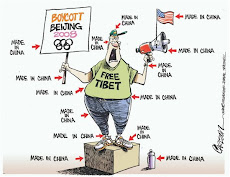
China’s Genocide Olympics

Jan. 24th. (NY Times) - The Beijing Olympics this summer were supposed to be China’s coming-out party, celebrating the end of nearly two centuries of weakness, poverty and humiliation. Instead, China’s leaders are tarnishing their own Olympiad by abetting genocide in Darfur and in effect undermining the U.N. military deployment there. The result is a growing international campaign to brand these “The Genocide Olympics.” This is not a boycott of the Olympics. But expect Darfur-related protests at Chinese Embassies, as well as banners and armbands among both athletes and spectators. There’s a growing recognition that perhaps the best way of averting hundreds of thousands more deaths in Sudan is to use the leverage of the Olympics to shame China into more responsible behavior. The central problem is that in exchange for access to Sudanese oil, Beijing is financing, diplomatically protecting and supplying the arms for the first genocide of the 21st century. China is the largest arms supplier to Sudan, officially selling $83 million in weapons, aircraft and spare parts to Sudan in 2005, according to Amnesty International USA. That is the latest year for which figures are available.

China provided Sudan with A-5 Fantan bomber aircraft, helicopter gunships, K-8 military training/attack aircraft and light weapons used in Sudan’s proxy invasion of Chad last year. China also uses the threat of its veto on the Security Council to block U.N. action against Sudan so that there is a growing risk of a catastrophic humiliation for the U.N. itself. Sudan feels confident enough with Chinese backing that on Jan. 7, the Sudanese military ambushed a clearly marked U.N. convoy of peacekeepers in Darfur. Sudan claimed the attack was a mistake, but diplomats and U.N. professionals are confident that this was a deliberate attack ordered by the Sudanese leaders to put the U.N. in its place. Sudan has already barred units from Sweden, Norway, Nepal, Thailand and other countries from joining the U.N. force. It has banned night flights, dithered on a status-of-forces agreement, held up communications equipment and refused to allow the U.N. to bring in foreign helicopters. The growing fear is that the U.N. force will be humiliated in Sudan as it was in Rwanda and Bosnia, causing enormous damage to international peacekeeping.

Another possible sign of Sudan’s confidence: an American diplomat, John Granville, was ambushed and murdered in Khartoum early this month. Many in the diplomatic and intelligence community believe that such an assassination could not happen in Khartoum unless elements of the government were involved. Chinese officials argue that they are engaging in quiet diplomacy with Sudan’s leaders and that this is the best way to seek a solution in Darfur. They note that Sudan has other backers, and that China’s influence is limited. It is true that since the start of the “Genocide Olympics” campaign (www.dreamfordarfur.org) a year ago, China has been more helpful, and it’s only because of Chinese pressure on Khartoum that U.N. peacekeepers were admitted to Darfur at all. But the basic reality is that China continues to side with Sudan — it backed Sudan again after it ambushed the U.N. peacekeepers — and Sudan feels protected enough that it goes on thumbing its nose at the international community.

Just a few days ago, Sudan appointed Musa Hilal, a founding leader of the Arab militia known as the janjaweed, to a position in the central government. This is the man who was once quoted as having expressed gratitude for “the necessary weapons and ammunition to exterminate the African tribes in Darfur.” Other countries also must do much more, but China is crucial. If Beijing were to suspend all transfers of arms and spare parts to Sudan until a peace deal is reached in Darfur, then that would change the dynamic. President Omar al-Bashir of Sudan would be terrified — especially since he is now preparing to resume war with South Sudan — and would realize that China is no longer willing to let its Olympics be stained by Darfuri blood. Without his Chinese shield, Mr. Bashir would be more likely to make concessions to Darfur rebels and negotiate seriously with them, and he would no longer have political cover to resume war against South Sudan. That would make long-term peace more likely in Darfur and also in South Sudan.

I’m a great fan of China’s achievements, and I’ve often defended Beijing from unfair protectionist rhetoric spouted by American politicians. But those of us who admire China’s accomplishments find it difficult to give credit when Beijing simultaneously underwrites the ultimate crime of genocide. China deserves an international celebration to mark its historic re-emergence as a major power. But so long as China insists on providing arms to sustain a slaughter based on tribe and skin color, this will remain, sadly, The Genocide Olympics.
by Nicholas Kristof
+++++++++++++++++++++++++++++++++++++++++++++++++++
Disclaimer
No responsibility or liability shall attach itself to either myself or to the blogspot ‘Mozlink’ for any or all of the articles/images placed here. The placing of an article does not necessarily imply that I agree or accept the contents of the article as being necessarily factual in theology, dogma or otherwise.
Mozlink

Saturday, January 12, 2008

Sudan Apologizes for Shooting at UN

KHARTOUM, Jan 10, (AP) - Sudan acknowledged Thursday that its troops shot at a United Nations convoy in Darfur, reversing an initial denial, but it in part blamed the peacekeepers saying they should have notified Khartoum of their movements. The Sudanese government has demanded that the joint U.N.-African Union peacekeeping force give it prior notification for all its movements and not move at night, conditions the United Nations has rejected. U.N. officials have accused Khartoum of trying to limit the abilities of the force or hold up its full deployment with a series of bureaucratic obstacles, including such conditions. The attack Monday night in West Darfur damaged an armored personnel carrier, destroyed a fuel tanker truck and severely injured a Sudanese driver. The U.N. has lodged a complaint with Khartoum and said "the government of Sudan has to provide unequivocal guarantees that there will be no recurrence of such activities by its forces."


Sudan's military spokesman and its ambassador to the United Nations initially denied the army had opened fire. But the military retracted the statements Thursday, saying the shoot-out did take place. It apologized for the error, which it said occurred because the U.N. force, known as UNAMID, had not given forward notice it was sending a convoy through this volatile zone of western Darfur near the border with Chad. "The Western Sudan military command has provided an apology to the representative of UNAMID in the region and that the apology was accepted, in recognition of the dual mistake committed," the state-run SUNA news agency said. Sudan's Defense Minister Abdel-Rahim Mohamed Hussein told the independent daily Al-Sahafa the army first fired warning shots at the U.N. convoy. "Those shots were ignored and that's when the soldiers opened fire, wounding the driver and damaging a troop carrier and a truck," Hussein said.

The U.N. mission began on Jan. 1 and now stands at around 9,000 peacekeepers. It is supposed to grow to 26,000 and aims at finally deploying a robust force to stop the chaos. More than 200,000 people have died in Darfur and 2.5 million have fled to refugee camps since 2003 when ethnic African rebels took arms against the Arab-dominated Sudanese government, accusing it of discrimination. Sudan denies multiple allegations of war crimes in the region.
+++++++++++++++++++++++++++++++++++++++++++++++++++
Disclaimer
No responsibility or liability shall attach itself to either myself or to the blogspot ‘Mozlink’ for any or all of the articles/images placed here. The placing of an article does not necessarily imply that I agree or accept the contents of the article as being necessarily factual in theology, dogma or otherwise.
Mozlink

Thursday, January 10, 2008

U.N. Official Fears For Darfur Force

UNITED NATIONS, Jan 10th. (LA Times) - The U.N. peacekeeping chief told the Security Council on Wednesday that a Sudanese attack this week on U.N.-led troops reinforces concerns that the force may be unable to protect itself or civilians in Darfur. The violence, along with foot-dragging by the Sudanese government and the lack of necessary helicopters and equipment, may doom the peacekeeping effort, Jean-Marie Guehenno told the council. "Without decisive progress on each of those three issues, we will indeed face dire consequences for the international efforts to help the Sudanese bring peace and stability to Darfur," Guehenno said.

On Monday night, an armed force in Darfur attacked a peacekeeping supply convoy of more than 20 vehicles marked with the United Nations logo. Guehenno said that the area commander for the Sudanese military confirmed responsibility for the attack shortly afterward by telephone. On Wednesday, however, Sudanese officials in the capital, Khartoum, and New York denied responsibility and said rebels backed by neighboring Chad had orchestrated the attack to put the government under pressure. "They were not the government," said U.N. Ambassador Abdalmahmood Abdalhaleem. "The rebels did that. No doubt about it." The attack was only the most immediate problem facing the new peacekeeping mission. The African Union forces switched their berets from AU green to U.N. blue on Dec. 31, signaling the beginning of a joint peacekeeping operation by the two organizations that ultimately is expected to include 27,000 personnel. So far, about 9,000 troops and police are in place to protect civilians threatened by conflict in an area larger than California. But Guehenno lamented that continued obstacles put up by Sudan make many countries reluctant to offer personnel and equipment.

The government has rejected non-African soldiers and said it won't allow a team of Scandinavian engineers to help build roads and airstrips, further delaying deployment. Khartoum still has not consented to night flights, supplied land and water for bases in some areas or provided visas, Guehenno said. The government insists that African personnel wear green berets and non-Africans wear blue to differentiate them, a demand the U.N. has ignored, saying it goes against the original agreement as well as the U.N. charter. U.N. Secretary-General Ban Ki-moon called Sudanese President Omar Hassan Ahmed Bashir after the attack, and the pair will meet in two weeks at an African Union summit in Ethiopia to iron out remaining technical and political obstacles to the force's deployment. Guehenno told the Security Council in December that it might be better to not deploy a U.N. force at all than to deploy one that was too vulnerable, recalling tragedies involving overwhelmed peacekeepers in Bosnia-Herzegovina, Sierra Leone and Liberia.

But the people of Darfur have little choice, with more than 300,000 people newly displaced in 2007 and malnutrition rates rising, despite the decrease in attacks on civilians by government-backed militias that earlier in the decade drove more than 2 million people from their homes. Aid workers are also at risk, with 13 killed and 147 abducted last year. Rebels continue to clash with government soldiers and militias, as well as with other rebel groups, over wealth, power and land. Peace talks have made little headway in stopping the 4-year-old conflict. The U.S. ambassador to the U.N., Zalmay Khalilzad, said the Bush administration considers the continuing conflict in Darfur to be "very important" and a challenge "to the credibility of the international community, the credibility of the U.N., the credibility of the Security Council. But we're not where we need to be," he said. "We need to take stock and see what adjustment needs to be made."
by Maggie Farley
+++++++++++++++++++++++++++++++++++++++++++++++++++
Disclaimer
No responsibility or liability shall attach itself to either myself or to the blogspot ‘Mozlink’ for any or all of the articles/images placed here. The placing of an article does not necessarily imply that I agree or accept the contents of the article as being necessarily factual in theology, dogma or otherwise.
Mozlink

Monday, December 3, 2007

Teddy Row Teacher Freed from Jail

BBC Dec. 3rd. - A UK teacher has been released and handed over to British officials in Sudan after being jailed for letting her class name a teddy bear Muhammad. Gillian Gibbons, 54, from Liverpool, was freed after eight days in custody. She had been given a 15-day jail term. Sudan's President Omar al-Bashir pardoned her after talks with two British Muslim peers. In a statement, Mrs Gibbons apologised for "any distress". Prime Minister Gordon Brown said he was "delighted". Mother-of-two Mrs Gibbons has been released into the care of the British embassy in Khartoum, but her exact location has not been disclosed. She was released four days after receiving a 15-day sentence for insulting religion.

Following her release, Foreign Secretary David Miliband said the teacher was "a little overwhelmed" at the attention her case had attracted, but was in "remarkably good spirits" and "elated to be back on her way home". Mr Miliband also hailed the "team effort" which led to Mrs Gibbons's release, praising diplomatic staff and saying that the intervention of Baroness Warsi and Lord Ahmed had been "an important contribution". Earlier, a demonstration of about 30 or 40 people was held outside the embassy in Khartoum, with banners protesting about the decision to release her.

Mrs Gibbons was arrested on 25 November and jailed on 29 November after allowing her pupils to name a teddy bear Muhammad. She was arrested after another member of staff at Unity High School complained to the Ministry of Education about the incident in September. The press office of President al-Bashir announced that he had pardoned Mrs Gibbons following his meeting with Baroness Warsi and Lord Ahmed, and that she had been "released after their mediation".

In a statement read out by Baroness Warsi, Mrs Gibbons said: "I have great respect for the Islamic religion and would not knowingly offend anyone and I am sorry if I caused any distress. I am looking forward to seeing my family and friends but I am very sorry that I will be unable to return to Sudan and work in Unity High School as the teacher of 2X." Lord Ahmed thanked the president for granting the pardon and said both he and Baroness Warsi were proud to have been able to help Mrs Gibbons. "This is a case which is unfortunate, unintentional, innocent misunderstanding, and as British Muslim parliamentarians we, Baroness Warsi and myself, we feel proud that we've been able to secure Gillian Gibbons's release." Speaking later, Baroness Warsi said that when she and Lord Ahmed had visited Mrs Gibbons in custody, all three had made "lots of Yorkshire jokes". All three were brought up in the county. Asked how she and Lord Ahmed had helped to win freedom for Mrs Gibbons, Baroness Warsi said: "We played very different roles but complementary roles with different negotiation skills which had to be used."

Mr Brown said it was "completely wrong" that Mrs Gibbons had been detained, and described her imprisonment as "completely unacceptable". Sudanese President Omar al-Bashir (right) with Lord Ahmed (second left) and Baroness Warsi (left)
The peers met Sudanese President Omar al-Bashir. He said: "Through the course of Mrs Gibbons's detention I was glad to see Muslim groups across the UK express strong support for her case. "I applaud the particular efforts of Lord Ahmed and Baroness Warsi in securing her freedom. I am also grateful to our officials for all their work behind the scenes." Speaking to reporters outside his home in Liverpool, Mrs Gibbons's son John said he was "very pleased". He said: "I'd like to thank the government for all they have done, the hard work behind the scenes, especially the two peers who went out there. "Everyone's been really great. Obviously it's a great feeling today, we're very pleased, we have been under a lot of pressure."

Dr Khalid al-Mubarak, of the Sudanese embassy in London, said he hoped the affair would not damage relations between Sudan and the UK. "I think this is the correct resolution - pardoned and released early," he told BBC News. "The word pardoned also means that the original mistake has been - not forgotten - but behind us now." Ibrahim Mogra from the Muslim Council of Britain told BBC News 24 that the whole saga had been very damaging for the image of the Muslim faith. "Each time we have stories like these, that distort what Islam stands for or misrepresents what the compassion of Muslim law stands for, then we have repercussions and people begin to feel that Islam has no place in modern society... "I have not come across one single Muslim in our country who has supported what has happened." President Omar al-Bashir had been under pressure from Sudanese hardliners to ensure Mrs Gibbons served her full sentence. There had been a protest and calls for a retrial and for the sentence to be increased. BBC Islamic affairs analyst Roger Hardy said the row over Mrs Gibbons had strained relations between Britain and Sudan - and, beyond that, between the West and Islam. And even if intervention by two prominent British Muslims had succeeded in limiting the damage, the fact remained that damage had been done, he added.
+++++++++++++++++++++++++++++++++++++++++++++++++++
Disclaimer
No responsibility or liability shall attach itself to either myself or to the blogspot ‘Mozlink’ for any or all of the articles/images placed here. The placing of an article does not necessarily imply that I agree or accept the contents of the article as being necessarily factual in theology, dogma or otherwise.
Mozlink

U.N. Official Criticizes Sudan for Resisting Peace Force in Darfur

UNITED NATIONS, Nov. 27 (NY Times) — The United Nations’ top peacekeeping official said Tuesday that obstacles created by the Sudanese government were jeopardizing the deployment of the joint African Union-United Nations force in Darfur. The force, which will ultimately number 26,000 members, is to replace a 7,000-member African Union force that has been overwhelmed by the scope of the crisis in Darfur, which has driven 2.5 million people from their land and cost the lives of at least 200,000. The new force is scheduled to start operating Jan. 1. The official, Jean-Marie Guéhenno, told the Security Council that Sudan was resisting accepting specialized troops from non-African militaries that were critical to the mission, blocking support staff and materials from the area through bureaucratic maneuvers, and withholding needed land and permissions for the assignment of helicopters.

In addition, he said, the government in Khartoum was asserting the right to close down the force’s communications when its own army was operating in the area and was refusing to give United Nations planes clearance to fly at night. “The mission has the mandate to protect civilians,” Mr. Guéhenno said, “and that responsibility does not end at sunset.” He said the actions left the United Nations with “hard choices. Do we move ahead with the deployment of a force that will not make a difference, that will not have the capability to defend itself, and that carries the risk of humiliation of the Security Council and the United Nations, and tragic failure for the people of Darfur?” he asked.

Sudan’s ambassador, Abdalmahmood Abdalhaleem Mohamad, rejected the charges, saying that his country “has carried out an intense effort to fulfill its obligations.” Outside the Council chamber, he rebuked Mr. Guéhenno for “taking technical issues and blowing them out of proportion” and continuing the peacekeeping department’s “habit of accusing Sudan for their mistakes and failures.” The non-African forces that Khartoum has refused to approve are an infantry battalion from Thailand, special forces from Nepal, and an engineering company from Norway and Sweden. They were first proposed in a letter from Secretary General Ban Ki-moon to the Sudanese on Oct. 2 that has gotten no response. The United Nations has no alternatives to the use of those units, Mr. Guéhenno said. He added that he was disturbed by reports out of Khartoum that officials were also going back on their agreement to let the force wear the blue berets that carry United Nations insignia, an essential condition, he said, for those countries that have agreed to contribute troops.

Zalmay Khalilzad, the American ambassador, said Sudan “absolutely must demonstrate through its statements and actions its intent to accept and facilitate an effective peacekeeping force in Darfur. Based on what we have heard today from Mr. Guéhenno,” he said, “it appears the government of Sudan has thus far failed to do so.” John Sawers, Britain’s ambassador, said he was convinced that a timely fielding of the force was being made “impossible” by Sudan’s “foot-dragging and obstruction.”
By WARREN HOGE
+++++++++++++++++++++++++++++++++++++++++++++++++++
Disclaimer
No responsibility or liability shall attach itself to either myself or to the blogspot ‘Mozlink’ for any or all of the articles/images placed here. The placing of an article does not necessarily imply that I agree or accept the contents of the article as being necessarily factual in theology, dogma or otherwise.
Mozlink

Wednesday, November 28, 2007

Sudan Continues to Obstruct Peacekeepers, U.N. Official Charges

UNITED NATIONS, Nov. 27 (Washington Post) -- Sudan's government has imposed a series of new bureaucratic obstacles that undermine the ability of a U.N.-backed peacekeeping mission in Darfur to protect civilians and its own troops there, according to the United Nations' top peacekeeping official. Jean-Marie Guéhenno, the U.N. undersecretary general for peacekeeping, told the U.N. Security Council on Tuesday that Sudan has insisted that international troops provide Sudan the authority to "temporarily disable" the mission's communications network if Sudanese forces are engaged in a military operation and to provide advance notice of all the mission's troop movements.

The latest Sudanese restrictions came to light just five weeks before a joint U.N. African Union mission of 26,000 peacekeepers is scheduled to formally replace a smaller African Union force in the Darfur region. The moves threatened to derail a U.S.-backed diplomatic effort at the United Nations to restore calm in one of Africa's deadliest regions. Abdalmahmood Abdalhaleem Mohamad, Sudan's ambassador to the United Nations, denied that his government was dragging its feet, saying that Guéhenno was blowing out of proportion a "small technical" dispute. The ambassador said the U.N. peacekeeping department has developed a habit of blaming Sudan for its own failure to meet its schedule for deploying a force in Darfur. Gu¿henno said Sudanese President Omar Hassan al-Bashir is backtracking from his commitments to support an international mission in Darfur, and the undersecretary appealed to the Security Council and influential African governments to persuade Khartoum to cooperate more fully. "A strategic decision on the part of the government of Sudan is necessary if we are to achieve our common goal: peace and security in Darfur," he said.

The violence in Darfur began in February 2003, when two Darfurian rebel groups took up arms against the country's Islamic government. A government-backed counterinsurgency campaign has driven more than 2 million civilians from their homes and led to the deaths of hundreds of thousands more. The United Nations' top political envoy, Jan Eliasson of Sweden, told the council that more than 30,000 people have been displaced by fighting between government and rebel forces over the past month. In recent weeks, Sudan has engaged in bureaucratic delays that raise concern about its commitment to the new peacekeeping mission, Guéhenno said. Khartoum has yet to grant the mission authority to conduct night flights in Darfur or to deploy six helicopters in an airfield close to its headquarters in El Fasher. The government has impounded U.N. communications equipment in the El Fasher airport for weeks and has yet to grant land for encampments in the towns of El Geneina and Zalingei. "If the government doesn't give us the land we need immediately, we will have to hold back some units," Guéhenno said. Khartoum refused to authorize the participation of non-African troops whose role is vital to the mission's success, according to Guéhenno. The new Sudanese demands, he said, "would make it impossible for the mission to operate."

Guéhenno also raised concern about new reports that two Darfurian rebel factions have threatened an advance unit of Chinese military engineers. And he faulted the U.N. membership for failing to provide the mission with trucks, as well as transport and attack helicopters. "Do we move ahead with the deployment of a force that will not make a difference," Guéhenno asked, "that will not have the capability to defend itself, and that carries the risk of humiliation of the Security Council and the United Nations and tragic failure for the people of Darfur?"
Colum Lynch"
+++++++++++++++++++++++++++++++++++++++++++++++++++
Disclaimer
No responsibility or liability shall attach itself to either myself or to the blogspot ‘Mozlink’ for any or all of the articles/images placed here. The placing of an article does not necessarily imply that I agree or accept the contents of the article as being necessarily factual in theology, dogma or otherwise.
Mozlink

Thursday, November 1, 2007

Editorial - Playing Sudan's Game

NY Times November 1: After four years of genocidal massacres that have killed more than 200,000 people, the Darfur region of Sudan desperately needs a peace agreement and a robust multinational force to carry it out. Regrettably, this week’s internationally sponsored peace conference in Libya is doing little to meet those urgent needs. The problem is not just Sudan’s continuing duplicity — it announced a cease-fire and then promptly violated it. Sudan does not really want a peace agreement. It merely wants more time to let the janjaweed militias it backs in Darfur finish killing or drive off what remains of the region’s non-Arab population.

Many of the rebel groups that claim to be Darfur’s defenders also bear serious responsibility. Some of the best-known rebel leaders failed to show up. And so, the killing is likely to proceed, with Sudan taking maximum advantage of the rebel’s fecklessness, the diplomatic timidity of those closest to it and the failure of an Iraq-distracted Bush administration to pay consistent, high-level attention to the Darfur issue. The Arab League, to which Sudan belongs, and China, a major customer for Sudan’s oil, have at least started talking about Darfur. But they have yet to apply real pressure on Khartoum. The Arab League is reportedly readying proposals for Darfur’s future economic development that all but overlook the far more pressing problem of creating the peace that is essential for development. China’s tepid complaints seem aimed more at fending off Darfur-related protests at next year’s Beijing Olympics than stopping the slaughter. President Bush’s words on Darfur have been admirably strong, but he has not followed up with the high-level diplomacy and focus needed to rally effective international pressure on Sudan.

These failures, large and small, go a long way toward explaining why the killing continues monthly despite worldwide protests, White House speeches, American sanctions, African peacekeepers and Security Council resolutions. They make it easier for Sudan to take credit for announcing cease-fires that it has no intention of honoring, agreeing to peacekeepers that it has no intention of cooperating with and attending peace conferences that have no realistic possibility of bringing peace.

Meanwhile, the genocide goes on.
+++++++++++++++++++++++++++++++++++++++++++++++++++
Disclaimer
No responsibility or liability shall attach itself to either myself or to the blogspot ‘Mozlink’ for any or all of the articles/images placed here. The placing of an article does not necessarily imply that I agree or accept the contents of the article as being necessarily factual in theology, dogma or otherwise.
Mozlink

Monday, October 8, 2007

South Sudan Peace in ‘Jeopardy’

Nairobi, Oct. 7th: A peace agreement that put an end to decades of civil war between north and south Sudan is in jeopardy because relations between the two sides have become “poisonous”, the US envoy to Sudan has warned. The comments from Andrew Natsios were a reminder that while international attention has focused on violence in the western province of Darfur, the animosities behind a conflict that has killed more people have been rising to the surface once more. Referring to the Comprehensive Peace Agreement signed in 2005 by the Khartoum government and southern rebels, Mr Natsios said at the weekend: “We are deeply concerned about the health of the CPA . . . Tensions are rising. This is dangerous.”

Officials from the north and from the Sudan People’s Liberation Movement, a non-Muslim group running the southern government, accuse each other of holding up the implementation of key provisions of the CPA. Disputes between the two sides centre on the demarcation of the north-south border and the sharing of revenues from oil reserves, which have been found close to the border area. Mr Natsios, speaking at the end of a 10-day visit to Sudan, said the risk of clashes between the two sides was high and stressed the importance of Sudan holding an election in 2009, as envisaged in the CPA. That is set to be followed in 2011 by a referendum on independence for the south.

In Khartoum, the hardline National Congress party and the SPLM are part of a government of national unity. The US played a key role in forging the CPA after the Islamist NCP, fearing a US backlash following the September 11 terrorist attacks, began to accept the idea of talks to end the civil war.
By Barney Jopson for the The Financial Times
+++++++++++++++++++++++++++++++++++++++++++++++++++
Disclaimer
No responsibility or liability shall attach itself to either myself or to the blogspot ‘Mozlink’ for any or all of the articles/images placed here. The placing of an article does not necessarily imply that I agree or accept the contents of the article as being necessarily factual in theology, dogma or otherwise.
Mozlink

Thursday, August 23, 2007

UN Accuses Sudan Militia of Mass Abduction and Rape

GENEVA August 21st. — The United Nations' human rights office on Tuesday accused forces allied with Sudan's government of mass abduction and rape of women and girls in Darfur, acts it said could constitute war crimes. Its latest report, based on testimony from victims and witnesses, called on Khartoum to investigate reports that about 50 women were forced into "sexual slavery" after an attack on the rebel-held town of Deribat in South Darfur's Jebel Marra region last December. The abductees, who included many children, were held for about one month, and beaten and raped repeatedly, often in front of each other, the report from the office of UN High Commissioner for Human Rights Louise Arbour said. "Witnesses indicated that the abduction, rape and other human rights violations that continued throughout the period were committed by the same group of men who conducted the actual attack," it said.

The report concluded that the Sudanese government bore responsibility for the abuses committed by the official Popular Defence Forces (PDF) militia and the Abu Gasim faction. Sudan's army had provided air and ground support for the raids which resulted in 36 civilian deaths. The UN report named three men as possibly sharing criminal responsibility for leading the attacks on Deribat, and the abductions and sexual abuse. "A series of violations have been committed that constitute both violations of international human rights law and international humanitarian law. Some of these may also constitute war crimes", it said. "The government should issue immediate clear instructions to all troops under its command including PDF and other militias that rape and other forms of sexual violence will not be tolerated, that they constitute war crimes," it continued.

An estimated 200,000 people have died and 2.5 million have fled their homes in Darfur since mostly non-Arab rebels took up arms against the government in the vast western region in 2003. Sudan denies mass rapes in Darfur. On Monday Justice Minister Mohamed Ali al-Mardi said that reports by international rights groups on abuses were "criminal." "All reports...about genocide and mass rape are frivolous and obviated by malice," he told Reuters. "They are executing policies of other nations like the United States ... against Sudan." The U.N. report said a "pattern of mass abduction" which began with the Darfur conflict, appeared to be ongoing. The report covers a six-month period ending in May 2007.

The victims in Deribat, who were mainly from the Fur tribe, may have been targeted because the Fur community in Jebel Marra has been perceived as sympathetic to Sudan Liberation Army rebels who stayed outside the 2006 Darfur peace deal, it said. Jebel Marra region is a stronghold of Abdul Wahed Mohammed el-Nur, leader of a faction of one of the Darfur rebel groups.
STEPHANIE NEBEHAY
+++++++++++++++++++++++++++++++++++++++++++++++++++
Disclaimer
No responsibility or liability shall attach itself to either myself or to the blogspot ‘Mozlink’ for any or all of the articles/images placed here. The placing of an article does not necessarily imply that I agree or accept the contents of the article as being necessarily factual in theology, dogma or otherwise.
Mozlink

Tuesday, August 21, 2007

Sudan Forces Attack Volatile Darfur Camp

KHARTOUM, Aug 21 (Reuters) - Sudanese forces surrounded and attacked Darfur's most volatile camp on Tuesday to flush out rebels they say are behind recent attacks on police, an army source and camp residents said. The move on Kalma camp, home to 90,000 people, follows two attacks in the past week on police posts in South Darfur, one near Kalma and the other inside al-Salam camp. One policeman was killed and eight injured. "At 6 a.m. the government of Sudan moved 2,000 soldiers to surround the camp -- army, police and border intelligence," said Abu Sharrad, a spokesman for Kalma camp. Sharrad, who called Reuters from inside the camp, said government forces had opened fire but it was unclear if anyone was killed or injured. "We still cannot tell. They are still surrounding the camp," he added. An army source said those who attacked the police posts were believed to be in Kalma camp, where rebels have previously taken refuge. "This is an administrative, organisational operation to restore internal security," he said, adding the army was not involved, only police forces.

The United Nations said it is continuing to monitor the situation. "We are indeed concerned to receive reports of armed activity in the area," said Murizio Giuliano, spokesman for the U.N. Office for Humanitarian Affairs. Kalma camp is one of Darfur's most volatile. Government offices were torched and officials expelled from the camp in 2005. Last year frustrated camp residents rioted, looting an African Union police base in the camps and hacking to death their Sudanese translator.

The 7,000-strong African Union force in Darfur has failed to stem the violence despite a 2006 peace deal. While large-scale fighting has largely ended, rebels and militias have fractured creating lawlessness and uncontrolled banditry. International experts estimate some 200,000 people have died and 2.5 million driven from their homes since mostly non-Arab rebels took up arms in early 2003. Khartoum agreed to a 26,000-strong joint U.N.-AU force which will absorb the AU mission and try to stop violence which has hampered the world's largest aid operation in Darfur. Some 500,000 people are out of reach of relief workers. On Tuesday the U.N. rights office said allied government militias had attacked a village in the central Darfur Jabel Marra region, accusing them of mass rape and abductions which could constitute war crimes. It called on Khartoum to investigate reports that about 50 women were forced into "sexual slavery" after an attack on the rebel-held town of Deribat last December. The area is seen as supporting the Darfur rebel Sudan Liberation Army founder and chairman Abdel Wahed Mohamed el-Nur, who rejects a May 2006 Darfur peace deal signed by only one of three negotiating rebel factions. The U.N. report said a "pattern of mass abduction" which began with the Darfur conflict, appeared to be ongoing. The report covered a six-month period ending in May 2007.
+++++++++++++++++++++++++++++++++++++++++++++++++++
Disclaimer
No responsibility or liability shall attach itself to either myself or to the blogspot ‘Mozlink’ for any or all of the articles/images placed here. The placing of an article does not necessarily imply that I agree or accept the contents of the article as being necessarily factual in theology, dogma or otherwise.
Mozlink

Monday, August 20, 2007

UN Considers Top Darfur Post for Controversial Rwandan

UNITED NATIONS Sat 18 Aug 2007 (Reuters) - The United Nations is seriously considering allegations of human rights violations against a Rwandan general, nominated as deputy commander for the new U.N.-African Union force in Darfur, a U.N. official said Saturday. The African Union has approved Rwandan Maj. Gen. Karenzi Karake for the post but the United Nations has not yet confirmed it, despite pressure from Rwanda, which fields some 2,000 of the 7,000 AU troops now in Darfur. "We are aware of these allegations and we take them seriously," the U.N. official said, speaking on condition of anonymity. "We are consulting with the African Union and the government of Rwanda on the matter."

The joint U.N.-African Union operation aims to protect civilians in Sudan's western Darfur region, where more than 2.5 million people have lost their homes and an estimated 200,000 have died in the past four years. The Brussels-based United Democratic Forces, an opposition group, has accused Karake of supervising extra judicial killings of civilians before and after the Tutsi-led Rwanda Patriotic Front rebels took power in Kigali following the genocide. In 1994 militant Hutus killed some 800,000 Rwandans, mainly Tutsis. Rwanda's U.N. ambassador, Joseph Nsengimana, was quoted on the allAfrica.com Web site as saying that those raising the allegations had simply run out of ideas to complain about. "The whole world and the diplomats at the U.N., the Sudanese government and people of Darfur have appreciated the role that our troops in Darfur have played," Nsengimana said. "Why can't these people develop in their thinking because they seem to be out of touch with the way Rwanda is changing?" he was quoted as telling the BBC's Great Lakes service. No immediate comment from Kigali was available.

The U.N. official stressed that rules and regulations require that all U.N. personnel, especially those in leadership roles, "must embody the highest levels of professionalism, integrity, respect for diversity and accountability." "The United Nations depends on member states to vet all candidates, presumably including with regard to allegations of human rights abuses," he said. The official said the United Nations also welcomed "any information that organizations or individuals may have regarding such allegations against candidates for U.N. appointments."