Wednesday, January 30, 2008

Would-Be Peacemaker Killed in Kenya

NAIROBI, Kenya, Jan. 30th. (NY Times) - Melitus Mugabe Were, a freshman member of Parliament, could have been one of the keys to unlocking Kenya’s crisis, but he never got the chance. He was a moderate opposition politician, a self-made businessman who grew up in a slum, and he bridged the ethnic divide. His wife is from another ethnic group, and as Kenya slid into chaos this past month after a disputed election, he shuttled between different communities and tried to organize a peace march. On Tuesday morning, as he pulled up to the gate of his home, Mr. Were was dragged out of his car and shot to death. “Whoever did this,” said Elizabeth Mwangi, a friend, “has killed the dreams of many.” The details are still sketchy, but the shooting appears to have been a planned murder, not a robbery. Word spread fast and led to violence, with opposition supporters rioting across Nairobi, the capital.

The unrest seems to be escalating, and Kenyans are now literally ripping parts of their country apart, uprooting miles of railroad tracks, chopping down telephone poles, burning government offices and looting schools. Militias from opposing ethnic groups are battling in several towns, and Kenyan Army helicopters fired warning shots on Tuesday to disperse them. There have been reports of forced circumcisions and beheadings. The economy is paralyzed. More than 800 people have been killed since the election on Dec. 27th. United Nations officials are saying the government has failed to protect civilians, including girls who have been raped at camps for the displaced. Many Kenyans fear that their country is tumbling toward disaster. “The police are not in control,” said Maina Kiai, chairman of the Kenya National Commission on Human Rights. “Actually, nobody is in control.” Mr. Kiai said he was especially concerned about Mr. Were’s killing because he and other prominent Kenyans, including several newspaper editors, had recently received death threats. “None of us are safe,” Mr. Kiai said.

According to Mr. Were’s guard and family members, Mr. Were had just pulled up to his gate after midnight and was waiting in his Mercedes for the gate to open when a car drew alongside him. “I heard a beep,” said Mr. Were’s wife, Agnes. “And then two loud shots. I ran out and saw my husband bleeding and people were yelling to me, ‘He’s still breathing! He’s still breathing!’ but when I got him to the hospital he was dead.” Mr. Were, 39, whose campaign posters show him smiling with street children, had been shot in the heart and in the eye. The guard at his house, who was unarmed, said two men had yanked Mr. Were out of the car, shot him and drove off, without taking a thing. Family members said he was followed by suspicious cars several weeks before. Opposition supporters immediately called the killing a political assassination, intended to intimidate their movement, which is challenging the election in December that Kenya’s president, Mwai Kibaki, narrowly won, against the top opposition leader, Raila Odinga. “We suspect the foul hand of our adversaries in this,” Mr. Odinga said. Police officials say they are investigating closely and ruling nothing out. Some of Mr. Were’s friends said the culprits might have been connected to the other contenders for his Parliament seat, who recently filed a petition to challenge the results. Mr. Were, a successful home builder, was known as a bright spot in a gritty place. He ran an orphanage, had a footbridge and soccer stadium built in the slum where he grew up and sponsored teenage mothers to go to college. On Tuesday morning, a huge crowd of mourners streamed into his ranch house. The grief soon turned to outrage, and by midmorning the tears had dried and the roadblocks were going up. Mourners set tires aflame and hauled huge stones into the road. It was the first time that riots had reached a middle-class neighborhood in Nairobi, and it was not just rowdy unemployed youths from the slums who were wreaking havoc. “This is how we express our outrage,” explained Evans Muremi, a social worker, who stacked tires to burn while wearing a jacket and tie.

The election controversy seems to have brought out the worst in Kenya. While the country has been considered one of the most stable and promising in Africa, it has long been a violent place, with carjackings and muggings all too common, and mobs routinely stoning to death people suspected of crimes. Likewise, ethnic tensions have always existed in Kenya, but have never exploded as widely as they have in the past few weeks. Ethnically driven clashes, fueled by grievances over land and power, have flared in just about every corner of the country.

The problems have laid bare the shortcomings of Kenya’s poorly paid security forces, who often respond either too harshly or too feebly. Nearly two weeks ago, they shot an unarmed protester at point-blank range in front of television cameras. On Tuesday, they drove past a crowd of young men pulling down a telephone pole in front of Mr. Were’s house and did nothing. There is also a crisis of leadership. Kenya’s top politicians have been arguing about who is to blame for the violence more than they have been working together to stop it. Mr. Kibaki, considered aloof even before the election, has made few public appearances since his country began to unravel. Western diplomats say he is surrounded by hard-liners bent on staying in power. On Tuesday, he began formal negotiations with Mr. Odinga. Kofi Annan, the former United Nations secretary general, has been in Kenya for a week trying to bring the two sides together. So far, neither has budged. Mr. Odinga says the election was rigged and is demanding a new vote. Mr. Kibaki has refused. Western observers have said the election was so flawed there was no telling who really won.

According to friends and family, Mr. Were grew up in a Nairobi slum called Dandora. He was friendly and sharp and caught the eye of some Italian missionaries, who helped put him through school. He lived in Italy for a time and then came back to Kenya to start his construction company. Five years ago he became a councilman for Dandora. Mr. Were was from the Luhya ethnic group and his wife is Kikuyu. But that did not seem to matter. “He was one of the least tribal people I knew,” said Wycliffe McKenzie, a friend. He seemed to be more moderate than other opposition leaders and avoided their often belligerent talk. He told supporters not to join protests, which have often become violent and destructive. Many people remember him as exceedingly generous. Ms. Mwangi, his friend, said she went to him when she was 19 and the mother of two and needed money to finish high school. Mr. Were stayed in touch with her through the ups and downs of single motherhood and the pressures of school. “He told me to hang in there,” Ms. Mwangi said, as she stared blankly at the metal gate where he was shot. “He said one day you’ll be my personal doctor. He told me never to give up.”
Jeffrey Gettleman

From Catholic Information Service for Africa
A Catholic opposition politician was shot dead in Nairobi on Monday night, triggering angry protests in the city and in parts of the country
Melitus Mugabe Were, 40, was the new Member of Parliament for Embakasi on an Orange Democratic Movement (ODM) ticket. He was shot and killed by unknown people outside his gate shortly after midnight, police said. A former student at Kiserian Seminary in Nairobi, Were was one of the young men who helped Comboni missionary Fr Adelmo Spagnolo found the National Catholic Youth Centre in the capital in December 1988. He later studied social communications at the Gregorian University in Rome and worked with disadvantaged youth in Dandora, a suburb in Nairobi, where he was elected councilor in 2002.

Described by a close friend as an intelligent and hardworking mobilizer who defended Catholic teaching, Were, however, made political enemies in the course of his activism. He even received death threats. He becomes the first member of the 10th Parliament to die. Police moved in to quell protests in Nairobi and in some towns in the ODM stronghold of western Kenya following the death. President Mwai Kibaki condemned the killing of Were, terming it a heinous crime. He ordered police to immediately and expeditiously launch investigations into the killing and ensure that the culprits are apprehended. ODM leader Raila Odinga said the death was political assassination.

Meanwhile, clashes between police and gangs targeting non-Kikuyu people continued in Naivasha on Tuesday. Nakuru remained calm but tense. People are still camped at police stations, the showground and in parish compounds. Tension was also reported in Maralal after rumour went round Monday night that members of the dreaded Mungiki movement had been transported to the town. Most businesses remain closed and police are on patrol. At the same time, formal talks between the government and ODM were expected to kick off Tuesday afternoon led by former United Nations secretary general Kofi Annan. President Kibaki and Odinga were required to recognize the Annan team as mediators and to commit themselves to the arbitration process and its outcome. Source: CISA
+++++++++++++++++++++++++++++++++++++++++++++++++++
Disclaimer
No responsibility or liability shall attach itself to either myself or to the blogspot ‘Mozlink’ for any or all of the articles/images placed here. The placing of an article does not necessarily imply that I agree or accept the contents of the article as being necessarily factual in theology, dogma or otherwise.
Mozlink

Ethnic Cleansing or Death, Kenya's Kikuyu Tribe Vows

NAIVASHA, Kenya. Jan 29th. (Toronto Star) –A thick black pillar of smoke billowed up from a neighbourhood in the ordinarily quiet town of Naivasha, surrounded by lush green mountains and dotted with flower farms. Young men carrying anything from wooden table legs, to stones and machetes cheered on as the fire rose and what once was a house turned into smouldering ashes. As the violence triggered by disputed polls has spread east, Kikuyus, the tribe that has borne the brunt of the chaos, are taking revenge on rival Luos with an ultimatum: ethnic cleansing or death. Several hundred Kikuyu men and women faced off against an equal number of displaced Luos, the tribe of defeated presidential candidate Raila Odinga in Naivasha and Nakuru, Rift Valley's provincial capital some 70 kilometres northwest. "Exactly what is being done to our own people is now being done to them," said Jack Kinyanjui, 30. "We are for peace and they are not. Either they leave, or they die."

The spreading violence has reached a point that neither President Mwai Kibaki, a Kikuyu, nor Odinga, a Luo, may be able to stop it, said an official from Kenya's state-funded human rights panel. "I don't think the politicians can stop it any more, it's out of hand," Linda Ochiel, program director at the Kenya National Commission on Human Rights, said yesterday in a telephone interview from Nairobi. "Yesterday we watched on television as people with machetes were hacking people to death and the army was looking on." Kenya's Rift Valley province has been the epicentre of the violence that has convulsed the nation. After the Dec. 27 election results were announced, the region's dominant tribe, the Kalenjin, began attacking their Kikuyu neighbours, who are the same tribe as Kibaki. But since Sunday, the tables have turned. In Naivasha, some 80 kilometres northwest of Nairobi, dozens have been killed as Kikuyu gangs burned through the town. In the western city of Kisumu, however, thousands of machete-wielding youths hunted down Kikuyu members, torching homes and buses and clashing with police. Witnesses yesterday described seeing two people pulled from cars and stoned to death, while another was burned alive in a minibus. Naivasha drew throngs of Kikuyus from the central highlands in controversial resettlement plans by the first post-independence government in the 1960s, ousting the indigenous Kalenjin and Masai from the area and spurring the start of years of resentment. Over the decades, several tribes descended on the town to find work in the flower industry, a major export, and Naivasha became a melting pot of different tribes.

But after the month-long orgy of violence, angry Kikuyus now want their co-workers and neighbours out and threaten that if they don't leave by the end of the month, more chaos will be unleashed. Already some 800 people have been killed since the election and 250,000 displaced. Naivasha, like other tourist towns nationwide, has seen a virtual halt in visitors and the crisis has caused $1 billion in damage to Kenya's economy. Kibaki and Odinga blame each other for the violence, trading accusations of "ethnic cleansing." Human rights groups and officials charge it has become organized. "What is so alarming about the last few days is ... there's evidently hidden hands organizing it now," said Britain's visiting minister for Africa, Mark Malloch-Brown. He spoke after meetings with Odinga, Kibaki and their mediator, former UN secretary-general Kofi Annan. Kibaki has said he is open to direct talks with Odinga, but that his position as president is not negotiable. Odinga says Kibaki must step down and only new elections will bring peace.
by Tia Goldenberg
+++++++++++++++++++++++++++++++++++++++++++++++++++
Disclaimer
No responsibility or liability shall attach itself to either myself or to the blogspot ‘Mozlink’ for any or all of the articles/images placed here. The placing of an article does not necessarily imply that I agree or accept the contents of the article as being necessarily factual in theology, dogma or otherwise.
Mozlink

Myanmar Stepping up Arrests, Human Rights Group says

SOLO, Indonesia, Jan. 27th. (Int. Herald tribune) - Four months after a violent crackdown on pro-democracy demonstrators, the government of Myanmar has stepped up arrests of dissenters, breaking a promise to the United Nations, according to the human rights group Amnesty International. "Rather than stop its unlawful arrests, the Myanmar government has actually accelerated them," the group, based in London, said in a report Friday. It said the junta had arrested 96 people since November, when it assured a UN envoy that it would bring the detentions to a halt. Instead of bowing to demands for moderation from around the world, the group said, "the government's chief priority is to silence its citizens who would hold them to account."

The demonstrations, touched off in August by a sudden rise in fuel prices, swelled to mass pro-democracy street protests led by monks before the military cracked down in late September. The government has acknowledged the deaths of a dozen people. The United Nations says that it has confirmed at least 31 deaths and that 74 people remain missing. In another show of defiance, the country's military junta has also postponed an invitation to the special UN envoy to whom it made the promise in November to end the arrests. The envoy, Ibrahim Gambari, was appointed to represent the demands of members of the United Nations, who had expressed outrage at the televised scenes of violence against the demonstrators. Gambari has visited twice and was promised a third visit soon, as part of what Myanmar, which was formerly known as Burma, said was a policy of cooperation with the United Nations. But the junta now says it will not be convenient for him to come until April. "This is business as usual for them," said U Aung Zaw, the editor of Irrawaddy Magazine, an exile magazine published in Thailand. "When they are under siege, they always create such a smoke screen to keep away international pressure," he said. "They postpone, they say they are restoring normalcy, they keep arresting people."

As the months have passed, the world's attention has moved elsewhere, talk of sanctions has faded and diplomats and exile groups say the junta has tightened its grip on its citizens. "People should realize they are being fooled," Aung Zaw said. The UN Security Council criticized Myanmar in mid-January for delaying the release of political prisoners and moving slowly on a promised dialogue with the pro-democracy leader Aung San Suu Kyi, who has been under house arrest for 12 of the past 18 years. Responding to earlier demands from the United Nations, the junta appointed a middle-level official to be its liaison with her. He is reported to have met with her only four times, and there has been no public word of any substantive result.

Amnesty International said 1,850 political prisoners were being held, including at least 700 people arrested during and after the protests. The group said more than 80 people were unaccounted for "and are likely the victims of enforced disappearance." It said at least 15 of the detained protesters and their supporters had been sentenced to prison terms since Gambari's last visit. In December, the junta asserted that only 80 prisoners remained of 3,000 people who were rounded up during and after the crackdown. One of the most recent arrests was of a prominent poet, U Saw Wai, who published a Valentine's Day poem in a weekly magazine that carried a hidden message about the leader of the junta. The first letters of its lines spelled out "Senior General Than Shwe is power-crazy."
by Seth Mydans
+++++++++++++++++++++++++++++++++++++++++++++++++++
Disclaimer
No responsibility or liability shall attach itself to either myself or to the blogspot ‘Mozlink’ for any or all of the articles/images placed here. The placing of an article does not necessarily imply that I agree or accept the contents of the article as being necessarily factual in theology, dogma or otherwise.
Mozlink

French Aid Workers Sentenced

Paris, France, Jan. 28th. (Time) - A court near Paris has ruled that six French aid workers convicted in Chad and sentenced to an eight-year prison for attempted kidnapping will serve that full jail term in France — though with no hard labor, which under French law is banned. The ruling brings the bizarre, at times tawdry saga of humanitarian assistance group Zoé's Ark to its legal conclusion, but emotions still run high: as the judgment was read out, relatives and friends of the six shook the courtroom with cries of protest and claims of political manipulation. Tasked only with rendering the Chadian punishment compatible with French law, the Créteil court in Paris pointed out in a statement that it wasn't mandated to reexamine the case evidence or the guilty verdict handed down in Chad's capital, N'Djamena. That controversial judgment, issued on December 26, convicted the six Zoé's Ark's workers of attempted kidnapping in their efforts to secretly fly 103 children they claimed were orphans from war-torn Darfur out of eastern Chad to France for urgent care. Later investigations concluded that virtually all the children were in fact relatively healthy Chadian nationals with at least one living parent, and elsewhere uncovered a range of troubling details surrounding Zoe's Ark and its mission

All six members have consistently maintained their innocence, and claimed they'd become scapegoats of the Chadian government's attempts to take advantage of the humanitarian crisis created by the violence in Darfur. But despite a considerable public relations push by supporters to cast the aid workers as victims, French public opinion has failed to warm to their cause. Before and during their trial in Chad, certain members of the group righteously justified their at times extra-legal efforts to tend to the children as legitimate given the urgency of the situation. Since their December 28 return to France under Franco-Chadian judicial accords, several members of the operation have reportedly fallen out with their leaders of its illegal aspects. Lawyers and families of those support staffers had hoped the tribunal would consider evidence in their conviction of the subordinate roles they assumed, and lighten their sentences as accomplices rather — a distinction not made by the Chadian court.

French government officials insist that even before the group's arrest by Chadian police on October 25, they cautioned Zoé's Ark against pursuing certain of their more audacious humanitarian projects in Chad, particularly what appeared to be clandestine adoption arrangements with families back in France. Because of that, it came as little surprise to many observers earlier this month when a French investigating magistrate named several members in the group as defendants in his case for "complicity in the illegal residence of foreign minors in France," "illegally exercising the role as intermediary towards adoption" and "fraud." With any eventual convictions on those charges be pronounced by a French law based on violation of national laws, any prison sentences arising from them would be added to the eight year jail terms the Chad court handed down for kidnapping.

Given this run up to the tribunal's ruling on their sentence Monday, there was little reason for the Zoé's Ark members or their supporters to expect French judges to upend the rulings of the Chad court. Indeed, despite accusations by supporters and lawyers for Zoé's Ark workers that the Chadian trial had been unfair, the French tribunal ruled it had met the minimal European criteria requiring defense lawyers, debate of evidence and testimony, and recourse to appeal. Given that, the judges concluded an attempt to review the Chadian case would amount to "interference in the affairs of a sovereign state," and limited their work to adapting the sentence to French law. Detractors accuse the tribunal of not wanting to be seen as protecting French nationals from a punishment meted out by a former French colony, and they contend that the ruling is colored by concerns about next month's deployment of 3,500 French-led European peacekeeping troops to eastern Chad, a foreign military presence Chadian leaders resent.

Lawyers for the six convicted aid workers said they'd file for an appeal — but legal experts believe that given the narrow ambit left to the court under the judicial accords between France and Chad, they stand virtually no chance of receiving a more favorable ruling. In fact, French appeals courts are notorious for stiffening sentences in lower court rulings, meaning the Zoé's Ark crew could see they Chadian prison jolts lengthened — and then possibly compounded by eventual conviction in the case the French state brings against them.
By Bruce Crumley
+++++++++++++++++++++++++++++++++++++++++++++++++
Disclaimer
No responsibility or liability shall attach itself to either myself or to the blogspot ‘Mozlink’ for any or all of the articles/images placed here. The placing of an article does not necessarily imply that I agree or accept the contents of the article as being necessarily factual in theology, dogma or otherwise.
Mozlink

Monday, January 28, 2008

19 Burned to Death in Violence in Kenya

NAIROBI, Kenya, Jan. 27th. (NY Times) — Ethnically driven violence intensified in Kenya on Sunday, and police officials said at least 19 people, including 11 children, were burned to death in a house by a mob. Even the Kenyan military, deployed for the first time to stop antagonists from attacking one another, has been unable to halt the wave of revenge killings. More than 100 people have been killed in the past four days, many of them shot with arrows, burned or hacked with machetes. It is some of the worst fighting since a disputed election in December ignited long-simmering tensions that have so far claimed at least 750 lives. The fighting appeared to be spreading Sunday across the Rift Valley region, a particularly picturesque part of Kenya known more for its game parks and fancy lodges.

The Kenyan government is now threatening to arrest top opposition leaders on suspicion of orchestrating the bloodshed, but opposition leaders are in turn accusing the government of backing criminal gangs. According to police officials in the Rift Valley town of Naivasha, fighting erupted Sunday morning between gangs of Kikuyus and Luos, two of Kenya’s biggest ethnic groups, who have clashed across the country since the election. Witnesses said mobs threw flaming tires and mountains of rocks into the streets to block police officers from entering some neighborhoods. The mobs then went house to house, looking for certain people. Grace Kakai, a police commander in Naivasha, said a large crowd of Kikuyus chased a group of Luos through a slum, trapped them in a house, blocked the doors and set the house afire. Police found 19 bodies huddled in one room, and Ms. Kakai said some of the children’s bodies were so badly burned that they could not be identified. “All I can say is that they were school age,” she said. The episode was similar to one on Jan. 1, when up to 50 women and children seeking shelter in a church in another Rift Valley town were burned to death by a mob. The victims in that case were mostly Kikuyus, and Kikuyus across the country seem to have been attacked more than any other group.

In the past few days, many Kikuyus have organized into militias, saying they are now ready for revenge. “The situation is very bad,” Ms. Kakai said. “People are fighting each other and trying to drive them out of the area. We have to evacuate people.”Thousands of families are streaming out of Naivasha, Nakuru, Molo, Eldoret and other towns across the Rift Valley, which has become the epicenter of Kenya’s violence. The province is home to supporters of both Mwai Kibaki, Kenya’s president, and Raila Odinga, the top opposition leader, and the site of historic land disputes between members of rival ethnic groups. Mr. Kibaki is a Kikuyu and Mr. Odinga is a Luo, and the disputed election, in which Mr. Kibaki was declared the winner by a narrow margin despite widespread evidence of vote rigging, set off the ethnically driven violence.

The Kenya of today is almost unrecognizable compared with the Kenya that until recently was celebrated as one of the most stable and promising countries on the African continent. On Sunday night, local television stations showed menacing young men waving machetes and iron bars at roadblocks along one of the country’s busiest highways. The men threw rocks at buses, with one large bus run off the road, as police officers stood by. The Kenyan Army was assigned early this month to help evacuate people from conflict zones, but on Friday, for the first time, soldiers were ordered to intervene between warring groups. That did not seem to make much of a difference, and witnesses said the soldiers had been as ineffective as the police.

A dusk-to-dawn curfew has been imposed in several Rift Valley towns, including Naivasha and Nakuru, but witnesses said violence continued to rage in the countryside, with bands of armed men burning down huts and attacking ethnic rivals. Many Kenyans have said the most distressing aspect is that the opposing politicians, instead of cooperating to stop the bloodshed, continue to bicker over who started it. That is exactly what happened on Sunday after news of the Naivasha killings spread. Salim Lone, Mr. Odinga’s spokesman, sent out a cellphone message calling the killings “ghastly” and saying that they were the work of criminal gangs backed by police officers and “part of a well orchestrated plan of terror.” “The government is doing this to try to influence mediation efforts,” the message said, referring to the continuing but so far fruitless negotiations led by Kofi Annan, the former secretary general of the United Nations. “After stealing the elections from Kenyans, Kibaki now wishes to deny them justice and peace.”

Alfred Mutua, a government spokesman, called the accusations “ridiculous". "What is really happening is a continuation of the ethnic cleansing that Raila’s people are doing to kill the president’s people,” he said. Mr. Mutua said the violence would stop “when we indict the leaders responsible for this.” “We are working on indictments,” he said Sunday night. “That will happen very soon.” Western diplomats have said there is a debate raging within Mr. Kibaki’s inner circle about the wisdom of arresting top opposition figures, with some advisers pushing for it, while others fear that the violence will only get worse if the leaders are jailed because their supporters will go on an even more intense rampage. Kenyan newspapers reflected the gloom. “For the umpteenth time, we again ask President Kibaki and Orange Democratic Movement leader Mr. Raila Odinga to work for peace, truth and justice,” said an editorial in The Sunday Standard. “Kenya has bled enough.”
By Jeffrey Gettleman
+++++++++++++++++++++++++++++++++++++++++++++++++++
Disclaimer
No responsibility or liability shall attach itself to either myself or to the blogspot ‘Mozlink’ for any or all of the articles/images placed here. The placing of an article does not necessarily imply that I agree or accept the contents of the article as being necessarily factual in theology, dogma or otherwise.
Mozlink

French Activists Fight Female Genital Mutilation

National Public Radio, Jan. 26th. - Female genital mutilation is an ancient rite practiced mostly in some sub-Saharan and North African countries. Many Muslims in that part of the world wrongly believe it's dictated by Islam. In recent decades, the practice has spread to immigrant communities in Europe. Women activists in France have led the campaign in prosecuting those responsible for excisions performed on young girls, and the United Nations now considers the practice a human rights abuse.

GAMS, the French Women's Association for the Abolition of Sexual Mutilations, estimates that there are more than 50,000 mutilated women in France. One of them is Aissata, a young woman from Mali who has a 2-year-old daughter. "I come from a village in Mali where excisions are always practiced," she says. "My sister had a daughter and when the baby was not even 2 years old, she was mutilated. When I was four months' pregnant and my doctor told me it was a little girl, I was scared for her and ran away to France. I didn't want my daughter to undergo what they did to me when I was young." But Aissata is in France illegally. She went to GAMS to file a request for political asylum. On average, six women a day, five days a week, come seeking asylum in France to protect their daughters from being subjected to mutilation in their home countries, says GAMS worker Khadi Diallo, 53. She claims GAMS has a 99 percent asylum success rate.

Diallo was mutilated when she was 14, and the brutality of the practice is etched in her memory. "I was mutilated against my parents' will," she says. "It was during the summer visiting my father's family in a village near the capital Bamako. In Mali, it's the father's relatives who decide everything in the family." Diallo describes how several women held her down as one of them inflicted excruciating pain. Supporters of female genital mutilation say it dampens a girl's sexuality and protects her honor. Diallo says she can't even begin to list the psychological traumas she has since suffered. "They cut off my sex. It was as if they cut off my finger. They took away a piece of me," she says. "They imposed customs of a society where it's not permissible for a 14 -year-old girl to remain intact." In most cases, the excision involves the removal of the clitoris and minor labia. The most extreme form is infibulation, where the vaginal opening is stitched closed. Often, knives or razor blades are used in unsanitary conditions. The result is scar tissue that not only makes sex difficult and not pleasurable, but can also create complications for childbirth and long-term infections. "There is such a strong taboo against sex that girls often learn they were mutilated at an early age only when visiting a doctor or after their first sexual experience, when their boyfriend says, you're not normal, you're not like the others," says Diallo.

Female genital mutilation is alien to the great majority of Muslims in Europe, but GAMS claims there's a growing number of fundamentalist imams, funded by Islamist movements from abroad, who preach that removal of the clitoris is endorsed by the Koran. Women activists here have enlisted rap singer Bafing Kul to help convince poor and uneducated immigrants to stop mutilation, saying the practice is backward and harmful. One song's lyrics include: "May my ancestors forgive me. Not all traditions should be preserved. Islam does not endorse this one." The producer and distributor of Kul's CD is lawyer and human rights activist Linda Weil-Curiel. "The aim of the mutilation is to deprive the woman of her own sexuality. She is only left to be a baby-maker," Weil-Curiel says. Weil-Curiel is the person most responsible for making France the leader in tracking and prosecuting both perpetrators of female genital mutilation and the consenting parents. Representing the interests of child victims over the last 15 years, Weil-Curiel has been involved in most of the 40-some trials that have led to convictions.

She says clitorectomies have all but been eradicated in France, but the tragedy continues. Families started taking their daughters to their homelands for summer vacations. So she and other activists go to schools. It's not easy, she says, to warn children about the risks. "And we are there saying, 'Beware, be very careful, 'cause your parents are planning to send you over and this is what will happen,'" Weil-Curiel says. "And each time … You have two to three girls, we can observe tears running down their face, so we know in the family, if it is not them, it has happened." But last year the law was toughened. It's now illegal for any girl who lives in France to be sexually mutilated whether it happens in France or not, whether the girl is a citizen or not. Doctors are obligated to report cases they discover, and parents can be prosecuted for neglect, even if they say it was done somewhere else, without their knowledge.
by Sylvia Poggioli
+++++++++++++++++++++++++++++++++++++++++++++++++++
Disclaimer
No responsibility or liability shall attach itself to either myself or to the blogspot ‘Mozlink’ for any or all of the articles/images placed here. The placing of an article does not necessarily imply that I agree or accept the contents of the article as being necessarily factual in theology, dogma or otherwise.
Mozlink

KENYA: Diocese Evacuates Workers as Ethnic Violence Claims More Lives

NAIROBI, Kenya, Jan. 28th. (CISA) - An operation to evacuate Catholic personnel trapped by ethnic violence was underway Monday afternoon in the Catholic Diocese of Nakuru where a priest was brutally killed Saturday. The diocese was moving to safety priests and other church workers from 10 parishes in the Kalenjin heartland where members of the Kikuyu and Kisii communities have been targeted in the ongoing post-election skirmishes. The death toll continued to rise Monday and more people were displaced as rival groups clashed in the Rift Valley, Nyanza and Western provinces. Over 800 people have been killed nationwide since the clashes broke out a month ago following the disputed re-election of President Mwai Kibaki. Suspected Kalenjin warriors on Sunday raided Burnt Forest, intending to kill displaced people camped in the town, but security personnel repulsed them, a Catholic priest told CISA. The warriors returned early on Monday and police killed seven of them, including two schoolboys. The priest expressed fears that the warriors, armed with bows, arrows, spears, machetes and petrol, were planning another attempt on the camp.

Clashes persisted in Naivasha, where, according to Kenya Broadcasting Corporation (KBC), four more people were killed Monday. Other reports say 14 more bodies were collected, bringing the toll to at least 28.Thousands of people are camped at the local police station fearing for their safety. The chaos spread to neighbouring Gigil Town, where at least two people were killed, according to a witness who spoke to us from inside a Catholic parish compound. She said houses had been torched, businesses closed down and about 800 people had fled to the parish compound. A nun who spoke to us from a religious community a few kilometers outside Gilgil said the violence had trapped the community between Gilgil and Nakuru. Fighting in Nakuru and Naivasha at the weekend triggered riots in towns in western Kenya, the stronghold of the opposition Orange Democratic Movement (ODM). Chaos erupted in Kisumu Monday morning, with thousands of angry youths barricading roads and burning tyres apparently in anger over the killing of their tribesmen. Police shot in the air to disperse the demonstrators. Skirmishes were also reported in Kakamega, Busia, Migori and Kapsabet. Fr Fred Ogambi in Kisumu said youths chased away teachers and students from schools to ensure the institutions remained closed. The Provincial Education Officer had announced that schools would open for the first term on Monday.

But Eldoret, scene of some of the worst violence in the immediate aftermath of the election, has been calm in recent days, except on Saturday when tensions rose after a Kalenjin man was stabbed. He had boarded a taxi and got into an exchange with the Kikuyu crew. About 13,000 displaced people camping at the Eldoret Show-ground are unlikely to leave soon for fear of being attacked again. Idleness in the camp and dismal leaving conditions have led some women to prostitution, Nixon Oira of the Eldoret Catholic Justice and Peace Commission said. In Nyahururu, “everything has returned to normal” after a brief confrontation between police and youths on Sunday, said Fr Joseph Waititu. About 50 non-Kikuyu residents have sought refuge at the local police station.

+++++++++++++++++++++++++++++++++++++++++++++++++++
Disclaimer
No responsibility or liability shall attach itself to either myself or to the blogspot ‘Mozlink’ for any or all of the articles/images placed here. The placing of an article does not necessarily imply that I agree or accept the contents of the article as being necessarily factual in theology, dogma or otherwise.
Mozlink

Sunday, January 27, 2008

Ethnic Violence in Rift Valley Tears Kenya Apart

NAIROBI, Kenya, Jan. 27th. (NY Times) - Nairobi, the capital of Kenya, may seem calm, but anarchy reigns just two hours away. In Nakuru, furious mobs rule the streets, burning homes, brutalizing people and expelling anyone not in their ethnic group, all with complete impunity. On Saturday, hundreds of men prowled a section of the city with six-foot iron bars, poisoned swords, clubs, knives and crude circumcision tools. Boys carried gladiator-style shields and women strutted around with sharpened sticks. The police were nowhere to be found. Even the residents were shocked. “I’ve never seen anything like this,” said David Macharia, a bus driver.

One month after a deeply flawed election, Kenya is tearing itself apart along ethnic lines, despite intense international pressure on its leaders to compromise and stop the killings. Nakuru, the biggest town in the beautiful Rift Valley, is the scene of a mass migration now moving in two directions. Luos are headed west, Kikuyus are headed east, and packed buses with mattresses strapped on top pass one another in the road, with the bewildered children of the two ethnic groups staring out the windows at one another. In the past 10 days, dozens of people have been killed in Molo, Narok, Kipkelion, Kuresoi, and now Nakuru, a tourist gateway which until a few days ago was considered safe.

In many places, Kenya seems to be sliding back toward the chaos that exploded Dec. 30, when election results were announced and the incumbent president, Mwai Kibaki, was declared the winner over Raila Odinga, the top opposition leader, despite widespread evidence of vote rigging. The tinder was all there, even before the voting started. There were historic grievances over land and deep-seated ethnic tensions, with many ethnic groups resenting the Kikuyus, Mr. Kibaki’s group, because they have been the most prosperous for years. The disputed election essentially served as the spark, and opposition supporters across Kenya vented their rage over many issues toward the Kikuyus and other ethnic groups thought to have supported Mr. Kibaki.

In the Rift Valley, local elders organized young men to raid Kikuyu areas and kill people in a bid to drive the Kikuyus off their land. It worked, for the most part, and over the past month, tens of thousands of Kikuyus have fled. More than 650 people, many of them Kikuyus, have been killed. Many of the attackers are widely believed to be members of the Luo and Kalenjin ethnic groups. What is happening now in Nakuru seems to be revenge. The city is surrounded by spectacular scenery, with Lake Nakuru and its millions of flamingos drawing throngs of tourists each year. The city has a mixed population, like much of Kenya, split among several ethnic groups including Kikuyus, Luos, Luhyas and Kalenjins. On Thursday night, witnesses and participants said, bands of Kikuyu men stormed into the streets with machetes and homemade weapons and began attacking Luos and Kalenjins. Paul Karanja, a Kikuyu shopkeeper in Nakuru, explained it this way: “We had been so patient. For weeks we had watched all the buses and trucks taking people out of the Rift Valley, and we had seen so many of our people lose everything they owned. Enough was enough.” In a Nakuru neighborhood called Free Area, hundreds of Kikuyu men burned down homes and businesses belonging to Luos, Mr. Odinga’s ethnic group. The Luos who refused to leave were badly beaten, and sometimes worse. According to witnesses, a Kikuyu mob forcibly circumcised one Luo man who later bled to death. Circumcision is an important rite of passage for Kikuyus but is not widely practiced among Luos.

The Luos and the Kalenjins, who have been aligned throughout the post-election period, then counterattacked, resulting in a citywide melee with hundreds wounded and as many as 50 people killed. By Friday night, the Kenyan military was deployed for the first time to intervene. Local authorities also placed a dusk-to-dawn curfew on Nakuru, another first. Many people in Free Area, which is now almost totally Kikuyu, say it will be difficult to make peace. “We’re angry and they’re angry,” said John Maina, a stocky butcher, whose weapon of choice on Saturday was a three-foot table leg with exposed screws. “I don’t see us living together any time soon.”

That is the reality across much of Kenya, and it seems to be nothing short of so-called ethnic cleansing. Mobs in Eldoret, Kisumu, Kakamega, Burnt Forest and countless other areas, including some of the biggest slums in Nairobi, have driven out people from opposing ethnic groups. Many neighborhoods that used to be mixed are now ethnically homogeneous. Kofi Annan, the former secretary general of the United Nations, visited the Rift Valley on Saturday. He called it “nerve-racking. We saw people pushed from their homes and farms, grandmothers, children and families uprooted,” said Mr. Annan, who is in Kenya trying to broker negotiations between Mr. Kibaki and Mr. Odinga. He called for the Kenyan government to investigate the attackers and increase security. On Saturday, Kenyan soldiers in Free Area escorted Luos back to their smoldering homes and stood guard with their assault rifles as the people sifted through the ruins and salvaged whatever they could before leaving.

Many Luos said they had no choice but to go to far western Kenya, the traditional Luo homeland, just as many Kikuyus who have been displaced said they would resettle in the highlands east of Nakuru, their traditional homeland. Mr. Macharia, the bus driver, who is Kikuyu, conceded that many Kikuyus were feeling vengeful. But he said it does not mean they actually want to fight. “I saw it myself,” he said. “The elders called ‘Charge!’ but not all the boys charged.” Still, enough did charge that the Luos who used to live in Free Area were not taking any chances. On Saturday afternoon, hundreds of people carrying trunks on their heads and bags of blankets streamed toward a government office that was protected by a few soldiers. Nancy Aloo, a Luo, was guiding four frightened young children. “God made all of us,” Ms. Aloo said. “We need his help.
by Jeffrey Gettleman
+++++++++++++++++++++++++++++++++++++++++++++++++++
Disclaimer
No responsibility or liability shall attach itself to either myself or to the blogspot ‘Mozlink’ for any or all of the articles/images placed here. The placing of an article does not necessarily imply that I agree or accept the contents of the article as being necessarily factual in theology, dogma or otherwise.
Mozlink

Saturday, January 26, 2008

Nepal - From Treks to Sex

Is a new sort of thrill-seeker heading for Nepal?
KATHMANDU, Nepal, Jan. 24th (Economist) - “I CAN only dance when I'm drunk,” confides Srijana, a 20-year-old employee of the Pussy Cat Bar and Shower, a tavern in Thamel, Kathmandu's main tourist hangout. A few slurps from a customer's glass later and she mounts a small stage. There, to whoops from a few tipsy locals, she sheds most of her clothes and gyrates to a Hindi pop tune. Dangling above her is the Damoclean sword included in the bar's name: a silver shower nozzle, positioned to spray flesh-revealing water on a dancer below.

Such gimmicks are common in Thamel's bars, where competition for lascivious males is fierce. Until a few years ago Nepal had no obvious sex industry. There are now an estimated 200 massage parlours and 35 “dance bars”, such as the Pussy Cat, in Thamel alone—with over 1,000 girls and women working in them. Many sell sex. In the Pussy Cat, another dancer admits to turning tricks, for 1,800 rupees ($28). That is a tidy sum in Nepal, South Asia's poorest country. It is much more than Nepali women are paid in India's flesh-pots—to which over 5,000 are trafficked each year, according to the UN. But the dancers in Thamel are chasing a richer sort of Indian: tourists. And their government seems to be encouraging them. In an advertisement for “Wild Stag Weekends”, the Nepal Tourism Board offers this advice: “Don't forget to have a drink at one of the local dance bars, where beautiful Nepali belles will dance circles around your pals.”

In a country with a rich tradition of dance, where paying for sex is illegal, this might be harmless innuendo. But not everybody thinks so. During the recently-ended civil war, Nepal's Himalayan tourism industry collapsed. Some activists think that sex tourism is replacing it. According to John Frederick, an expert on South Asia's sex trade, “Ten years ago the sex industry was underground in Nepal. Now it's like Bangkok, it's like Phnom Penh.” The war, which put much of rural Nepal under the control of Maoist insurgents, has increased the supply of sex workers. Srijana is from the poor and still violent district of Siraha in southern Nepal. She was widowed there two years ago, and left an infant son to come to the capital. Yet she is remarkably cheerful—perhaps because she is drunk, and the shower is not working.
+++++++++++++++++++++++++++++++++++++++++++++++++++
Disclaimer
No responsibility or liability shall attach itself to either myself or to the blogspot ‘Mozlink’ for any or all of the articles/images placed here. The placing of an article does not necessarily imply that I agree or accept the contents of the article as being necessarily factual in theology, dogma or otherwise.
Mozlink

Catholic Priest Killed as Ethnic Violence Toll Rises

NAKURU, Kenya, Jan. 26th. (CISA) -A Catholic priest of the Diocese of Nakuru was today killed as vicious inter-ethnic violence claimed more lives in the Rift Valley town. Fr. Michael Kamau Ithondeka, 41, was killed Saturday morning at an illegal roadblock set up by armed youth on the Nakuru - Eldama Ravine Road. He was vice rector at St Mathias Mulumba Senior Seminary in Tindinyo. According to Fr Simon Githara, the parish priest of Eldama Ravine, Fr Kamau was accosted by armed youths who claimed they were on a revenge mission after one of their own was killed in Nakuru. His pleas for mercy fell on deaf ears as the youths descended on him with crude weapons, killing him on the spot.

The news comes as other reports indicate that public mortuaries in Nakuru have received at least 51 bodies and police are still collecting more from around the town. Our reporter in Nakuru, David Omwoyo, says the violence appears to be revenge against members of the Kalenjin, Luo and Luhyia communities following the recent killing of members of the Kikuyu community in the Rift Valley. Suspected Kikuyu gangs have taken over the town, our reporter says. There are about six groups of about 1,000 armed men conducting raids in various parts of the town. Businesses remain closed and there is no public transport. Police and the military are evacuating non-Kikuyus from the town. Hundreds of newly displaced persons have sought refuge in four Catholic parishes.

Meanwhile, security sources say a group calling itself Kalenjin Land Defence Forces is distributing leaflets calling for continued violence against members of the Kikuyu community in the Rift Valley. Kikuyus will be attacked even in their homeland in Central Kenya, the group says. In a Thursday report which accused the opposition Orange Democratic Movement of helping to plan the chaos, Human Rights Watch collected accounts from several Kalenjin men present at community meetings where local elders and ODM mobilizers urged Kalenjins to contribute money to buy automatic weapons. Some communities had reportedly managed to obtain such weapons already.

The death of Fr. Kamau comes in the wake of threats to Kikuyu Catholic personnel working in the Rift Valley Province. In Eldoret, two priests based at Moi University escaped death narrowly last week when goons attacked their house at night. One of the priests told CISA that he and his colleague had received several threats after violence broke out following the disputed re-election of President Mwai Kibaki. The priests were successfully evacuated to Burnt Forest, a small town teeming with displaced people on the Eldoret-Nairobi highway.

The late Fr Kamau was born in Kiambu, near Nairobi, in 1966 and was baptized at Riara Parish in 1967. He joined St Mary’s Minor seminary Molo in 1986 and later St Augustine Seminary in 1987, before proceeding to St. Mathias Mulumba, 1989-1992. Kamau was ordained a priest of Nakuru Diocese on January 9, 1993, and sent to Lower Subukia Parish. Between 1998 and 2002, Fr. Kamau studied scripture at the Biblicum (the Pontifical Institute for Biblical Studies) in Rome. Between 2003 and 2005, he served in Mwaragania Parish and as principal at Archbishop Ndingi Secondary School in Naivasha. In 2005, he was posted to St Thomas Aquinas Seminary, Nairobi, before being moved to St Mathias Mulumba Seminary as Vice Rector.
+++++++++++++++++++++++++++++++++++++++++++++++++++
Disclaimer
No responsibility or liability shall attach itself to either myself or to the blogspot ‘Mozlink’ for any or all of the articles/images placed here. The placing of an article does not necessarily imply that I agree or accept the contents of the article as being necessarily factual in theology, dogma or otherwise.
Mozlink

Thursday, January 24, 2008

U.S. Envoy Wants Political Pact in Kenya

NAIROBI, Kenya, Jan. 24th. (NY Times) — The American ambassador to Kenya said Wednesday that his deepest worries about the postelection crisis here were not about Kenyans rampaging in the streets or killing one another because of ethnic hatreds, both of which have claimed hundreds of lives. Possibly even more dangerous, he said, were the deep rifts among the country’s opposing politicians, who seem “entrenched” and surrounded by “hard-liners.” “You can never underestimate the ability of just a couple of people to tear a place apart,” said Michael E. Ranneberger, the ambassador, during an interview at his home in Nairobi, the capital. He said his chief concern was whether Mwai Kibaki, the president and Raila Odinga, the top opposition leader, were “prepared to rise above themselves and put the interests of the nation ahead of their own personal or their group’s political interest. That is still an unanswered question,” he said. The politicians need to sit down and compromise, the ambassador added, because “we’re in the middle of a very serious crisis.”

It has been four weeks since Kenyans went to the polls in record numbers, and the country is still reeling from the aftershocks of a disputed tally in which Mr. Kibaki was declared the winner over Mr. Odinga, despite widespread evidence of vote rigging. The Kenyan government has said that more than 650 people have been killed, though Western diplomats and aid workers say the death toll is several hundred higher. On Wednesday, Kofi Annan, the former United Nations secretary general, met with Mr. Odinga and persuaded him to call off another round of protests that had been scheduled for Thursday. Mr. Annan was also supposed to meet with Mr. Kibaki, but the president postponed the get-together until Thursday and chose instead to meet with Yoweri Museveni, Uganda’s president and a close political ally who is pushing his own peace plan. So far, Mr. Kibaki and Mr. Odinga have said they are willing to negotiate, but neither has offered substantial concessions, despite pleas from Kenyans and other African dignitaries. The two men have yet to talk face to face.

Mr. Annan, who arrived on Tuesday, seems to have created more buzz and hope than any visitors involved in the previous mediation efforts. “I think everybody knows that if this mission fails, there are no others in the offing,” said Salim Lone, a spokesman for the opposition. The stakes are clearly high. Killings driven by ethnic strife continue in the Rift Valley, one of Kenya’s most scenic provinces but also the most violent because of historic tensions over land that have been ignited by the election controversy. On Wednesday, two more people were killed there by poison arrows. In Nairobi, street clashes are becoming the norm. A funeral on Wednesday degenerated into a riot. Opposition protesters pelted cars with stones and set a government building on fire. Last week, protesters sabotaged a crucial railway line running to Uganda. It is still out of commission. The violence has been a mix of ethnically driven killings, fighting in Nairobi’s slums and battles between the police and protesters. Mr. Ranneberger, who has been ambassador here for about a year and a half, said he was “outraged” when he saw television reports last week showing what appeared to be a police officer shooting an unarmed demonstrator. The protester had been dancing in the street and making faces when one officer leveled an assault rifle and shot him at close range. The officer, who is under investigation, was then shown on television kicking the protester, who later died.

Mr. Ranneberger said the fighting, even in the Rift Valley, was not purely ethnic but “politically, economically and socially motivated,” stemming from tensions over land and the perception that Mr. Kibaki’s ethnic group, the Kikuyu, had marginalized others. He said the violence in the Rift Valley after the election appeared to have been organized because of the involvement of large numbers of heavily armed men who seemed to strike just minutes after the disputed results were announced. Mr. Ranneberger said the American government, which gives more than $600 million in aid to Kenya annually, was frustrated at the political impasse but was not at the stage where it was ready to cut assistance. “It’s counterproductive,” he said. “And it’s way too premature to talk about anything punitive.” The way forward, he said, was for the Kenyan government to be more inclusive and to address the long-simmering grievances over economic and political inequality. He also said officials should investigate the postelection violence and fix Kenya’s election system, which has been badly discredited by the balloting on Dec. 27. “I really am fundamentally optimistic about the future of the country,” he said, citing Kenya’s strong middle class, its high literacy rates and its independent media. “There are all sorts of reasons why Kenya can overcome this.”
by Jeffry Gettleman
+++++++++++++++++++++++++++++++++++++++++++++++++++
Disclaimer
No responsibility or liability shall attach itself to either myself or to the blogspot ‘Mozlink’ for any or all of the articles/images placed here. The placing of an article does not necessarily imply that I agree or accept the contents of the article as being necessarily factual in theology, dogma or otherwise.
Mozlink

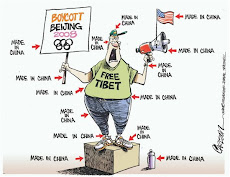
China’s Genocide Olympics

Jan. 24th. (NY Times) - The Beijing Olympics this summer were supposed to be China’s coming-out party, celebrating the end of nearly two centuries of weakness, poverty and humiliation. Instead, China’s leaders are tarnishing their own Olympiad by abetting genocide in Darfur and in effect undermining the U.N. military deployment there. The result is a growing international campaign to brand these “The Genocide Olympics.” This is not a boycott of the Olympics. But expect Darfur-related protests at Chinese Embassies, as well as banners and armbands among both athletes and spectators. There’s a growing recognition that perhaps the best way of averting hundreds of thousands more deaths in Sudan is to use the leverage of the Olympics to shame China into more responsible behavior. The central problem is that in exchange for access to Sudanese oil, Beijing is financing, diplomatically protecting and supplying the arms for the first genocide of the 21st century. China is the largest arms supplier to Sudan, officially selling $83 million in weapons, aircraft and spare parts to Sudan in 2005, according to Amnesty International USA. That is the latest year for which figures are available.

China provided Sudan with A-5 Fantan bomber aircraft, helicopter gunships, K-8 military training/attack aircraft and light weapons used in Sudan’s proxy invasion of Chad last year. China also uses the threat of its veto on the Security Council to block U.N. action against Sudan so that there is a growing risk of a catastrophic humiliation for the U.N. itself. Sudan feels confident enough with Chinese backing that on Jan. 7, the Sudanese military ambushed a clearly marked U.N. convoy of peacekeepers in Darfur. Sudan claimed the attack was a mistake, but diplomats and U.N. professionals are confident that this was a deliberate attack ordered by the Sudanese leaders to put the U.N. in its place. Sudan has already barred units from Sweden, Norway, Nepal, Thailand and other countries from joining the U.N. force. It has banned night flights, dithered on a status-of-forces agreement, held up communications equipment and refused to allow the U.N. to bring in foreign helicopters. The growing fear is that the U.N. force will be humiliated in Sudan as it was in Rwanda and Bosnia, causing enormous damage to international peacekeeping.

Another possible sign of Sudan’s confidence: an American diplomat, John Granville, was ambushed and murdered in Khartoum early this month. Many in the diplomatic and intelligence community believe that such an assassination could not happen in Khartoum unless elements of the government were involved. Chinese officials argue that they are engaging in quiet diplomacy with Sudan’s leaders and that this is the best way to seek a solution in Darfur. They note that Sudan has other backers, and that China’s influence is limited. It is true that since the start of the “Genocide Olympics” campaign (www.dreamfordarfur.org) a year ago, China has been more helpful, and it’s only because of Chinese pressure on Khartoum that U.N. peacekeepers were admitted to Darfur at all. But the basic reality is that China continues to side with Sudan — it backed Sudan again after it ambushed the U.N. peacekeepers — and Sudan feels protected enough that it goes on thumbing its nose at the international community.

Just a few days ago, Sudan appointed Musa Hilal, a founding leader of the Arab militia known as the janjaweed, to a position in the central government. This is the man who was once quoted as having expressed gratitude for “the necessary weapons and ammunition to exterminate the African tribes in Darfur.” Other countries also must do much more, but China is crucial. If Beijing were to suspend all transfers of arms and spare parts to Sudan until a peace deal is reached in Darfur, then that would change the dynamic. President Omar al-Bashir of Sudan would be terrified — especially since he is now preparing to resume war with South Sudan — and would realize that China is no longer willing to let its Olympics be stained by Darfuri blood. Without his Chinese shield, Mr. Bashir would be more likely to make concessions to Darfur rebels and negotiate seriously with them, and he would no longer have political cover to resume war against South Sudan. That would make long-term peace more likely in Darfur and also in South Sudan.

I’m a great fan of China’s achievements, and I’ve often defended Beijing from unfair protectionist rhetoric spouted by American politicians. But those of us who admire China’s accomplishments find it difficult to give credit when Beijing simultaneously underwrites the ultimate crime of genocide. China deserves an international celebration to mark its historic re-emergence as a major power. But so long as China insists on providing arms to sustain a slaughter based on tribe and skin color, this will remain, sadly, The Genocide Olympics.
by Nicholas Kristof
+++++++++++++++++++++++++++++++++++++++++++++++++++
Disclaimer
No responsibility or liability shall attach itself to either myself or to the blogspot ‘Mozlink’ for any or all of the articles/images placed here. The placing of an article does not necessarily imply that I agree or accept the contents of the article as being necessarily factual in theology, dogma or otherwise.
Mozlink

Zimbabwe Police Break Up Protest

Rally Organized as Test of New Laws on Political Freedom
JOHANNESBURG, Jan. 23 (Washington Post) -- Zimbabwean police dispersed hundreds of opposition demonstrators with tear gas Wednesday afternoon in the first major test of new laws granting greater political freedoms in one of Africa's most repressive nations. The opposition Movement for Democratic Change said the demonstrations were staged to reveal whether President Robert Mugabe was prepared to loosen his grip on Zimbabwe after nearly 28 years of increasingly authoritarian rule. Despite months of negotiations on the changes, including what appeared to be significant government concessions on a planned new constitution with a bill of rights, true freedom remains elusive, opposition officials said. They estimated that dozens of their members were arrested Wednesday. "This was a severe test for Robert Mugabe, and he has failed," said Tendai Biti, secretary general of the largest faction of the opposition party, which fractured in 2005.

Tensions have been especially high in Zimbabwe since March, when police beat and arrested dozens of opposition figures, including party leader Morgan Tsvangirai, shortly before a major demonstration was to begin. That incident led to an intensive regional diplomacy effort led by South African President Thabo Mbeki, who last week traveled to Harare, the capital of Zimbabwe, in an attempt to close a deal. But after negotiations faltered in recent days, opposition leaders decided to challenge Mugabe's forces on the streets of Harare, something the movement has rarely done with success since its founding in 1999. Police banned the planned demonstration. Then at 4 a.m. Wednesday, officers went to Tsvangirai's home and took him into custody for four hours of questioning before he was released, opposition officials said. That was followed by an urgent court hearing during which the party asked a judge to allow the rally. The judge told the opposition members that they could not hold their demonstration in Harare's city center, as planned, but could protest in a nearby park. But as protesters walked to the park, police blocked their way, fired tear gas and beat some of them, according to opposition accounts and news reports. Two truckloads of protesters, as well as some party leaders, were arrested, Biti said.

Calls to police spokesman Wayne Bvudzijena and Mugabe spokesman George Charamba did not go through on Zimbabwe's troubled phone system, one of many elements of the country's infrastructure that has markedly deteriorated in recent years. State radio said police believed that the opposition protest was not intended to be peaceful and had "sinister motives," according to news reports. After police dispersed the protest, a small number of opposition activists traveled toward the park where the court ruling had explicitly allowed a rally. Tsvangirai spoke to the crowd there, saying the police action had made a mockery of regional diplomatic efforts led by Mbeki, Biti said.

Negotiations in recent months between Mugabe and the opposition have led to agreement on the new constitution as well as the relaxing of laws limiting political expression and rallies and press freedoms. But there has been sharp disagreement over the timing of presidential and parliamentary elections, with the opposition insisting they should be delayed for several months so that the constitution can be implemented and a free vote guaranteed. "Under these conditions . . . the election will be a farce," Biti said, but he added that no decision had been made on whether the opposition would boycott the vote. The country has been in steep economic decline for nearly a decade and has the world's worst hyperinflation along with mounting food shortages, widespread power cuts and massive unemployment.
by Craig Timberg
+++++++++++++++++++++++++++++++++++++++++++++++++++
Disclaimer
No responsibility or liability shall attach itself to either myself or to the blogspot ‘Mozlink’ for any or all of the articles/images placed here. The placing of an article does not necessarily imply that I agree or accept the contents of the article as being necessarily factual in theology, dogma or otherwise.
Mozlink

Kenya: Do we Seek Relief or a Solution?

Mombassa, Kenya, Jan 18th. - One of the saddest aspects of the post election nightmare is that every utterance or statement is scrutinized with suspicion by just about everyone in Kenya. As the middle ground disappears, even non-Kenyans are forced to take sides as the battle lines are drawn. In such a highly polarised environment, the wise man might well be advised to keep his mouth shut and only reveal his heart to the Almighty. Yet, the crisis that faces the country demands that we all search for solutions that can bring hope and encouragement to Kenyans.

What we witnessed on our TV screens on December 29th and 30th are events that we will recall for decades with outrage, horror and disgust. Our dignity and our innocence were violated before our eyes by an inept, incompetent and disgraced electoral commission. The angry rebellion all over the country was a spontaneous reaction to a vicious assault on the voter's choice and voice.

While the ECK Chairman claims he does not know if Mwai Kibaki won the election, no one knows for sure whether Raila Odinga won either. All we can say with certainty is that Kalonzo Musyoka lost miserably but recovered quickly to pick up the scraps. He now serves in a government that may be legally in place but lacks legitimacy. So we face the prospect of being ruled by a government that is deemed illegitimate at home and lacks credibility abroad.

What ever happened to our nascent democracy? Were we naïve to imagine that our votes were important, or that ultimate power rested with the people? What the December 27th election proved beyond doubt is that democracy without constitutionalism is simply ethnic majority tyranny. We may
possess an energetic civil society, a courageous media, a host of freedoms and a growing economy but we are still governed by a constitution designed to facilitate a one-party or single-ethnic community dictatorship. For two decades we have laboured to create a Constitution that protected and promoted human rights; that freed the Judiciary and Legislature from the excesses and whims of the Executive; and that produced legislation that would dismantle the colonial authoritarian structures and replace them with institutions that were accountable and effective. But our efforts have not borne fruit.

There was a "Constitutional Moment" in 1997 that was snatched from wananchi by the political class under the guise of the IPPG. They have not returned it to its rightful owner since. The Bomas farce and the Referendum fiasco were just opening rounds in a battle for power that reached its climax on December 29th. The events of the past two weeks confirm that without constitutionalism our politicians can reduce the country to ruins and deny us even the few freedoms that we thought were inherent and guaranteed rights. We are in a crisis that is recognised by everyone except a small powerful clique who are currently in denial. We have frequently heard that the best constitutions are made in times of crises. How much deeper must we sink before the protagonists acknowledge that our biggest crisis is constitutional and not merely political or ethnic?

Our religious and civil leaders keep addressing the symptoms of the crisis as they try to bring relief from the suffering. Regretfully, such platitudes and admonitions are inadequate as any resolution must begin by acknowledging the root causes of the present chaos. Any analysis that lacks substance will in any case be considered by the public as support for one side or another. Let us first admit that it is a futile exercise to attempt to revisit the tallying as the ECK has had over three weeks to complete their dirty work. There are genuine demands for a repeat presidential vote, but how satisfactory would that exercise be as the ethnic arithmetic and voting patterns have changed dramatically with the capitulation of ODM-K and the disenfranchisement of 300,000 IDPs? An early repeat election would satisfy no-one and leave us just as divided, regardless of the outcome.

Many have called for the immediate establishment of a Truth, Justice and Reconciliation Commission as recommended by the Prof Makau Mutua task force in 2004. Commissions of this nature, however, should follow constitutional settlements rather than precede them. When institutions are established and stability restored, we possess the capacity and confidence to face the dark side of our nation's past. But to present truth commissions as the panacea for all our ills especially when we are hurting and vulnerable is simplistic and imprudent.

It would appear then that the only viable and realistic option is for the country to endorse a power-sharing transitional government whose chief mandate would be to complete the constitutional review process within a period of 18 months and pave the way for elections in 2 years time. This proposal will not be welcomed by the conflicting parties. It will not appeal to their die-hard supporters either who are convinced that 'their man' won. Yet it has the capacity to garner the support of most Kenyans as a win-win solution that can move us slowly forward as a nation out of this dreadful mess. Such a solution demands humility, self-sacrifice and generosity, qualities which appear to be in short supply at the moment. However, I contend that any other proposal will give us just temporary relief from our misery and not heal the deep divisions that are so apparent at the moment. What is required is a solution that requires an institutional setting in which the state is no longer communalised and no longer the monopoly of a particular ethnic group, but in which the state is reinvented as the arbiter of a civic pact between all the ethnic communities. That can only occur when we acknowledge that the current crisis is about constitutionalism and not about politics.

However, I would hasten to add that a transitional government would fail once more in this task if it were not bolstered and monitored by a vigorous civil society and a panel of experts who would guide the process and prevent the political hegemonies from hijacking and politicising the process for the umpteenth time, We know the darkest hour is just before the dawn. We are surely at the darkest hour in Kenya's history but a quantum leap in terms of imagination, generosity and faith can still save the country. Our leaders must make that leap in the dark and trust the goodwill of the public and the guidance of the good spirit to see them through. Despite signs to the contrary, I believe that they are up to that challenge and I pray that
they can take it.
by Fr Gabriel Dolan SPS
+++++++++++++++++++++++++++++++++++++++++++++++++++
Disclaimer
No responsibility or liability shall attach itself to either myself or to the blogspot ‘Mozlink’ for any or all of the articles/images placed here. The placing of an article does not necessarily imply that I agree or accept the contents of the article as being necessarily factual in theology, dogma or otherwise.
Mozlink

Wednesday, January 23, 2008

Annan in Kenya to Mediate in Crisis

Nairobi, Kenya, Jan 23nd. (Financial Times) - Kofi Annan, the former United Nations secretary-general, has arrived in Nairobi to try to reinvigorate the international community’s attempts to reconcile the two sides in Kenya’s political crisis. President Mwai Kibaki and Raila Odinga, leader of the opposition Orange Democratic Movement, have not met since a disputed election on December 27 that has triggered widespread bloodshed and crippled parts of east Africa’s biggest economy. Mr Annan’s first challenge will be convincing the two men to begin a face-to-face dialogue, but their public pronouncements indicate the gap between the two remains large.

Mr Kibaki insists he was elected legitimately and has rebuffed attempts at international mediation: his allies say Mr Annan is in Nairobi to “facilitate” not mediate. ODM has called for the formation of an interim government to oversee a rerun of the election, or the creation of a coalition government in which the powers of the president are reduced and the opposition has full control over certain ministries. Diplomats say both men have been heavily influenced by hardliners in their camps who do not want to see dialogue or have set unrealistic pre-conditions. Steven Smith, vice-chairman of the Kenya Private Sector Alliance who met both men last week, said: “People may be taking a breath this week and reconsidering what their position might be … There are things going on behind the scenes that indicate there is flexibility.” But Macharia Gaitho, a columnist with the Daily Nation, said in an article on Tuesday: “Short of getting them both in chokeholds and banging their heads together, Mr Annan has very little leverage on either president Kibaki and Mr Odinga or their respective entourages of myopic warmongers and sycophants.”

While most of Kenya is peaceful, Mr Annan is due to arrive in a bad tempered atmosphere. Michael Ranneberger, US ambassador to Kenya, on Tuesday described as “scurrilous propaganda” advertisements placed by the government that accused him and others of inciting violence by questioning the election result. Adam Wood, the British high commissioner in Nairobi, was summoned by the foreign minister on Monday to explain why a deputy foreign minister told parliament last week that the UK government had not recognised the Kibaki government. Over 600 people have died in clashes between police and opposition supporters and ethnic violence sparked by the election. More than 200,000 have been forced from their homes.
By Barney Jopson in Nairobi
+++++++++++++++++++++++++++++++++++++++++++++++++++
Disclaimer
No responsibility or liability shall attach itself to either myself or to the blogspot ‘Mozlink’ for any or all of the articles/images placed here. The placing of an article does not necessarily imply that I agree or accept the contents of the article as being necessarily factual in theology, dogma or otherwise.
Mozlink

Starving Refugees Eat Endangered Chimps

NAIROBI, Kenya, Jan. 23rd. (Toronto Times) –Hungry refugees in Tanzania are eating chimpanzees and other endangered species in order to supplement their meagre diet, says an international conservation group. Refugees living near national parks are also illegally hunting buffalo, topi, eland, elephant and waterbuck, the wildlife-trade monitoring group Traffic said yesterday.

In neighbouring Kenya, aid and conservation groups say refugee camps housing thousands of people who fled violence after the disputed Dec. 27 election are damaging the environment, as displaced people chopped down trees for firewood. Camps such as the Show Ground site in Eldoret – currently hosting 11,200 people – could cause "significant environmental damage," Jemini Pandya, a spokesperson for the International Organization for Migration told reporters in Geneva. "IOM will try and protect the areas around camps in Rift Valley Province through the rebedding of saplings and plants in other areas until the crisis is over," she said.

George Jambiya, lead author of the Traffic report on Tanzania, said the refugees' vegetarian food aid rations were partly to blame for the poaching problem. "The scale of wild meat consumption in East African refugee camps has helped conceal the failure of the international community to meet basic refugee needs," he added. Traffic's report was based on studies carried out in 2005 and 2006. But Christiane Berthiaume of the UN's World Food Program, which feeds 215,00 refugees in Tanzania, said meat spoils quickly and canned meat is much more expensive. Substituting canned meat for cheaper beans as a protein supply would add $46 million to the estimated $60 million cost of feeding Tanzania's refugees in 2007 and 2008, she said. Traffic said Tanzania's illegal bush meat trade has also eaten into government revenues from licensed sport hunting and game viewing.

According to the UN refugee agency, Tanzania hosted 11 camps in January 2007, housing 287,061 refugees, down from 350,590 in 2005. Most of the refugees fled conflict in Burundi and the Democratic Republic of Congo as far back as the 1960s, and Rwanda in the 1990s.
by George Obulutsa (Reuters)
+++++++++++++++++++++++++++++++++++++++++++++++++++
Disclaimer
No responsibility or liability shall attach itself to either myself or to the blogspot ‘Mozlink’ for any or all of the articles/images placed here. The placing of an article does not necessarily imply that I agree or accept the contents of the article as being necessarily factual in theology, dogma or otherwise.
Mozlink

Saudi Rape Case Lawyer 'Reinstated'

Jan. 21st. (CNN) -- The Saudi lawyer who represented a woman kidnapped and raped by seven men said his license to practice has been reinstated. Lawyer and human rights activist Abdul Rahman al-Lahem told CNN's Nic Robertson that the Justice Ministry has reinstated his license. Al-Lahem had previously told CNN that the Saudi judge revoked his license as punishment for speaking to the media about his client's case, which attracted international attention. His client, an engaged teenager, was raped by seven men who found her alone with a man unrelated to her. She has said she was meeting with the man to retrieve a photograph. The attack took place in Qatif in March 2006.

The seven rapists were sentenced to two to nine years in prison but she also was sentenced to 200 lashes and six months in prison for having violated the kingdom's strict Islamic law by being alone with an unrelated man. The woman's sentence provoked outrage in the West and cast light on the treatment of women under Saudi Arabian law. Under Saudi law, women are subject to numerous restrictions, including a strict dress code, a prohibition against driving and a requirement that they get a man's permission to travel or have surgery. In challenging what he said were his suspension and disbarment, al-Lahem said he had received threats on his life from the religious right.

Last month, Minister of Justice Abdallah bin Mohammed al-Sheikh, in a phone call to a Saudi Television newscast, said the lawyer's license had never been revoked. "Such decisions are made through institutions in the kingdom," he said. "The punishment of the lawyer or any lawyer does not come from a reaction; it comes from a carefully examined procedure within a special council in the ministry." He said the council charged with deciding law license revocations had not issued any decisions in the case.
++++++++++++++++++++++++++++++++++++++++++++++++++
Disclaimer
No responsibility or liability shall attach itself to either myself or to the blogspot ‘Mozlink’ for any or all of the articles/images placed here. The placing of an article does not necessarily imply that I agree or accept the contents of the article as being necessarily factual in theology, dogma or otherwise.
Mozlink

Monday, January 21, 2008

Kenyan Refugees, With Hatred in Tow

A large crowd of residents of the Kibera slum in Nairobi line up at a local school to receive personal food staple rations, January 15, 2008

Time Magazine, Jan 19th. - More than 6,000 Kenyans have fled since last month's disputed presidential elections erupted into violence. For more than two weeks, Kenyan towns have suffered mass riots and looting, more than 600 people have been killed and a qaurter of a million have been uprooted. The refugees bring horror stories of torched homes, murdered family members and bloodthirsty mobs. Ethnic clashes between the tribes loyal to incumbent President Mwai Kibaki, a Kikuyu, and opposition leader Raila Odinga, a Luo, have been a particularly ugly aspect of the post-poll conflict. Ugandan authorities say they have been forced to separate refugees by tribe due to simmering tensions.

Kikuyus have suffered the brunt of ethnic-targeted violence. In Nairobi's sprawling slums and northern towns in the lush Rift Valley, reports abound of Kenyan Kikuyus being stopped at roadblocks by drunken gangs of Luo and Kalenjin tribesmen to be beaten or killed. "We don't put tribes together in the camps because they have extended their conflicts into Uganda," said Bimpabaza Hashaka, the top government official in the eastern Ugandan district Tororo. Hashaka said youth gangs of the Kalenjin tribe have repeatedly threatened attacks on Kikuyus, even going as far as to try to poison the food being prepared for Kikuyu refugees sheltering in a church. Hospital emergency rooms in Tororo have also been the site of further fighting between men of differing tribes. Refugees poured in this week as the Kenyan opposition waged three days of rallies in all parts of the country. Says Hashaka: "They keep on coming, saying their homes have been burnt." The number of refugees is expected to rise as the political tumult continues in Kenya. Nairobi's slum Mathare could have passed for a war zone on Thursday. Ambulances roared through trash-littered streets, as hundreds of protestors faced off with police. Between makeshift roadblocks, residents dodged flying stones, tear gas and live bullets. "We are after peace, but only peace with solidarity!" shouted a young man armed with a machete. Behind him, the streets teemed with crowds of people and abandoned bullet-scarred shacks. But voicing the opinion of many violence-weary Kenyans, Pamela Atieno complained of the riots: "You go out to buy food and get teargassed."

The United Nations World Food Programme says that the timeline for when the Kenyan refugees will return home is highly uncertain. The agency has started distributing food along the Uganda-Kenya border. Kenya's opposition announced Friday that it would switch to economic protests and boycotts next week, but refugees seeking shelter are still expected to flock to Uganda. It is an unusual situation for Uganda, which still has millions of its own citizens displaced due to a brutal 20-year civil war. The conflict between Lord's Resistance Army rebels and the Ugandan government only ended in July 2006. Nevertheless, says Hashaka of the refugees from Kenya: "They think they're safer here than where they're coming from."
By Alexis Okeowo
+++++++++++++++++++++++++++++++++++++++++++++++++++
Disclaimer No responsibility or liability shall attach itself to either myself or to the blogspot ‘Mozlink’ for any or all of the articles/images placed here. The placing of an article does not necessarily imply that I agree or accept the contents of the article as being necessarily factual in theology, dogma or otherwise. Mozlink