Monday, October 8, 2007

Myanmar Junta Names Liaison to Aung San Suu Kyi

BANGKOK Oct 8th: The military junta in Myanmar has named its deputy labor minister to act as a liaison with the opposition leader Aung San Suu Kyi, the government announced Monday. It said Deputy Labor Minister Aung Kyi, a retired general, would act as "liaison minister" but did not elaborate on what this liaison would involve. State television said the appointment followed a recommendation by a United Nations envoy, Ibrahim Gambari, during a visit to Myanmar last week.

Analysts have voiced concern that the junta would take cosmetic steps to try to deflect international concern over its violent suppression of huge pro-democracy protests. An unknown number of Burmese were killed during the peaceful uprising and hundreds were arrested. Since the demonstrations were crushed late last month, the government has been carrying out night-time searches and arrests, and state media said Monday that arrests were continuing. In an earlier concession to international demands, the junta's leader, Senior General Than Shwe, said last week that he would meet with Aung San Suu Kyi, but only if she renounced some of her demands, including her support for international sanctions against the regime.

It remained unclear whether the junta would open any real dialogue with Aung San Suu Kyi, who has been under house arrest for 12 of the past 18 years. A commentary Monday in the government's English-language mouthpiece, the New Light of Myanmar, indicated that the government was not planning to release her from house arrest anytime soon, despite widespread demands from abroad. "The three demands of the protesters - lowering consumer prices, release of Daw Aung San Suu Kyi and political prisoners, and national reconciliation - cannot be satisfied through protest," the paper said, using an honorific it has avoided in commentaries over the years. "Now, those responsible are making arrangements to draft the state constitution and collect the list of voters," it added. "When the state constitution is approved, the fulfillment of the three demands will be within reach." "The drafting of a new constitution is one of the steps on a "road map" that the junta says will lead to a form of "disciplined democracy," but the constitutional guidelines it adopted in August assured that the military would play the dominant role in any future government. The completion of a constitution and its approval in a referendum could still take many months or years, analysts said.
International Herald Tribune
+++++++++++++++++++++++++++++++++++++++++++++++++++
Disclaimer
No responsibility or liability shall attach itself to either myself or to the blogspot ‘Mozlink’ for any or all of the articles/images placed here. The placing of an article does not necessarily imply that I agree or accept the contents of the article as being necessarily factual in theology, dogma or otherwise. Mozlink

CAFOD launches Campaign for Zimbabwe 'On Edge of Precipice'

London Oct. 8th: The Archbishop of Harare has issued an urgent appeal for help as Zimbabwe faces a spiralling food crisis. It is estimated that one in three people will soon be in need of food aid following a disastrous harvest. CAFOD launched a £4million appeal on Friday for Zimbabwe. The aid agency will run an emergency response programme providing over 120,000 people in some of the worst affected areas with food supplies and seeds and tools.

In his appeal the Archbishop of Harare, Robert Ndlovu, said: "The people of Zimbabwe are suffering. Our once bountiful nation is unable to feed its people and the coming months will bring yet deeper hunger and desperation for many. "Now the Zimbabwean people stand at the edge of a precipice. Our country is in deep crisis. Our harvest has failed, through a combination of severe drought, HIV and AIDS and the consequences of economic decline. "We have already lost too many of our children, friends, brothers and sisters to hunger and disease. Many more have fled the country, fleeing from lives that have become unbearable through poverty and hunger.

"Now the Zimbabwean people stand at the edge of a precipice. Our country is in deep crisis. Our harvest has failed, through a combination of severe drought, HIV and AIDS and the consequences of economic decline. "By March one in three people in Zimbabwe will have no food. Many will run out very soon. Our brothers and sisters face a struggle for survival at a time when many have nothing left, their possessions sold and their health gone. "On behalf of my Zimbabwean brothers and sisters living in hunger, I appeal to their fellow Christian brothers and sisters to walk alongside them during this difficult time in faith and Christian charity. "Our message of hope remains: 'God is always on the side of the Oppressed.'"

CAFOD director Chris Bain said: "CAFOD is one of the few aid agencies that is still able to reach people directly in Zimbabwe. The country is facing an immense crisis but unless we act quickly, the situation will spiral downwards and we will start to see loss of life on a large scale. "In response to this crisis, CAFOD has decided that all money raised from Friday's Fast Day will now go to helping the most vulnerable people in Zimbabwe. "CAFOD is asking its supporters to respond generously to the Archbishop's appeal."
Independent Catholic News

To donate now to CAFOD's Zimbabwe appeal, please visit www.cafod.org.uk/zimbabweappeal

+++++++++++++++++++++++++++++++++++++++++++++++++++
Disclaimer
No responsibility or liability shall attach itself to either myself or to the blogspot ‘Mozlink’ for any or all of the articles/images placed here. The placing of an article does not necessarily imply that I agree or accept the contents of the article as being necessarily factual in theology, dogma or otherwise.
Mozlink

Saturday, October 6, 2007

I Survived Blackwater

A former U.S. official received the security company's services -- and witnessed its disregard for Iraqi lives.
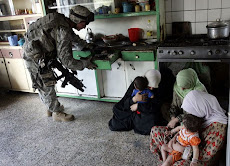
October 6th 2007: When the Iraqi government last month demanded the expulsion of Blackwater USA, the private security firm, I had one reaction: It's about time. As a U.S. official in Baghdad for nearly two years, I was frequently the "beneficiary" of Blackwater's over-the-top zeal. "Just pretend it's a roller coaster," I used to tell myself during trips through downtown Baghdad. We would careen around corners, jump road dividers, reach speeds in excess of 100 mph and often cross over to the wrong side of the street, oncoming traffic be damned. But much more appalling than the ride was the deleterious effect each movement through town had on the already beleaguered people of Iraq. I began to wonder whether my meetings, intended to further U.S. policy goals and improve the lives of Iraqis, were doing more harm than good. With our drivers honking at, cutting off, pelting with water bottles (a favorite tactic) and menacing with weapons anyone in their way, how many enemies were we creating?

One particularly infuriating time, I was in the town of Irbil in northern Iraq, being driven to a meeting with a Kurdish political leader. We were on a narrow stretch of highway with no shoulders and foot-high barriers on both sides. The lead Suburban in our convoy loomed up behind an old, puttering sedan driven by an older man with a young woman and three children. As we approached at typical breakneck speed, the Blackwater driver honked furiously and motioned to the side, as if they should pull over. The kids in the back seat looked back in horror, mouths agape at the sight of the heavily armored Suburbans driven by large, armed men in dark sunglasses. The poor Iraqi driver frantically searched for a means of escape, but there was none. So the lead Blackwater vehicle smashed heedlessly into the car, pushing it into the barrier. We zoomed by too quickly to notice if anyone was hurt.

Until that point I had never mentioned anything to my drivers about their tactics, but this time I could not contain myself. "Where do you all expect them to go?" I shrieked. "It was an old guy and a family, for goodness' sake. Was it necessary for them to destroy their poor old car?" My driver responded impassively: "Ma'am, we've been trained to view anyone as a potential threat. You don't know who they might use as decoys or what the risks are. Terrorists could be disguised as anyone." "Well, if they weren't terrorists before, they certainly are now!" I retorted. Sulking in my seat, I was stunned by the driver's indifference.

The Iraqis with whom I dealt quickly learned to differentiate between the U.S. military and private contractors. The military has established rules of engagement, plus it is required to pay compensation for damages (though it is a difficult and bureaucratic process). Blackwater seemed to have no such rules, paid no compensation and, per long-standing Coalition Provisional Authority fiat, had immunity from prosecution under Iraqi law. As we do the work of bridge building and improving our host citizens' lives, if the people providing our transportation and security are antagonizing, angering and even killing the people we are putatively trying to help, our entire mission is undermined.

Janessa Gans, a visiting political science professor at Principia College, was a U.S. official in Iraq from 2003 to 2005.
+++++++++++++++++++++++++++++++++++++++++++++++++++
Disclaimer
No responsibility or liability shall attach itself to either myself or to the blogspot ‘Mozlink’ for any or all of the articles/images placed here. The placing of an article does not necessarily imply that I agree or accept the contents of the article as being necessarily factual in theology, dogma or otherwise.
Mozlink

Myanmar - Burma Atrocity


Soldiers in downtown Rangoon are shooting directly into crowds killing many peaceful protestors. Japanese camera man lies dying on the road.


++++++++++++++++++++++++++++++++++++++++++++++++++
Disclaimer
No responsibility or liability shall attach itself to either myself or to the blogspot ‘Mozlink’ for any or all of the articles/images placed here. The placing of an article does not necessarily imply that I agree or accept the contents of the article as being necessarily factual in theology, dogma or otherwise.
Mozlink

Friday, October 5, 2007

October 17th. - Stand up for the Millenium Goals

Just 2 weeks to go until October 17! We now have information from over 50 countries about the plans but we are still waiting on more. If you are participating in the Stand Up and Speak Out action, you also need to register your events on-line at www.standagainstpoverty.org

Political demands and actions
We need to know more about your specific policy demands and campaign actions. We can already see a range of demands based on the Montevideo Declaration – however to make this action strong politically, we need to understand each country’s specific demand to the media. If you have not communicated these already, please let us know by emailing sarah.gregory@civicus.org – and if you are undertaking a petition or e-action, let us know so we can publicise it on the website.

Requiem, Political Delegations, Banners and other actions
Many people around the world are focusing their efforts on October 16th and 17th on activities that will not count towards the Guinness World Record challenge. You will receive communications directly about what is required of you for these events via the different point people ( Joe: Banners, Ben: Delegations, Irheen: Requiem etc.). In all events it is important to send copies of your press release and any materials or images to www.whiteband.org

Stand Up and Speak Out Guinness record Action

Materials for the Stand Up and Speak Out mobilization are available to download at wwww.standagainstpoverty.org (or e-mail the support team). They include:

  • Brochures
  • Posters
  • Postcards
  • A4 flyers
  • Resources for youth and teachers
  • How To Stand Up - Animation
  • Stand Up and Speak Out Video clip – available for downloading in different versions at www.whiteband.org/resources/audio-video/

If you are organizing a different action you can access different mobilisation materials via your regional focal points.

Counting Process for Stand Up and Speak Out Guinness Record Challenge:

For countries with broad internet access:

Before the event: All events to be counted in the Guinness record challenge must be pre-registered on www.standagainstpoverty.org. Make sure all groups you work with know that their events must be registered! All events should have an event “organizer” who will log on with a user name and pass code. Don’t forget this as you will need it to record the numbers!

During the event: Count the numbers of people who stood up and where possible get photographic evidence. Remember: all events must take place between 9pm GMT October 16 and 9pm GMT October 17 to count towards the record.

After the event: Record the numbers on www.standagainstpoverty.org and upload your photo if you have it. Remember: You must record the numbers before 6am GMT on October 18 or they won’t be counted!

There are already hundreds of events listed on the stand up website so make sure yours are there!

10 tips for planning stand up and speak out actions:

  1. put the stand up and speak out logo on your website with a link to www.standagainstpoverty.org so that everyone visiting your site can organize an event
  2. contact schools, trade unions, NGOs and faith groups to make sure they are organized for the stand up
  3. send an email and the brochure to your supporter networks reminding them its 2 weeks to go
  4. download the on-line resources - put posters up around your city in public areas, schools and universities, drop the postcards in cafes and shops – organize teams of volunteers so you cover all areas
  5. get in touch with the media in your country and let them know about your key events – you can download a media advisory from the website
  6. organize a stunt to take place in front of a government building or place of interest
  7. make sure you have a photographer ready to capture the moment and where possible get it on video too – we will be producing a clip of all the stand up events taking place around the world
  8. prepare your ambassadors to speak out on the issues and the key policy asks in your country
  9. invite local politicians to your events so that they can be made aware of the public pressure
  10. Make your stand up count! Don’t forget to have a plan about how you will convey the impact afterwards – to media, politicians and all your supporters.
    +++++++++++++++++++++++++++++++++++++++++++++++++++
    Disclaimer
    No responsibility or liability shall attach itself to either myself or to the blogspot ‘Mozlink’ for any or all of the articles/images placed here. The placing of an article does not necessarily imply that I agree or accept the contents of the article as being necessarily factual in theology, dogma or otherwise.
    Mozlink

Thursday, October 4, 2007

ANGOLA: UN Experts Find Widespread Illegal Detention and Torture

NEW YORK, October 2, 2007 (CISA) - A United Nations human rights team has reported that Angolans are still being arbitrarily detained, tortured and often denied access to lawyers, following a 10-day visit to the Southern African nation. “There is still no effective system in place which can prevent instances of arbitrary detention from occurring,” concluded the UN Working Group on Arbitrary Detention, in a statement issued by its Chairperson, Leila Zerrougui.

The group of independent experts interviewed some 400 detainees during its visits to the capital, Luanda, as well as the cities of Cabinda and Dundo, which were carried out at the invitation of the Government. “The Working Group has received credible allegations in Cabinda that civilians are or were detained incommunicado at military institutions and never produced before a judge,” Ms. Zerrougui stated. “It would like to stress that secret detention puts the persons concerned at risk of ill-treatment, disappearance and other serious human rights violations.” The group found that a number of detainees at Cacuaco and Viana Prisons in Luanda “showed visible signs of torture.

Among the team’s other findings, Ms. Zerrougui noted that “the right to access to a lawyer and a corresponding legal aid system as guaranteed by the Constitution exists only in theory. Also, while Angolan law stipulates that those arrested must be presented to a prosecutor within 24 hours, “this rule is virtually never adhered to,” according to information received by the Group. Another issue of concern is the lack of a special system for minors, who according to the country’s laws are criminally liable from the age of 16. “They are treated like adults during the criminal proceedings, and merely receive a lighter sentence than an adult.” In addition, they are regularly detained together with adults at police stations and prisons. The Group also found that prisoners are facing “harsh conditions” in prisons and other detention facilities, citing overcrowded cells and a food and water supply problem.

+++++++++++++++++++++++++++++++++++++++++++++++++++
Disclaimer
No responsibility or liability shall attach itself to either myself or to the blogspot ‘Mozlink’ for any or all of the articles/images placed here. The placing of an article does not necessarily imply that I agree or accept the contents of the article as being necessarily factual in theology, dogma or otherwise.
Mozlink

Vatican Secret Archives: "Processus contra Templarios"

VATICAN CITY, OCT 4, 2007 (VIS) - On October 25 in the Vatican's Old Synod Hall, the presentation will take place of the "Processus contra Templarios," a book published by the Vatican Secret Archives on the subject of the Knights Templar, the medieval military-religious order founded in Jerusalem in 1118 and suppressed by Pope Clement V (1305-1314).

According to a communique made public yesterday afternoon, the new volume is "a previously unpublished and exclusive edition of the complete acts of the original hearing against the Knights Templar." The book, unique of its kind, will have a print run "rigorously limited to 799 copies" and contains the "faithful reproduction of the original parchments conserved in the Vatican Secret Archives." The project, the communique concludes, "is part of the series of 'Exemplaria Praetiosa,' ... the most elaborate and important publication yet undertaken by the Pontifical Archives."

The new volume will be presented by Archbishop Raffaele Farina S.D.B., archivist and librarian of Holy Roman Church; Bishop Sergio Pagano, prefect of the Vatican Secret Archives, and experts such as the historian Franco Cardini and the archaeologist and author Valerio Massimo Manfredi."

+++++++++++++++++++++++++++++++++++++++++++++++++++
Disclaimer
No responsibility or liability shall attach itself to either myself or to the blogspot ‘Mozlink’ for any or all of the articles/images placed here. The placing of an article does not necessarily imply that I agree or accept the contents of the article as being necessarily factual in theology, dogma or otherwise.
Mozlink

Collaboration between Church and State for Good of Man

VATICAN CITY, OCT 4, 2007 (VIS) - In the Vatican today, Feast of St. Francis of Assisi, patron saint of Italy, the Holy Father received the Letters of Credence of Antonio Zanardi Landi, Italy's new ambassador to the Holy See. In his talk to the diplomat, the Pope referred to the "mutual collaboration" between Church and State "for the promotion of mankind and the good of the entire national community. In pursuing this goal," he added, "the Church does not aim to acquire power nor does she seek privileges or positions of economic and social advantage.


"Her only aim," he went on, "is to serve mankind, drawing inspiration, as the supreme norm of behavior, from the words and example of Jesus Christ Who 'went about doing good and healing everyone.' Hence the Catholic Church asks to be considered for her specific nature, and to have the opportunity freely to carry out her special mission for the good, not only of her own faithful, but of all Italians." Benedict XVI expressed the hope that collaboration between all components of Italian society may contribute "not only to carefully guarding the cultural and spiritual heritage that distinguishes [Italy] and that is an integral part of its history," but even more so that it may be "a stimulus to seek new ways to face the great challenges that characterize the post-modern age." In this context the Pope mentioned "the defense of life, ... the protection of the rights of the individual and the family, the building of a united world, respect for creation and inter-religious and inter-cultural dialogue."


After recalling that the year 2008 marks the 60th anniversary of the Declaration of Human Rights, the Pope pointed out that this date "could constitute a useful occasion for Italy to offer its own contribution to the creation of a just order in the international arena, at the center of which is ... respect for mankind, for his dignity and for his inalienable rights." Quoting from his own Message for World Peace Day 2007, the Holy Father then went on to say that the Declaration of Human Rights "is regarded as a sort of moral commitment assumed by all mankind. There is a profound truth to this, especially if the rights described in the Declaration are held to be based not simply on the decisions of the assembly that approved them, but on man's very nature and his inalienable dignity as a person created by God." "Italy," Pope Benedict concluded, "by virtue of its recent election as a member of the Council for Human Rights, and even more so for its own particular tradition of humanity and generosity, cannot but feel committed to the tireless construction of peace and the defense of the dignity of human beings and all their inalienable rights, including the right to religious freedom."

+++++++++++++++++++++++++++++++++++++++++++++++++++
Disclaimer
No responsibility or liability shall attach itself to either myself or to the blogspot ‘Mozlink’ for any or all of the articles/images placed here. The placing of an article does not necessarily imply that I agree or accept the contents of the article as being necessarily factual in theology, dogma or otherwise.
Mozlink

Monday, October 1, 2007

God does not Forget Those who are Forgotten by Everyone

VATICAN CITY, SEP 30, 2007 (VIS) - At midday today, during his last Angelus at Castelgandolfo before returning to the Vatican, Benedict XVI commented on the parable of the rich man and Lazarus, as recounted in the Gospel according to Luke. "The rich man personifies the iniquitous use of wealth by one who uses his riches for unbridled and selfish luxury," the Pope explained, "while the poor man represents the individual whom only God cares for. ... God does not forget those who are forgotten by everyone. ... The story shows how earthly iniquity is overturned by divine justice. After death Lazarus is welcomed ... into eternal beatitude, while the rich man ends 'in agony in the flames'."

The Holy Father also pointed out how the parable can "be given a social meaning," and he recalled the "memorable" interpretation which Pope Paul VI gave it in his Encyclical "Populorum Progressio." Quoting the Encyclical, Pope Benedict said that combating hunger "involves building a human community where men can live truly human lives, ... where the needy Lazarus can sit down with the rich man at the same banquet table." As for the causes of poverty, they are, on the one hand, "servitude to other men" and, on the other, "natural forces which are not yet satisfactorily controlled." Pope Benedict continued: "Unfortunately, some people suffer from both these factors together. At this moment, how can we not think especially of sub-Saharan Africa struck by grave flooding in recent days? And nor can we forget many other humanitarian emergencies in various parts of the earth, where conflicts for political and economic power make serious environmental problems even worse."


"The appeal launched by Paul VI - 'The hungry nations of the world cry out to the peoples blessed with abundance' - still maintains all its validity today," the Holy Father added. "We cannot say that we do not know which path to follow. We have the Law and the Prophets, Jesus tells us in the Gospel. Those who do not wish to listen would not change even if someone returned from the dead to warn them." The Holy Father concluded his remarks by calling upon the Virgin Mary to help us "become more attentive to our brothers and sisters in need, to share with them the much or little we have and to contribute ... to spreading the logic and practice of true solidarity."

+++++++++++++++++++++++++++++++++++++++++++++++++++
Disclaimer
No responsibility or liability shall attach itself to either myself or to the blogspot ‘Mozlink’ for any or all of the articles/images placed here. The placing of an article does not necessarily imply that I agree or accept the contents of the article as being necessarily factual in theology, dogma or otherwise.
Mozlink

Attack Kills 10 AU Peacekeepers in Darfur

HASKANITA, Sudan Sept. 30th (AP) – Rebel forces stormed an African Union base in northern Darfur killing 10 peacekeepers from the beleaguered mission in an unprecedented attack that threatened key peace talks set for October. Several others were wounded and dozens were missing in action after the attack on the base in Haskanita just after sunset Saturday. AU officers told Associated Press in Haskanita that a force of about 1,000 rebels from the Sudan Liberation Army had attacked the small AU base just after the fast-breaking meal during the Muslim holy month of Ramadan. The AU troops said they initially repelled the assailants. But the rebels eventually overran the camp around 4 a.m. on Sunday, peacekeepers said as they recovered from the fighting. "This is a terrible incident, we're still trying to understand what happened," said Gen. Martin Agwai, the AU force commander, as he inspected the destroyed base.

Darfur rebels have grown increasingly hostile to the AU peacekeepers, saying the force is not neutral and favours the government side. Several ambushes of AU forces in the past year have been blamed on the rebels. The attack came as rebels appeared to flee the area around Haskanita because of a large government offensive there over the past two weeks, AU soldiers said. The announcement that new peace talks to solve Darfur's conflict will open on Oct. 27 in Libya has sparked a flurry of fighting between rebels and Sudanese government forces as each try to improve their position ahead of the conference. "There is a war going on between the rebels and the government, and the AU is crunched in the middle," said a senior AU officer who asked not to be named because of the sensitivity of the issue. Ten peacekeepers were killed in the attack, including a police officer from Senegal, two military observers from Botswana and Mali and seven soldiers from Nigeria, AU officers said, requesting anonymity because the casualty toll was not official. Eight peacekeepers were seriously wounded, they said. An AU statement said 10 were killed and seven wounded.

Some peacekeepers tried to leave the camp during the night, and more than 30 were missing in action late Sunday, though a dozen others called to say they evacuated, AU officers said. "This is the heaviest loss of life and the biggest attack on the African Union mission," said AU spokesman Noureddine Mezni. Peacekeepers said the rebels used armoured vehicles and rocket-propelled grenades, an indication that they have heavier armament than previously believed. "We battled for hours, but when we ran out of ammunition, we took refuge in this ditch," said a Nigerian peacekeeper who would only give his first name, Aboubakar, because he was not authorized to speak to the media under military regulations. He showed a corner of the camp – riddled with bullet marks and mortar holes – where the AU troops resisted. Rebels looted several AU armoured vehicles and jeeps and took a large amount of ammunition from the base before the Sudanese army routed them out early Sunday, the AU soldiers said.

As the last AU peacekeepers evacuated the camp late Sunday, Sudanese government troops and militias could be seen patrolling the area. Other government troops were sifting through the camp's debris amid the burning tents and a smouldering AU armoured vehicle. Some soldiers carried away mattresses, fans and other gear. "It may not be the right political thing to say, but the government forces saved us," said an AU officer, who also asked not to be named because of military regulations. About 150 peacekeepers had been stationed at the Haskanita base, but they had been grounded since June because of the insecurity in the area. Rebel commanders told AP a few days earlier that they were involved in heavy battles against government-allied forces around Haskanita. "The government has massed five or six janjaweed units who are converging on us," said Abdelaziz Ushar, a commander in the rebel Justice and Equality Movement, which fights alongside the SLA, referring to the militias of Arab nomads that fight alongside the Sudanese army.

Rebels from JEM strongly condemned the attack Sunday, and insisted they had left the area days before it occurred. "JEM is not certain about the exact culprits in this senseless attack," the group said. There was no comment from the rebel faction known as SLA-Unity, which peacekeepers in Haskanita alleged conducted the raid. The Sudanese army also deplored the attack, saying it offered protection to the evacuating peacekeepers. Despite a few sporadic gunshots, the army appeared in control of the area Sunday. Plumes of smokes from several burning villages could be seen rising into the air. Forces from the Arab-dominated government have been accused of indiscriminately targeting ethnic African Darfur villagers on suspicions they support the rebels.

The situation had been expected to improve after U.N. Secretary General Ban Ki-moon visited Sudan in early September, announcing new negotiations to settle four years of conflict that have killed at least 200,000 people and displaced another 2.5 million. Sudanese President Omar al-Bashir also announced a cease-fire in September, but violence has since increased. The attack was the first time since the 7,000-strong AU mission was deployed in June 2004 that one of its bases was overrun. The underfunded AU force has been unable to stem the fighting in the war-torn region and will soon be merged into a more powerful hybrid U.N. force. The first units of the 26,000-strong joint AU-U.N. force are due to be deployed in October. and the new mission is expected to assume responsibility for the area on Dec. 31. The U.N., AU, France and Britain all strongly condemned the attack Sunday.
+++++++++++++++++++++++++++++++++++++++++++++++++++
Disclaimer
No responsibility or liability shall attach itself to either myself or to the blogspot ‘Mozlink’ for any or all of the articles/images placed here. The placing of an article does not necessarily imply that I agree or accept the contents of the article as being necessarily factual in theology, dogma or otherwise.
Mozlink

Wednesday, September 26, 2007

The Despotism Formerly Known as Burma

New York: Sept 26, 2007: By dispatching troops into the streets and imposing a curfew, Myanmar’s cruel military junta has set the stage for a serious clash with pro-democracy activists. A firm and united international response along the lines outlined by President Bush and the European Union at the United Nations yesterday offers the best hope of encouraging peaceful change in a nation that has endured a 19-year reign of fear. The question is whether the countries with the greatest influence on Myanmar’s generals — China, Russia and India, which all sell weapons to the army, as well as the members of the Association of Southeast Asian Nations that are Myanmar’s immediate neighbors — have the good sense to condemn the repression and exert the pressures only they can wield with any hope of positive effect. It is essential that they step up to the plate, and fast, before blood is spilled.

Peaceful protests that began last month over dramatically increased fuel prices became seriously threatening to the junta when Myanmar’s highly revered Buddhist monks joined in. The growing crowds gave voice to pent-up grievances — and the junta responded in a predictable, entirely wrongheaded way. It sent troops into the streets, and Daw Aung San Suu Kyi, the iconic democracy leader and Nobel Peace Prize winner, was reported to have been moved to prison from house arrest.

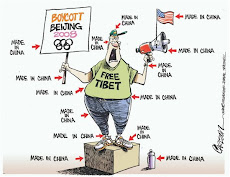
The United States, which has long had sanctions on Myanmar, including an import ban, will now expand a visa ban against regime leaders and tighten financial penalties, Mr. Bush told the United Nations. Although not spelled out, the plan is believed to include going after regime bank accounts in Singapore and other Southeast Asian countries, a tactic used by Washington with some effect against North Korea. The European Union also warned the junta that it faced tougher sanctions if it used force to crush the pro-democracy movement. These were good and necessary moves, but the greatest leverage to forestall disaster lies with China, Russia and India, who are making money off the junta and enabling it to stay in power. China, Myanmar’s chief trade partner and the host of the 2008 Olympic Games, has beefed up arms sales to Yangon, formerly Rangoon, prompting Russia and India to do likewise as a way of offsetting Beijing’s influence.

Moscow has discussed providing the junta with a nuclear research reactor, and India — the democracy on which the United States hopes to build a key security and economic relationship for the 21st century — had a senior minister in Myanmar for energy talks, even as the democracy protests were under way. There are some signs that China has urged restraint, but more must be done, including supporting U.N. sanctions on Myanmar that Beijing and Moscow have so far blocked. The U.N. envoy dealing with Myanmar, Ibrahmim Gambari, must aggressively rally these major countries, as well as the Asean nations, to persuade the generals to stand down.
The New York Times
+++++++++++++++++++++++++++++++++++++++++++++++++++
Disclaimer
No responsibility or liability shall attach itself to either myself or to the blogspot ‘Mozlink’ for any or all of the articles/images placed here. The placing of an article does not necessarily imply that I agree or accept the contents of the article as being necessarily factual in theology, dogma or otherwise.
Mozlink

Missionary's Murderer also Killed Catholic Priest

Bangalore Sept. 25th: (ENI). A Hindu activist convicted of murdering an Australian missionary and his two sons in India in 1999 has now been found guilty of killing an Indian Roman Catholic priest in the same year. "This verdict instils hope and courage for harassed minorities," said the spokesperson of the Catholic Bishops' Conference of India, the Rev. Babu Joseph, after a court in the state of Orissa found Dara Singh and three others guilty of the murder of Catholic priest Arul Doss in 1999. The court sentenced the four defendants to life in prison. Singh is already serving a life imprisonment term for the murder of Australian Baptist missionary Graham Stuart Staines and his two young sons, who all died after the vehicle in which they were sleeping was set on fire.
+++++++++++++++++++++++++++++++++++++++++++++++++++
Disclaimer
No responsibility or liability shall attach itself to either myself or to the blogspot ‘Mozlink’ for any or all of the articles/images placed here. The placing of an article does not necessarily imply that I agree or accept the contents of the article as being necessarily factual in theology, dogma or otherwise.
Mozlink

Tuesday, September 25, 2007

Environmental Protection is a Moral Imperative

VATICAN CITY, SEP 25, 2007 (VIS) - Made public today was the text of a speech delivered by Msgr. Pietro Parolin, under-secretary for Relations with States, before the 62nd session of the UN General Assembly which is meeting to deliberate on the theme of "the future is in our hands: addressing the leadership challenge of climate change." "Climate change is a serious concern and an inescapable responsibility," said Msgr. Parolin in his English-language talk. "My delegation wishes to stress the underlying moral imperative that everyone, without exception, has a grave responsibility to protect the environment," he added.


"The best scientific assessments available have established a link between human activity and climate change," he continued. "However, the results of these scientific assessments, and the remaining uncertainties, should neither be exaggerated nor minimized in the name of politics, ideologies or self-interest. Rather they now need to be studied closely in order to give a sound basis for raising awareness and making effective policy decisions.


"In recent times," he added, "it has been unsettling to note how some commentators have said that we should actually exploit our world to the full, with little or no heed to the consequences, using a world view supposedly based on faith." This, said Msgr. Parolin "is a fundamentally reckless approach." However "there are those who hold up the earth as the only good, and would characterize humanity as an irredeemable threat to the earth, whose population and activity need to be controlled by various drastic means." They, he stressed, "would place human beings and their needs at the service of an inhuman ecology."


"Since no country alone can solve the problems related to our common environment, we need to overcome self-interest through collective action. On the part of the international community, this presupposes the adoption of a coordinated, effective and prompt international political strategy" to "identify ways ... to enhance sustainable development and foster a healthy environment," while bearing in mind "that poor nations and sectors of society are particularly vulnerable to the adverse consequences of climate change, due to lesser resources and capacity to mitigate their effects and adapt to altered surroundings."


"The pace of achieving and codifying a new international consensus on climate change is not always matched by an equally expeditious and effective pace of implementation of such agreements. States are free to adopt international conventions and treaties, but unless our words are matched with effective action and accountability, we would do little to avert a bleak future and may find ourselves gathering again not too long from now to lament another collective failure."
+++++++++++++++++++++++++++++++++++++++++++++++++++
Disclaimer
No responsibility or liability shall attach itself to either myself or to the blogspot ‘Mozlink’ for any or all of the articles/images placed here. The placing of an article does not necessarily imply that I agree or accept the contents of the article as being necessarily factual in theology, dogma or otherwise.
Mozlink

Myanmar Junta's Secretive Supremo

Five facts about the Burmese military junta's most powerful figure, Than Shwe:

Born in British-controlled central Burma in February 1933. Than Shwe joined the army in 1953 and rose through the ranks to become military supremo with the official title "Senior General" in 1992.

On taking power, he said the junta that seized power in a 1962 coup would "not hold onto power for long," sparking hopes of civilian government. Since then, opposition leader Aung San Suu Kyi has spent most of her time either in prison or under house arrest.

Than Shwe is rarely seen in public or out of uniform. One notable exception was his appearance at a secretly leaked video of his daughter's wedding in 2006. The ceremony's lavishness sparked outrage among Burma's 53 million people, among the poorest in Asia.

He is known to have an intense personal dislike of Suu Kyi and is alleged to have walked out of a meeting with a foreign envoy when her name was mentioned.

Rumours about his failing health and imminent demise are common.
+++++++++++++++++++++++++++++++++++++++++++++++++++
Disclaimer
No responsibility or liability shall attach itself to either myself or to the blogspot ‘Mozlink’ for any or all of the articles/images placed here. The placing of an article does not necessarily imply that I agree or accept the contents of the article as being necessarily factual in theology, dogma or otherwise.
Mozlink

Poor Nations Need Incentives to Cut Emissions

New York Sept. 25th: Rich countries must cut their “unacceptably high” greenhouse gas emissions and provide incentives for poorer nations to follow suit, the United Nations secretary-general told a meeting of more than 80 heads of state and government on climate change on Monday. Ban Ki-moon said industrialised countries must show more leadership on the issue. “It has been 10 years since the Kyoto protocol was adopted. Yet most industrialised country emissions are still rising and their per capita emissions remain unacceptably high.” He said that poor countries, rather than being given the strict emissions reduction targets meted out to the developed world under the current Kyoto protocol, should be given “incentives to act without sacrificing economic growth or poverty eduction”.

Gordon Brown, prime minister, did not attend the meeting as it clashed with the Labour party conference. But Hilary Benn, secretary of state for the environment, used it to urge the US to reverse its opposition to binding targets to cut emissions. “[Tackling climate change] means all of us, including the largest economy in the world, the US, taking on binding emissions reduction targets. It is inconceivable that dangerous climate change can be avoided without this happening.” His words marked a change in tone for the UK in its approach towards the US on environmental issues. Tony Blair preferred to use his relationship with George W. Bush to press him privately to soften his stance on climate change.

Mr Bush was not at Monday’s meeting, but did attend a dinner that followed. He is holding a separate meeting on climate change with the world’s 16 biggest emitting countries later this week in Washington. The US is unlikely to commit to targets to reduce its emissions. Paula Dobriansky, undersecretary of state for democracy and global affairs, told the Financial Times the US supported a “long-term global goal” for reducing emissions, but that shorter-term goals should be set at a national level. The US has not proposed a specific target for emissions cuts. Ms Dobriansky said the White House would discuss in Washington later this week what such a goal should be.

Mr Ban called on Monday’s meeting, the biggest gathering of heads of state and government to talk about the problem, to agree the broad principles of tackling climate change ahead of a UN conference in Bali in December at which negotiations will begin on a successor to the Kyoto treaty, the main provisions of which expire in 2012. Although government representatives meet each year to discuss the Kyoto protocol, progress on agreeing to action on climate change has been slow. Many observers say part of the problem is that only environment ministers and their officials attend such meetings, rather than heads of government or more senior ministers. Mr Ban’s meeting was intended to break this deadlock by persuading heads of state and government of the need for international action in the hope that they would empower their environment ministers to make more progress in Bali.

Deal agreed to eliminate global warming gas

An environmental agreement was signed at the weekend by a host of the world’s biggest greenhouse gas emitters. The agreement was an extension to the Montreal Protocol, a landmark treaty signed 20 years ago that was intended to stem the destruction of the earth’s protective ozone layer by the use of certain chemicals. The agreement accelerated the phasing out of compounds known as HCFCs. These are used in refrigeration and other technologies as substitutes for other chemicals that destroy the ozone layer, but have the unfortunate side effect of warming the planet even more effectively than carbon dioxide. Phasing out HCFCs is much less controversial than cutting emissions of carbon dioxide because the technology to do so is readily available, whereas reducing carbon requires fundamental changes to the way we produce energy. HCFCs, though very potent greenhouse gases, make up only a small proportion of overall greenhouse gas emissions.
By Fiona Harvey Copyright The Financial Times Ltd. 2007
+++++++++++++++++++++++++++++++++++++++++++++++++++
Disclaimer
No responsibility or liability shall attach itself to either myself or to the blogspot ‘Mozlink’ for any or all of the articles/images placed here. The placing of an article does not necessarily imply that I agree or accept the contents of the article as being necessarily factual in theology, dogma or otherwise.
Mozlink

Monday, September 24, 2007

Logic of Sharing and Not of Profit is the Ultimate Good

Vatican City, Sep 23rd, 2007 (VIS) - This morning, the Holy Father made a pastoral visit to Velletri, south of Rome, where he presided at a Eucharistic celebration in the cathedral square. Benedict XVI held the title of the suburbicarian diocese of Velletri-Segni from the year 1993 until his election to the pontificate in April 2005. His successor as the titular holder of the diocese is Cardinal Francis Arinze, prefect of the Congregation for Divine Worship and the Discipline of the Sacraments, while the incumbent is Bishop Vincenzo Apicella.

In his homily the Pope commented on today's Gospel reading of the dishonest manager, and reflected on the danger of excessive attachment to money and material wealth. "In truth," he told the several thousand faithful who had gathered to hear him, "life is always a choice: between faithfulness and unfaithfulness, between selfishness and altruism, between good and evil. The end of this particular Gospel passage is incisive and peremptory: no servant can serve two masters," which in the final analysis means "you cannot serve God and wealth." "A fundamental decision is, then, necessary," Pope Benedict proceeded, "the choice between the logic of profit as the ultimate criteria for our actions and the logic of sharing and solidarity. If the logic of profit prevails, the imbalance between poor and rich increases, as does the ruinous exploitation of the planet. When, on the other hand, the logic of sharing and solidarity prevails it is possible to alter and redirect our course towards equal development and the common good of everyone. Ultimately it is a decision between selfishness and love, between justice and dishonesty, ... between God and Satan. "If loving Christ and our fellow man is not considered as a superficial accessory," he added, "but rather as the real and ultimate aim of our entire life, we must know how to take fundamental decisions, to be ready to make radical sacrifices, if necessary even unto martyrdom. Today, as yesterday, the life of Christians calls for the courage to swim against the tide, to love like Jesus Who went so far as to sacrifice Himself upon the cross."

After the Mass, the Pope blessed a bronze column given to him a year ago as a gift by 100 Bavarian cities to mark his apostolic trip to Germany and his 80th birthday. Two columns were made, one is in the Pope's home town of Marktl am Inn, the other has been donated by him to the diocese of Velletri-Segni. After bidding farewell to the civil and religious authorities of Velletri, the Holy Father returned to the Apostolic Palace at Castelgandolfo where he prayed the Angelus.

+++++++++++++++++++++++++++++++++++++++++++++++++++
Disclaimer
No responsibility or liability shall attach itself to either myself or to the blogspot ‘Mozlink’ for any or all of the articles/images placed here. The placing of an article does not necessarily imply that I agree or accept the contents of the article as being necessarily factual in theology, dogma or otherwise.
Mozlink

Myanmar Officials Threaten Clerics

YANGON, Myanmar (AP) Sept. 24th. — Myanmar's religious affairs minister warns the Buddhist clergy to restrain demonstrating monks, or else the government will act against protesting clerics. As many as 100,000 anti-government protesters led by a phalanx of Buddhist monks marched Monday through Yangon, the largest crowd to demonstrate in Myanmar's biggest city since a 1988 pro-democracy uprising that was brutally crushed by the military. From the front of the march, witnesses could see a 11/2 -kilometre stretch of eight-lane road was filled with people. Some participants said there were several hundred thousand marchers in their ranks, but an international aid agency official with employees monitoring the crowd estimated said the size was well over 50,000 and approaching 100,000.

It was the latest in a series of protests that began Aug. 19 as a movement against economic hardship in the Southeast Asian country after the government sharply raised fuel prices. But arrests and intimidation kept demonstrations small and scattered until the monks entered the fray. The usually iron-fisted junta has so far kept minimal security at the protests, and diplomats and analysts said Myanmar's military rulers were showing the unexpected restraint because of pressure from the country's key trading partner and diplomatic ally, China. The march kicked off, like the previous ones, at the Shwedagon pagoda, a historical centre for political movements as well as the country's most sacred religious shrine. Some 20,000 monks took the lead, with onlookers joining in on what had been billed as a day of general protest.

In the central city of Mandalay, meanwhile, 500 to 600 monks set off shortly after noon on their own protest march. The monks, who took over a faltering protest movement from political activists, already had managed to bring people into the streets in numbers not seen since the 1988 pro-democracy uprising snuffed out by the army at a cost of thousands of lives. On Sunday, about 20,000 people including thousands of monks filled the streets in Yangon, stepping up their confrontation with authorities by chanting support for detained democracy leader Aung San Suu Kyi. The increasingly confrontational tone of the anti-government protesters has raised both expectations of possible political change and fear that the military might forcefully stamp out the demonstrations, as it did in 1988. A Southeast Asian diplomat, speaking on condition of anonymity as a matter of protocol, said the regime is under pressure from China to avoid a crackdown just as its larger neighbour has pressured it to speed up other democratic changes. "The Myanmar government is tolerating the protesters and not taking any action against the monks because of pressure from China," the diplomat told the Associated Press. "Beijing is to host the next summer's Olympic Games. Everyone knows that China is the major supporter of the junta so if government takes any action it will affect the image of China." China, which is counting on Myanmar's vast oil and gas reserves to help fuel its booming economy, earlier this year blocked a UN Security Council criticizing Myanmar's rights record saying it was not the right forum. But at the same time, it has employed quiet diplomacy and subtle public pressure on the regime, urging it to move toward inclusive democracy and speed up the process of dialogue and reform.

Josef Silverstein, a political scientist and author of several books on Myanmar, said it would not be in China's interest to have civil unrest in Myanmar, also known as Burma. "China is very eager to have a peaceful Burma in order to complete roads and railroads, to develop mines and finish assimilating the country under its economic control," Mr. Silverstein said. The movement seemed to gain momentum Saturday, when more than 500 monks and sympathizers went past barricades to walk to the house where Suu Kyi is under house arrest. She greeted them from her gate in her first public appearance in more than four years. But access to her home was barred Sunday. The meeting symbolically linked the current protests to Nobel laureate's Suu Kyi's struggle for democracy, which has seen her detained for about 12 of the last 18 years.
+++++++++++++++++++++++++++++++++++++++++++++++++++
Disclaimer
No responsibility or liability shall attach itself to either myself or to the blogspot ‘Mozlink’ for any or all of the articles/images placed here. The placing of an article does not necessarily imply that I agree or accept the contents of the article as being necessarily factual in theology, dogma or otherwise.
Mozlink

Myanmar officials threaten clerics

YANGON, Myanmar (AP) Sept. 24th. — Myanmar's religious affairs minister warns the Buddhist clergy to restrain demonstrating monks, or else the government will act against protesting clerics. As many as 100,000 anti-government protesters led by a phalanx of Buddhist monks marched Monday through Yangon, the largest crowd to demonstrate in Myanmar's biggest city since a 1988 pro-democracy uprising that was brutally crushed by the military. From the front of the march, witnesses could see a 11/2 -kilometre stretch of eight-lane road was filled with people. Some participants said there were several hundred thousand marchers in their ranks, but an international aid agency official with employees monitoring the crowd estimated said the size was well over 50,000 and approaching 100,000.

It was the latest in a series of protests that began Aug. 19 as a movement against economic hardship in the Southeast Asian country after the government sharply raised fuel prices. But arrests and intimidation kept demonstrations small and scattered until the monks entered the fray. The usually iron-fisted junta has so far kept minimal security at the protests, and diplomats and analysts said Myanmar's military rulers were showing the unexpected restraint because of pressure from the country's key trading partner and diplomatic ally, China. The march kicked off, like the previous ones, at the Shwedagon pagoda, a historical centre for political movements as well as the country's most sacred religious shrine. Some 20,000 monks took the lead, with onlookers joining in on what had been billed as a day of general protest.

In the central city of Mandalay, meanwhile, 500 to 600 monks set off shortly after noon on their own protest march. The monks, who took over a faltering protest movement from political activists, already had managed to bring people into the streets in numbers not seen since the 1988 pro-democracy uprising snuffed out by the army at a cost of thousands of lives. On Sunday, about 20,000 people including thousands of monks filled the streets in Yangon, stepping up their confrontation with authorities by chanting support for detained democracy leader Aung San Suu Kyi. The increasingly confrontational tone of the anti-government protesters has raised both expectations of possible political change and fear that the military might forcefully stamp out the demonstrations, as it did in 1988. A Southeast Asian diplomat, speaking on condition of anonymity as a matter of protocol, said the regime is under pressure from China to avoid a crackdown just as its larger neighbour has pressured it to speed up other democratic changes. "The Myanmar government is tolerating the protesters and not taking any action against the monks because of pressure from China," the diplomat told the Associated Press. "Beijing is to host the next summer's Olympic Games. Everyone knows that China is the major supporter of the junta so if government takes any action it will affect the image of China." China, which is counting on Myanmar's vast oil and gas reserves to help fuel its booming economy, earlier this year blocked a UN Security Council criticizing Myanmar's rights record saying it was not the right forum. But at the same time, it has employed quiet diplomacy and subtle public pressure on the regime, urging it to move toward inclusive democracy and speed up the process of dialogue and reform.

Josef Silverstein, a political scientist and author of several books on Myanmar, said it would not be in China's interest to have civil unrest in Myanmar, also known as Burma. "China is very eager to have a peaceful Burma in order to complete roads and railroads, to develop mines and finish assimilating the country under its economic control," Mr. Silverstein said. The movement seemed to gain momentum Saturday, when more than 500 monks and sympathizers went past barricades to walk to the house where Suu Kyi is under house arrest. She greeted them from her gate in her first public appearance in more than four years. But access to her home was barred Sunday. The meeting symbolically linked the current protests to Nobel laureate's Suu Kyi's struggle for democracy, which has seen her detained for about 12 of the last 18 years.
+++++++++++++++++++++++++++++++++++++++++++++++++++
Disclaimer
No responsibility or liability shall attach itself to either myself or to the blogspot ‘Mozlink’ for any or all of the articles/images placed here. The placing of an article does not necessarily imply that I agree or accept the contents of the article as being necessarily factual in theology, dogma or otherwise.
Mozlink

Zimbabwe 'near collapse'

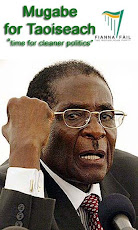
September 18th: Zimbabwe is "closer than ever to complete collapse" under the weight of a deepening economic crisis that threatens to destabilise southern Africa, an independent report said today. The International Crisis Group (ICG) called on the Southern African Development Community (SADC) group of nations to overcome internal divisions and focus on ways to persuade Zimbabwean President Robert Mugabe to step down. "SADC must resolve internal differences about how hard to press into retirement Robert Mugabe, Zimbabwe's 83-year-old president and liberation hero, and the wider international community needs to give it full support," the Brussels-based think tank said in a report.

SADC has launched an initiative led by South African President Thabo Mbeki aimed at mediating between Mugabe and Zimbabwe's opposition in the hope of reaching a political solution that would end the country's turmoil. SADC heads of state report "positive" mediation efforts but Western diplomats say little progress has been made as Mugabe tightens his grip on a once prosperous country suffering from the world's highest inflation rate and food and fuel shortages. "Four out of five of the country's twelve million people live below the poverty line and a quarter have fled, mainly to neighbouring countries," the ICG report said. "A military-led campaign to slash prices has produced acute food and fuel shortages, and conducting any business is becoming almost impossible."

Mugabe, in power since independence in 1980, accuses the main opposition Movement for Democratic Change (MDC) and Western foes of sabotaging Zimbabwe's economy and plotting to oust him. He denies accusations that he has hurt the economy with policies like seizing white-owned farms for landless blacks. Mugabe faces few political challenges. His opponents are weak and divided and international efforts to isolate him have had little impact, analysts say.

"Western sanctions - mainly targeting just over 200 members of the leadership with travel bans and asset freezes - have proven largely symbolic," said the ICG. "And general condemnations from the UK and US if anything (are) counterproductive because they help Mugabe claim he is the victim of neo-colonial ambitions." Mugabe has vowed to crush opponents in a presidential vote expected in 2008 and has manoeuvred to consolidate his control. His government has introduced a bill to give blacks majority ownership of foreign firms, including mines and banks, a move business leaders fear will further hurt the ailing economy. Zimbabwe's parliament was expected to start debating a constitutional bill today that would allow Mugabe to pick a successor if he chose to retire. "Some SADC leaders remain Mugabe supporters, and there is a risk the organisation will accept cosmetic changes that further entrench the status quo," the report said.
+++++++++++++++++++++++++++++++++++++++++++++++++++
Disclaimer
No responsibility or liability shall attach itself to either myself or to the blogspot ‘Mozlink’ for any or all of the articles/images placed here. The placing of an article does not necessarily imply that I agree or accept the contents of the article as being necessarily factual in theology, dogma or otherwise.
Mozlink

UN Chief Urges Immediate Climate Action

UNITED NATIONS(AP)Sept. 24th. — U.N. Secretary-General Ban Ki-moon told an unprecedented summit on climate change Monday that "the time for doubt has passed" and a breakthrough is needed in global talks to sharply reduce emissions of global-warming gases. "The U.N. climate process is the appropriate forum for negotiating global action," Ban told assembled presidents and premiers, an apparent caution against what some see as a U.S. effort to open a separate negotiating track. The U.N. chief also addressed a chief U.S. objection to negotiated limits on greenhouse-gas emissions, that it will be too damaging to the American economy. "Inaction now will prove the costliest action of all in the long term," Ban said.

California Gov. Arnold Schwarzenegger, in another summit-opening speech, told the international delegates U.S. states are taking action. While the Bush administration has resisted emissions caps, California's Republican governor and Democrat-led legislature have approved a law requiring the state's industries to reduce greenhouse gases by an estimated 25 percent by 2020. Other U.S. states, in various ways, are moving to follow California's lead. "California is moving the United States beyond debate and doubt to action," Schwarzenegger said. "What we are doing is changing the dynamic."

The one-day meeting, with more than 80 national leaders among some 150 participants, also was scheduled to hear from Al Gore, German Chancellor Angela Merkel and other international figures. U.N. chief Ban organized the summit to build political momentum toward launching negotiations later this year for deep cutbacks in emissions of carbon dioxide and other manmade gases blamed for global warming. President Bush, who has long opposed such negotiated limits on "greenhouse gases," wasn't participating in the day's meetings but was to attend a small dinner Monday evening, a gathering of key players hosted by Ban. Rather than accept treaty obligations, Bush has urged industry to cut emissions voluntarily, and emphasizes research on clean-energy technology as one answer.

On Thursday and Friday, Bush will host his own two-day climate meeting, limited to 16 "major emitter" countries. It's the first in a series of U.S.-sponsored climate gatherings. Many environmentalists fear the separate U.S. "track," which will involve China and India, may undercut the global U.N. negotiating process. But some hope it eventually helps draw those two big developing nations and others into a new, U.N.-negotiated emissions regime. Speaking to a technology session at Monday's U.N. conference, Secretary of State Condoleezza Rice said the administration views the Washington sessions "as the first in a series of meetings to support and help advance the ongoing U.N. discussion."

This first-ever U.N. climate summit looked ahead to December's annual climate treaty conference in Bali, Indonesia, when the Europeans, Japanese and others hope to initiate talks for an emissions-reduction agreement to succeed the Kyoto Protocol in 2012. The 1997 Kyoto pact, which the U.S. rejects, requires 36 industrial nations to reduce heat-trapping gases emitted by power plants and other industrial, agricultural and transportation sources by an average 5 percent below 1990 levels by 2012. Advocates say a breakthrough is needed at Bali — almost certainly requiring a change in the U.S. position — to ensure an uninterrupted transition from Kyoto to a new, deeper-cutting regime. To try to spur global negotiations, the European Union has committed to reduce emissions by at least an additional 20 percent by 2020.

In comments clearly directed at the U.S., long the biggest greenhouse-gas emitter, French President Nicolas Sarkozy told Monday's summit that "all the developed countries and the largest emitters" must commit to a 50 percent reduction by 2050. Sarkozy, speaking for the EU, also said the U.N. negotiating process is the only "efficient and legitimate framework."
Bush has objected that Kyoto-style mandates would damage the U.S. economy, and says they should have been imposed on fast-growing poorer countries, such as China and India, as well as on developed nations. The U.N. summit follows a series of reports by a U.N. scientific network that warned of temperatures rising by several degrees Fahrenheit by 2100 and of a drastically changed planet from rising seas, drought and other factors, unless nations rein in greenhouse gases. The U.N.-sponsored scientists reported global average temperatures over the past 100 years rose 1.3 degrees, and the planet's sea levels rose 6.6 inches, as oceans expanded from warmth and from the runoff of melting land ice. Just last week, U.S. scientists reported that warmer temperatures this summer had shrunk the Arctic Ocean's ice cap to a record-low size.
By CHARLES J. HANLEY
+++++++++++++++++++++++++++++++++++++++++++++++++++
Disclaimer
No responsibility or liability shall attach itself to either myself or to the blogspot ‘Mozlink’ for any or all of the articles/images placed here. The placing of an article does not necessarily imply that I agree or accept the contents of the article as being necessarily factual in theology, dogma or otherwise.
Mozlink